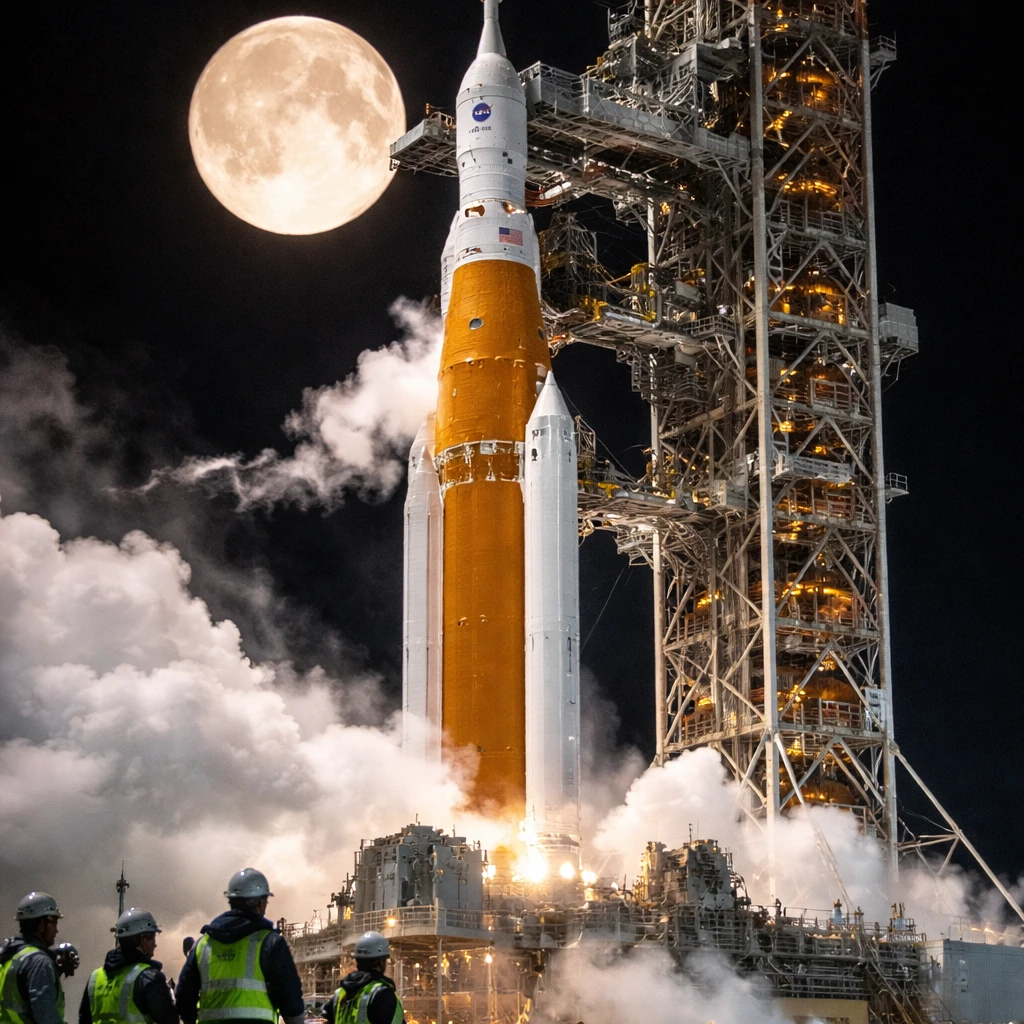

At Kennedy Space Center in Florida on Monday, NASA undertook a comprehensive fueling test of its 322-foot (98-meter) Space Launch System (SLS) rocket, marking a critical step in validating readiness for a crewed lunar mission.
Throughout the midday hours, technicians infused the rocket with over 700,000 gallons (2.6 million liters) of ultra-cold liquid hydrogen and oxygen. The procedure aimed to replicate the final countdown phase of an actual flight, requiring the cryogenic propellants to remain stable within the fuel tanks for several hours.
The operation functioned as a full dress rehearsal for launch teams, though there was one notable absence: the astronaut crew. The four-man team—three Americans and one Canadian—observed from Houston, nearly 1,000 miles (1,600 kilometers) away, specifically from the Johnson Space Center. Having been in quarantine for approximately ten days leading up to the test, the astronauts await assessment of the fueling process as they prepare for potential launch.
This extensive test will inform NASA on the timeline for departure on a mission that would mark the first crewed lunar journey in over 50 years.
Delays caused by a severe cold front put the countdown about two days behind schedule. To accommodate this, NASA controllers programmed the countdown clocks to halt thirty seconds before reaching zero, just prior to engine ignition. Initiated on Saturday night, the countdown exercise allowed teams to execute all necessary protocols and address any residual technical issues with the SLS rocket, which faced prolonged pre-launch setbacks the previous year due to hydrogen leaks. Launch officials have conveyed confidence that those complications have since been resolved.
Should the fueling trial prove successful, NASA hopes to commence the flight of commander Reid Wiseman and his crew by Sunday, as the launch window extends only until February 11. Missing this opportunity would necessitate postponing the mission to March, given the agency’s limited launch opportunities within the month and the launch window reduction caused by extreme cold weather conditions.
The mission is designed to last nearly ten days, during which the astronauts will travel beyond the moon, circumnavigate its far side, and return directly to Earth. The primary objective focuses on evaluating critical life support functions and verifying other essential spacecraft systems. Notably, this flight will not involve entering lunar orbit or attempting a moon landing.
Historically, crewed missions to the moon last took place in the 1960s and 1970s under NASA’s Apollo program. This Artemis initiative aims to reestablish sustained human presence on the moon, beginning with foundational missions such as this fly-around that pave the way for subsequent lunar landings.