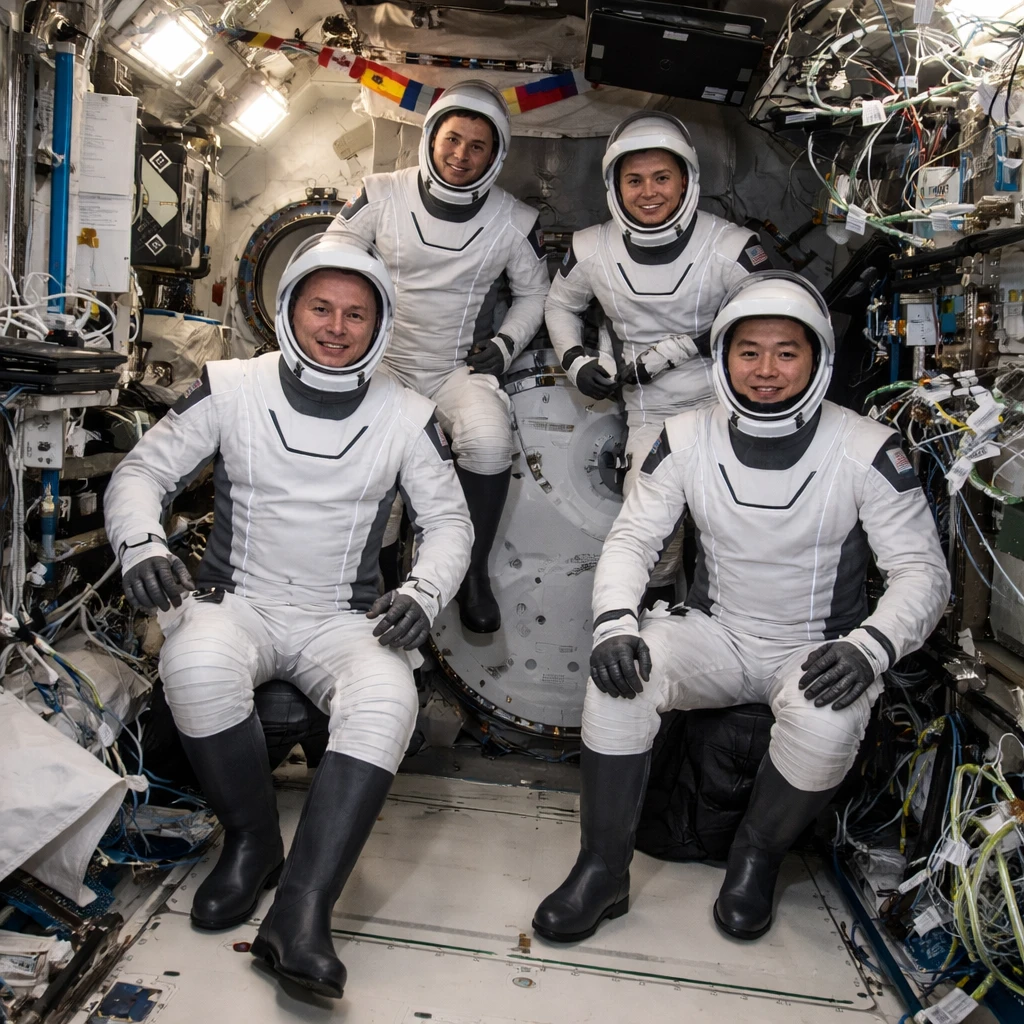

A team of four astronauts concluded their mission aboard the International Space Station (ISS) and returned to Earth on Thursday, more than a month ahead of the originally scheduled timeline. This early return represents the first medical evacuation carried out by NASA from the space station.
The capsule piloted by SpaceX completed a nighttime splashdown in the Pacific Ocean close to San Diego, occurring less than 11 hours after the astronauts departed from the ISS. Upon landing, NASA astronaut Zena Cardman, who served as capsule commander, expressed relief and gratitude, stating it was "great to be home."
The mission had begun in August but came to an abrupt early end, leaving the space laboratory with only one American astronaut along with two Russian cosmonauts remaining onboard. NASA and SpaceX have announced intentions to accelerate the launch of a new four-member crew, currently planned for mid-February.
The astronauts who returned included NASA's Zena Cardman and Mike Fincke, alongside Japan's Kimiya Yui and Russia's Oleg Platonov. Officials have chosen to withhold the identity and specific medical details of the crew member who presented the health issue the previous week, respecting medical privacy protocols.
While the astronaut in question was reportedly stable during orbit, NASA prioritized a prompt return to Earth to ensure the individual received appropriate medical evaluations and treatment on the ground. The re-entry and splashdown did not require modifications or special adjustments, and the recovery vessel was equipped with the customary medical response team.
After the capsule was secured on the recovery ship, the astronauts disembarked one at a time and were assisted onto reclining stretchers. They proceeded quickly to standard medical examinations, pausing briefly to acknowledge media presence.
Following initial assessments, the crew members will undergo more comprehensive medical testing at a local hospital before flying back to their base in Houston. Arrangements and timing for Platonov's return to Russia remain uncertain.
Jared Isaacman, the new administrator of NASA, observed the recovery operation remotely from the agency's Mission Control Center in Houston.
Throughout the week leading up to the return, NASA emphasized that the situation did not constitute an emergency. The astronaut's illness or injury was first identified on January 7, which led to the cancellation of a planned spacewalk involving Cardman and Fincke the following day, and ultimately necessitated the mission's premature conclusion.
This event marks the first instance where NASA has shortened a spaceflight mission due to medical reasons; the Russian space program had carried out similar medical evacuations decades ago.
The ISS has accommodated crews as small as two or three members previously. However, NASA has stated it will be unable to conduct any spacewalks, even if emergencies arise, until the arrival of the next crew. This incoming team is slated to include two Americans, one French astronaut, and a Russian cosmonaut.