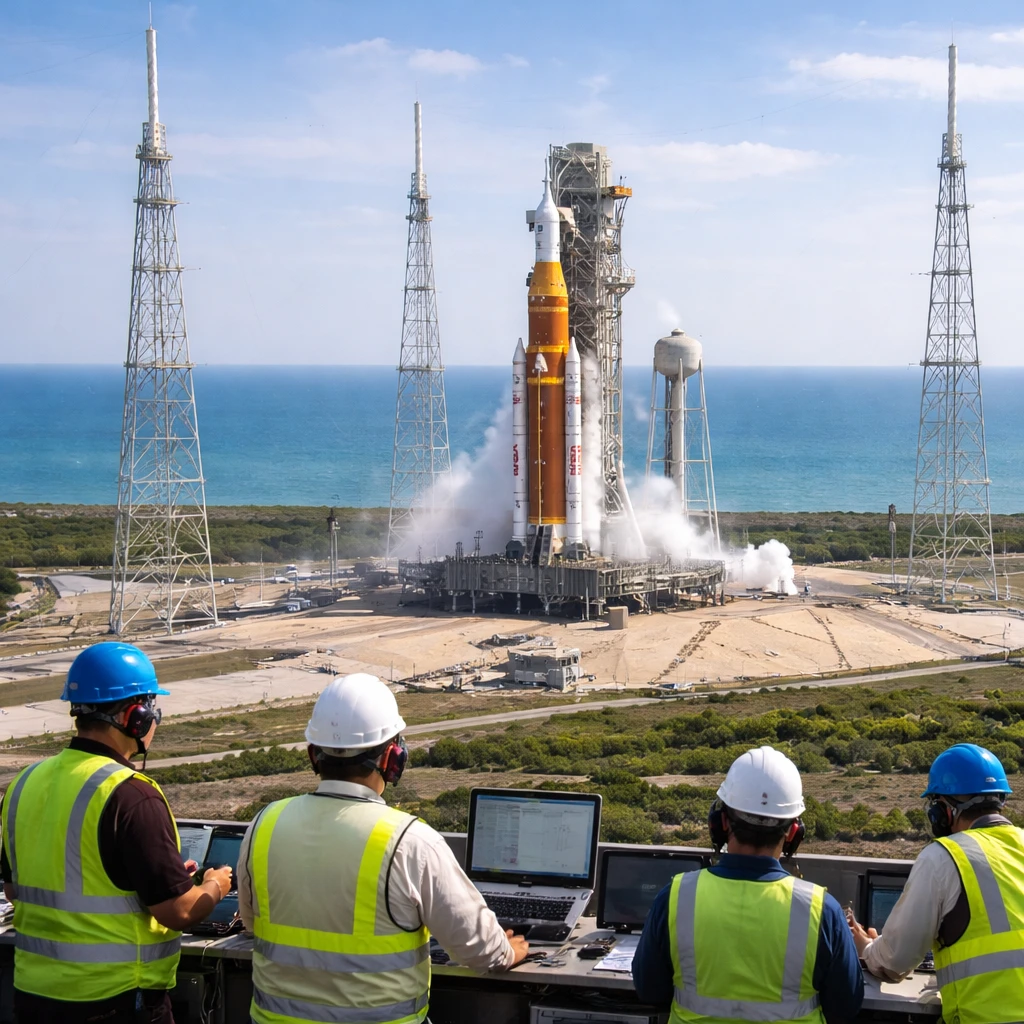

At Florida's Kennedy Space Center, NASA has begun a significant two-day countdown drill focused on preparing its next-generation Space Launch System (SLS) rocket for a manned lunar mission. The rehearsal includes a critical procedure where over 700,000 gallons (approximately 2.6 million liters) of supercooled propellant will be loaded into the massive 98-meter (322-foot) rocket. This fueling simulation is scheduled for Monday and is designed to stop mere seconds before engine ignition would normally occur.
The crew assigned to this historic flight, led by Commander Reid Wiseman along with his team, is currently in quarantine to prevent potential contamination by germs. They are set to become the first humans to head toward the Moon since the Apollo program ended in 1972. The astronauts will participate in the countdown practice from their base in Houston, prior to traveling to the Kennedy Space Center following approval of the SLS rocket's status for flight.
The SLS integrated rocket and Orion capsule stack was transported to its launch pad approximately two weeks ago. Completion of a successful fueling test will enable NASA to target a possible launch within about one week, with February 8 currently being the earliest feasible date. Recent extreme cold weather forced a two-day delay for both the fueling drill and the potential launch.
The upcoming mission will carry astronauts from the United States and Canada atop the Orion spacecraft, which is positioned on the rocket’s upper stage. Unlike Apollo missions that landed, this flight will involve a lunar flyby followed by a direct return journey to Earth, concluding with a splashdown in the Pacific Ocean. The entire Artemis mission is planned to last nearly ten days.
During the Apollo era, between 1968 and 1972, NASA sent 24 astronauts to the Moon, twelve of whom walked on its surface. The current Artemis effort represents NASA’s renewed commitment to crewed lunar exploration.
Note: This article does not include information on the spacecraft's technical specifications beyond the data provided, nor does it speculate on the mission's success or future lunar program developments.