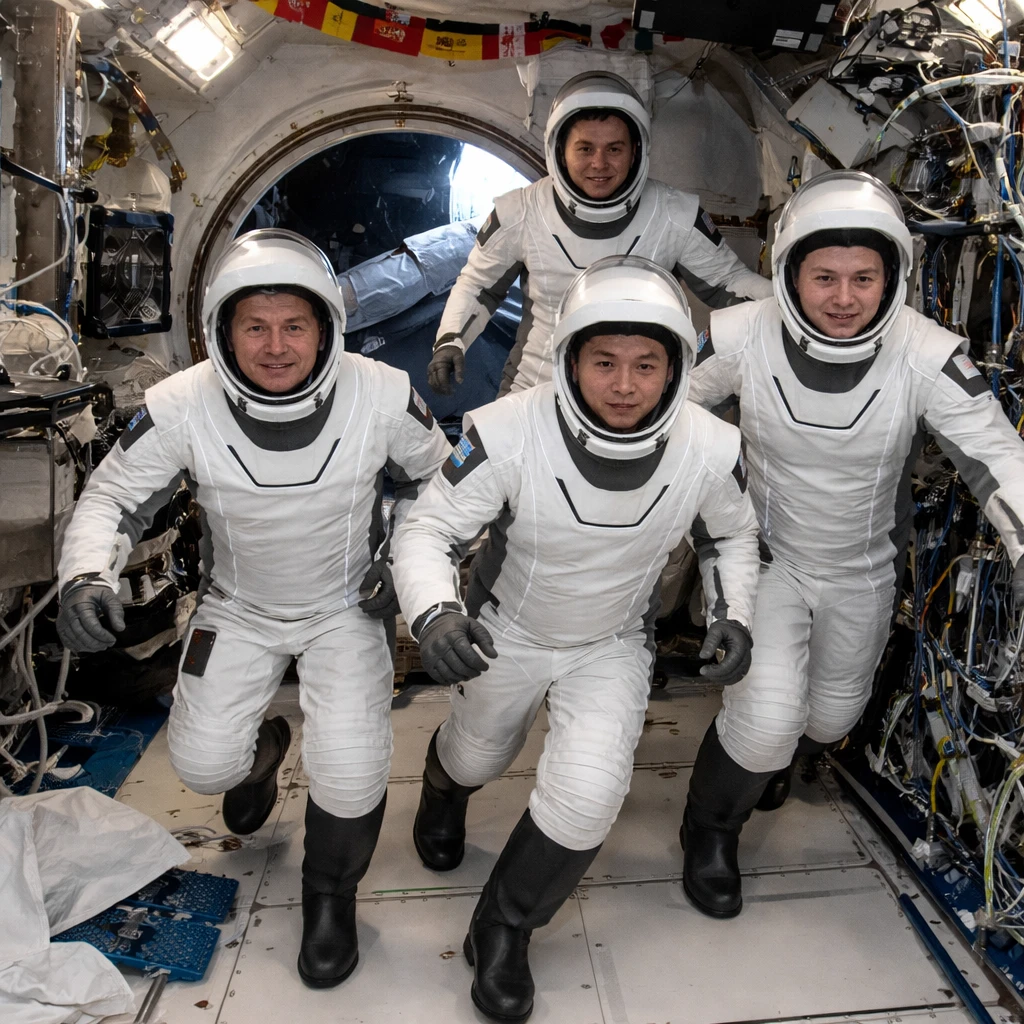

At Cape Canaveral, Florida, NASA initiated its first ever medical evacuation from the International Space Station (ISS) on Wednesday, when an astronaut requiring specialized medical attention departed the orbiting laboratory along with three fellow crew members. This action, driven by medical necessity, represents an unprecedented event in NASA's human spaceflight history, highlighting the agency's commitment to crew health and safety.
The group comprising astronauts from the United States, Russia, and Japan departed the ISS early, aiming for a splashdown in the Pacific Ocean near San Diego in the early hours of Thursday, facilitated by SpaceX’s spacecraft. This return marks an abrupt curtailment of their mission duration by more than a month.
Before the return, NASA astronaut Zena Cardman acknowledged the unexpected nature of the departure timeline, emphasizing the remarkable camaraderie and mutual support demonstrated by the crew: "Our timing of this departure is unexpected, but what was not surprising to me was how well this crew came together as a family to help each other and just take care of each other."
Officials have withheld the identity of the astronaut involved as well as exact medical details, citing privacy concerns. However, outgoing ISS commander Mike Fincke reassured the public that the astronaut is "stable, safe and well cared for" and underscored that the decision to evacuate was made deliberately to access comprehensive diagnostic capabilities available only on Earth.
The mission began in August and included Cardman, Fincke, Japan’s Kimiya Yui, and Russia’s Oleg Platonov, who were initially scheduled to remain aboard until late February. However, on January 7, NASA abruptly canceled a planned spacewalk involving Cardman and Fincke, subsequently confirming the early return of the crew. While officials confirmed that the health concern was unrelated to recent spacewalk preparations or station operations, no further specifics have been provided to respect confidentiality, though it was emphasized the situation did not constitute an emergency.
NASA confirmed recovery protocols would adhere to established entry and splashdown procedures, with medical experts on board the recovery vessel positioned in the Pacific. The return flight constitutes another overnight retrieval for SpaceX, unfolding under 11 hours after undocking. The timeline for transferring the astronauts from California back to NASA’s Johnson Space Center in Houston has yet to be established.
Remaining aboard the ISS are one U.S. astronaut and two Russian cosmonauts, completing just one and a half months of what was planned as an eight-month expedition following a Soyuz launch from Kazakhstan. In response, NASA and SpaceX are accelerating preparations to launch a replacement four-person crew from Florida, now projected for mid-February.
Computer models had predicted such medical evacuations might occur roughly once every three years during space station missions. However, NASA had never previously enacted such a procedure throughout its 65 years of crewed spaceflight experience. Soviet spaceflight history includes similar instances, such as the 1985 early return of cosmonaut Vladimir Vasyutin from the Salyut 7 station due to a severe medical condition, along with several other early returns caused by health matters.
This mission represented the inaugural spaceflight for Cardman, a 38-year-old biologist and polar explorer, who was unable to perform spacewalk duties, and for Platonov, 39, a former Russian Air Force fighter pilot who faced a prior undisclosed health delay before his eventual spaceflight. Cardman had originally been scheduled for a 2023 launch but was deferred to accommodate other crew members with extended missions, including NASA astronauts Butch Wilmore and Suni Williams.
In contrast, experienced spacefarers Fincke, 58, a retired Air Force colonel, and Yui, 55, a retired fighter pilot in the Japan Air Self-Defense Force, returned for this mission with extensive flight pedigrees. Fincke has accumulated nine spacewalks over four missions totaling approximately 18 months in orbit. Yui marked his 300th day in space during this mission, heartened by spectacular Earth vistas such as Japan’s Mount Fuji and auroras, which he described as profoundly memorable experiences on the social media platform X.
NASA officials determined that the risk of leaving the astronaut in need aboard the ISS for another month without advanced medical care was greater than the operational challenges posed by reducing the station crew by more than half temporarily. Until SpaceX introduces a new crew, all planned and emergency spacewalks—generally executed by pairs and requiring internal crew backup—are paused.
The decision to carry out this unprecedented medical evacuation was the first major directive issued by NASA’s new administrator Jared Isaacman, who took office in December. Isaacman, a billionaire entrepreneur and veteran space traveler, reiterated NASA’s unwavering priority of prioritizing astronaut health and wellbeing when announcing the move last week.