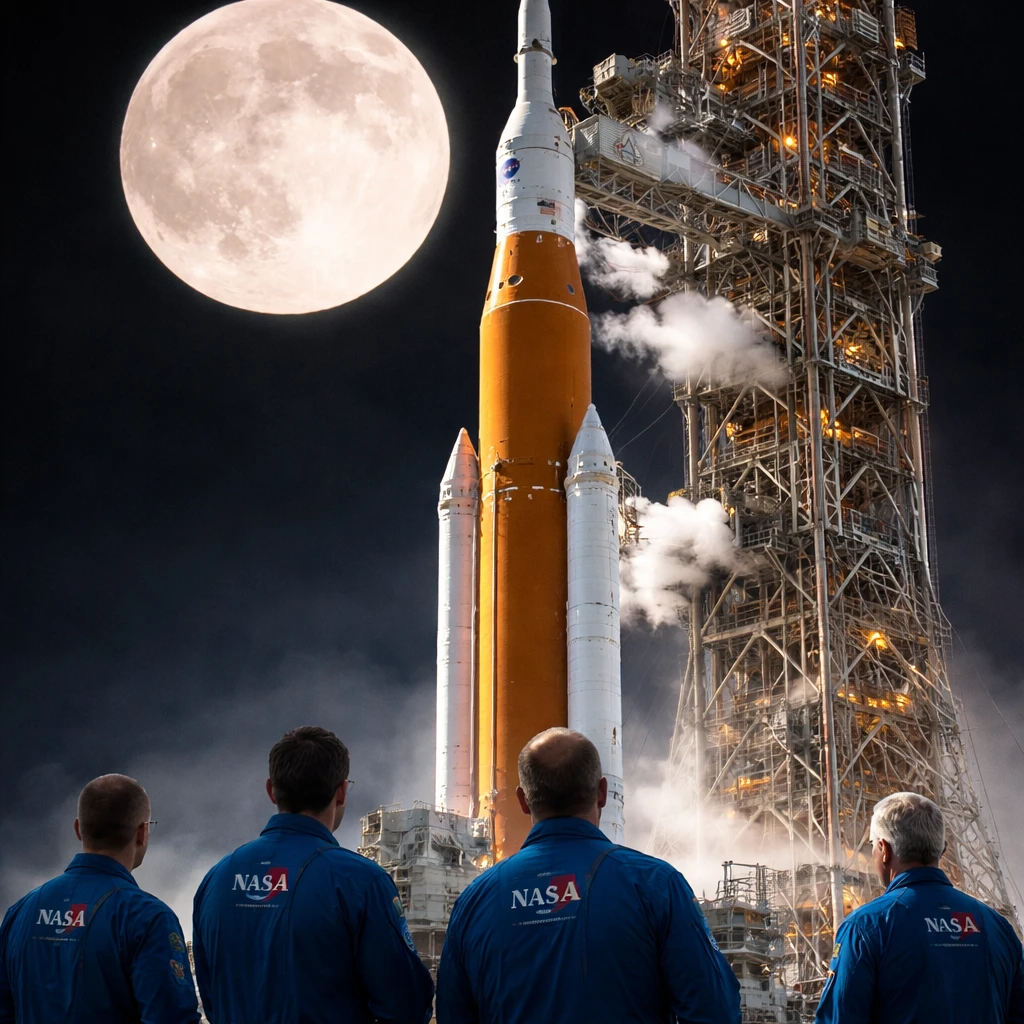

NASA announced on Tuesday a shift in the timeline for launching its next-generation moon rocket, setting sights on a March lift-off after serious fuel leakage troubles emerged during a pivotal test conducted the previous day at Kennedy Space Center in Florida. The agency highlighted that the postponement affords technical teams the opportunity to "thoroughly review the gathered data and execute a second wet dress rehearsal" before committing to the flight sequence.
The leaking problems, which surfaced within hours of beginning the extensive fueling procedure, recalled similar setbacks the rocket faced during its originally planned debut nearly three years ago. These complications have generated uncertainty surrounding the near-term prospects for sending astronauts on this mission.
NASA informed that the four astronauts trained for this journey will exit their quarantine period that had spanned nearly two weeks but will reenter approximately two weeks ahead of the rescheduled launch window, when the crew is slated for the around-the-moon voyage.
At this stage, the space agency refrained from naming a definitive March launch date, explaining additional time is required "to fully analyze test outcomes, resolve identified issues, and proceed with subsequent testing." Prior to Tuesday's announcement, the earliest anticipated launch could have been as soon as Sunday.
The fueling began midday Monday with launch controllers filling the towering 322-foot (98-meter) Space Launch System with super-cooled cryogenic hydrogen and oxygen. Over 700,000 gallons (around 2.6 million liters) of these propellants needed to be loaded and sustained in tanks for hours, simulating the terminal moments of a genuine countdown.
Problems arose quickly as excessive hydrogen concentration accumulated near the rocket's base. This anomaly forced pauses in fuel loading at least twice while engineering personnel implemented countermeasures developed from lessons learned during last year's inaugural SLS countdown, which was also marred by hydrogen leaks before its uncrewed flight.
The agency also cited delays in final preparations during the test and persistent audio communication interruptions among ground teams as additional factors impacting the process.
Meanwhile, the quartet of astronauts—comprising three Americans alongside one Canadian—remained about 1,000 miles away in Houston at the Johnson Space Center, closely monitoring the test operation. The narrow launch windows available each month are further constrained by unusually cold weather in February, which has already reduced feasible launch opportunities by two days.
Despite weather setbacks, countdown clocks initiated Saturday night to afford the launch team a chance to simulate all procedures and address any ongoing rocket issues. The clocks were scheduled to halt approximately 30 seconds before engine ignition.
The upcoming mission spans roughly 10 days, during which the crew will journey beyond the moon, traverse its enigmatic far side, and then return directly to Earth. The objectives include rigorous assessments of the spacecraft’s life-support and other fundamental systems. It is important to note that the spacecraft will neither enter lunar orbit nor land on the moon's surface during this flight.
NASA's last crewed moon expeditions date to the Apollo era of the 1960s and 1970s. The Artemis program aims for a renewed, sustained presence on the lunar surface, with this mission setting essential groundwork for subsequent lunar landings by future astronauts.