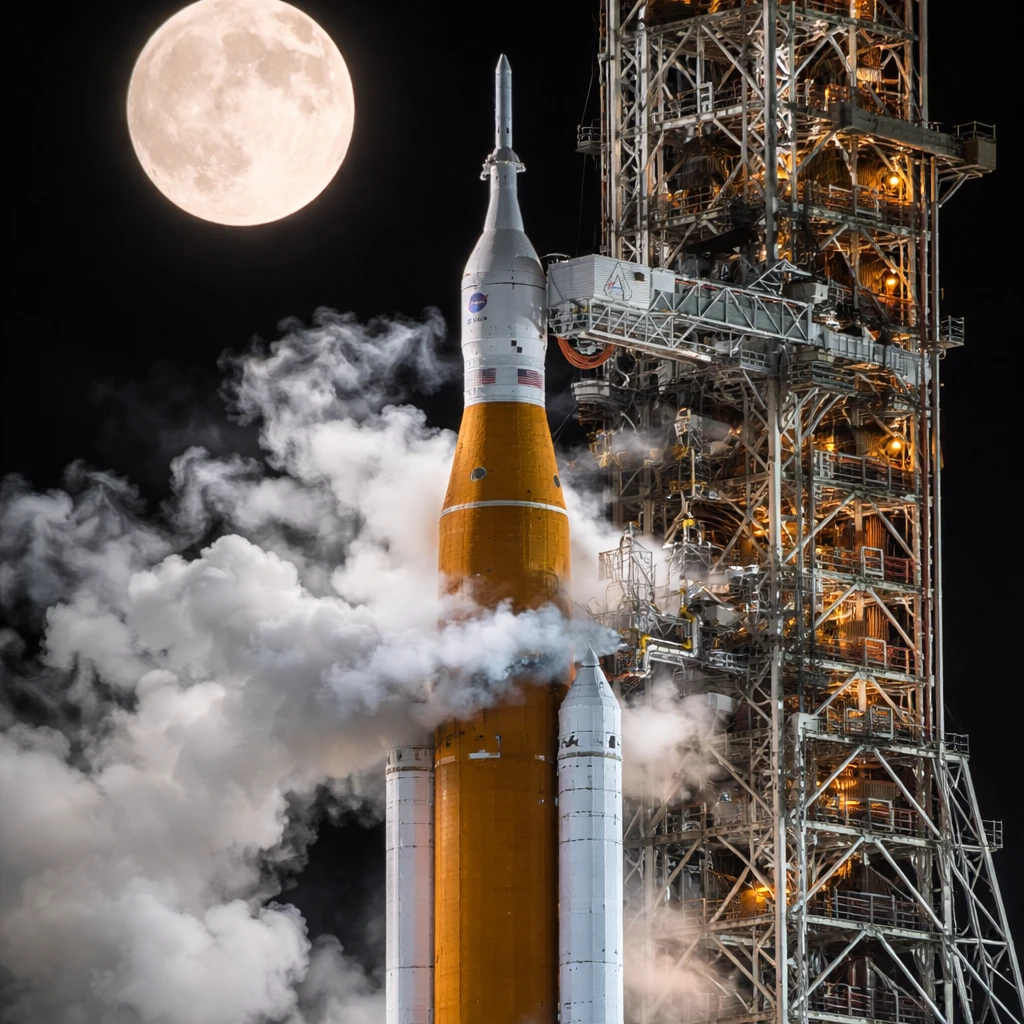

At Kennedy Space Center in Florida, NASA announced on Tuesday it has indefinitely postponed the inaugural launch of its latest lunar rocket following the discovery of persistent fuel leaks during a vital pre-launch test. The fueling operation, which started midday on Monday, encountered multiple complications when excessive liquid hydrogen accumulated near the rocket's base, forcing stop-start procedures as ground crews scrambled to mitigate the issue using approaches from previous launch attempts.
The test involved loading over 700,000 gallons (2.6 million liters) of supercooled hydrogen and oxygen into the massive 322-foot (98-meter) rocket, simulating the final stages of a real countdown. Issues with hydrogen venting caused repeated interruptions, echoing challenges from the rocket's first test flight three years ago, which was delayed by similar fuel leaks before successfully launching without a crew.
In a statement, NASA indicated the launch delay provides the necessary timeframe for engineers and specialists to thoroughly review test data, address each identified problem, and plan for a second comprehensive rehearsal ahead of the actual flight. The agency stopped short of setting a definitive target date, but previous preliminary plans considered a launch window starting this Sunday.
The four astronauts slated for the mission, including commander Reid Wiseman, were withdrawn from their quarantine status of nearly two weeks. NASA expects them to return to quarantine approximately two weeks prior to the rescheduled launch window.
The test also revealed delays during shutdown sequences and recurrent audio communication problems between ground control teams. Meanwhile, the astronauts, three American and one Canadian, monitored the fueling exercise remotely from NASA's Johnson Space Center in Houston, about 1,000 miles (1,600 kilometers) away.
NASA's monthly launch windows for the Artemis program are tightly constrained, with the current February opportunity already shortened by two days due to recent cold weather conditions. Countdown clocks had commenced Saturday night, permitting launch controllers to go through operational procedures and engage with any emergent system issues. The countdown was programmed to pause just seconds before engine ignition.
The mission itself is a roughly ten-day operation designed to send the crew beyond lunar orbit, around the Moon's far side, and return directly to Earth. The crew will remain in the capsule; no lunar orbit insertion or landing attempts will take place. This flight aims to test the spacecraft's life support and critical systems, setting the stage for future manned lunar landings under NASA's Artemis program, which seeks to establish a lasting human presence on the Moon.
Historically, NASA's last crewed lunar missions occurred during the Apollo program of the 1960s and 1970s. The Artemis mission represents a renewed ambition to extend lunar exploration, with commander Wiseman's team playing a foundational role for upcoming missions involving astronauts making lunar surface landings.