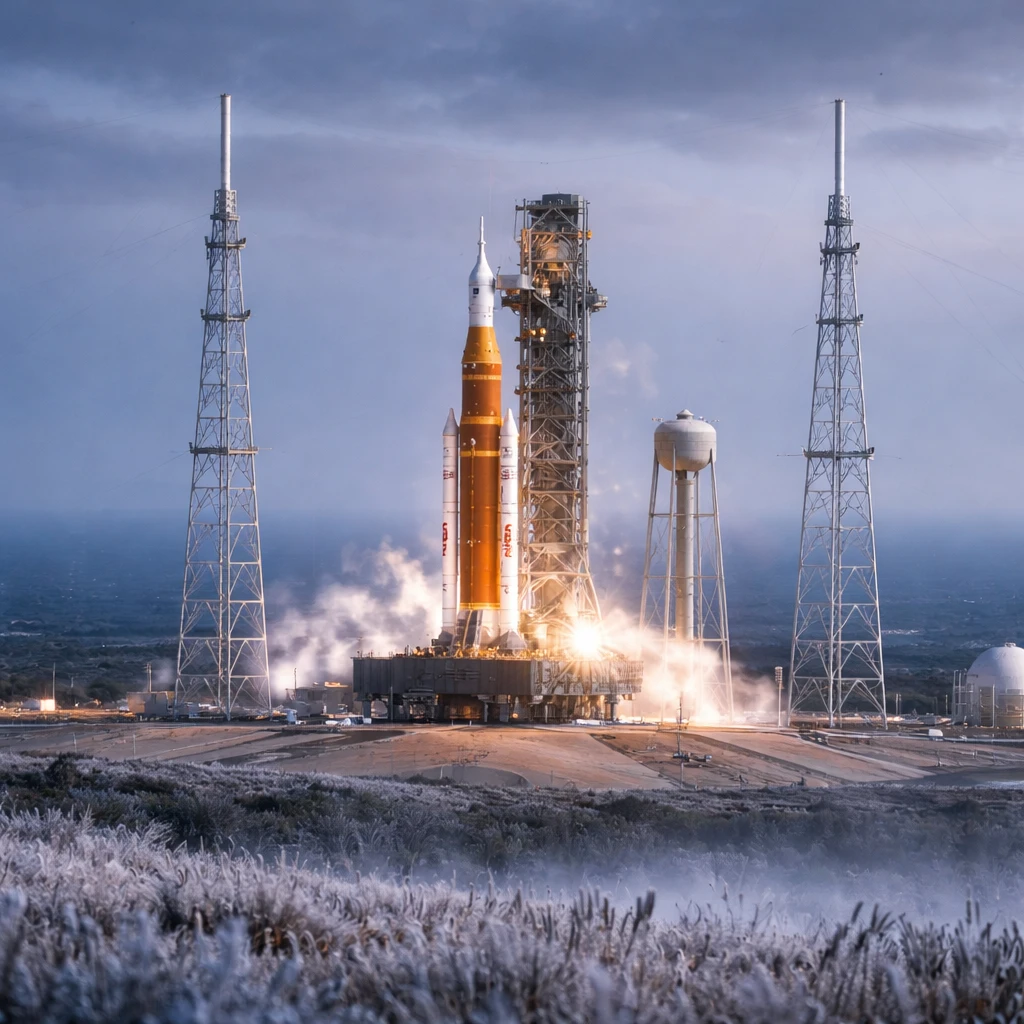

At Cape Canaveral, Florida, NASA has enacted a delay for the first crewed mission of the Artemis lunar program in response to an anticipated period of near-freezing temperatures at the launch facility. The revised target for liftoff is now set for no earlier than February 8, which represents a two-day postponement from the previously scheduled date.
Preparations had been underway for a pivotal fueling test of the Artemis moon rocket, towering at 322 feet (98 meters), which was originally planned for Saturday. Nevertheless, due to environmental concerns and the potential impacts of frigid weather conditions on hardware and safety procedures, NASA made the decision late Thursday to forgo the test on that day.
This critical dress rehearsal, essential for verifying the readiness of the launch vehicle systems and ground operations, has been rescheduled for Monday, contingent on favorable weather conditions. The adjustment consequently leaves NASA with a constrained timeframe of merely three days in February to execute the mission profile involving four astronauts performing a circumlunar voyage and safe return, before potentially extending into March.
A NASA spokesperson highlighted the temporal sensitivity, noting that “any additional delays would result in a day for day change,” underscoring the tight operational margins facing the program.
In response to the cold, NASA officials have implemented measures to stabilize temperatures within key spacecraft components. Heaters are actively maintaining the warmth of the Orion capsule positioned atop the rocket, while rocket-purging systems have been modified to operate effectively in the expected cold environment.
Commander Reid Wiseman and his crew are currently isolated in quarantine quarters located in Houston. Their scheduled transfer to the Kennedy Space Center, NASA’s primary launch site in Florida, remains uncertain amid these evolving conditions.
The Artemis mission marks NASA’s first human lunar journey in over five decades, with the program following the historic Apollo missions, the last of which concluded in 1972 with Apollo 17. The program’s tight schedule includes a narrow launch window each month, heightening the impact of any delays.