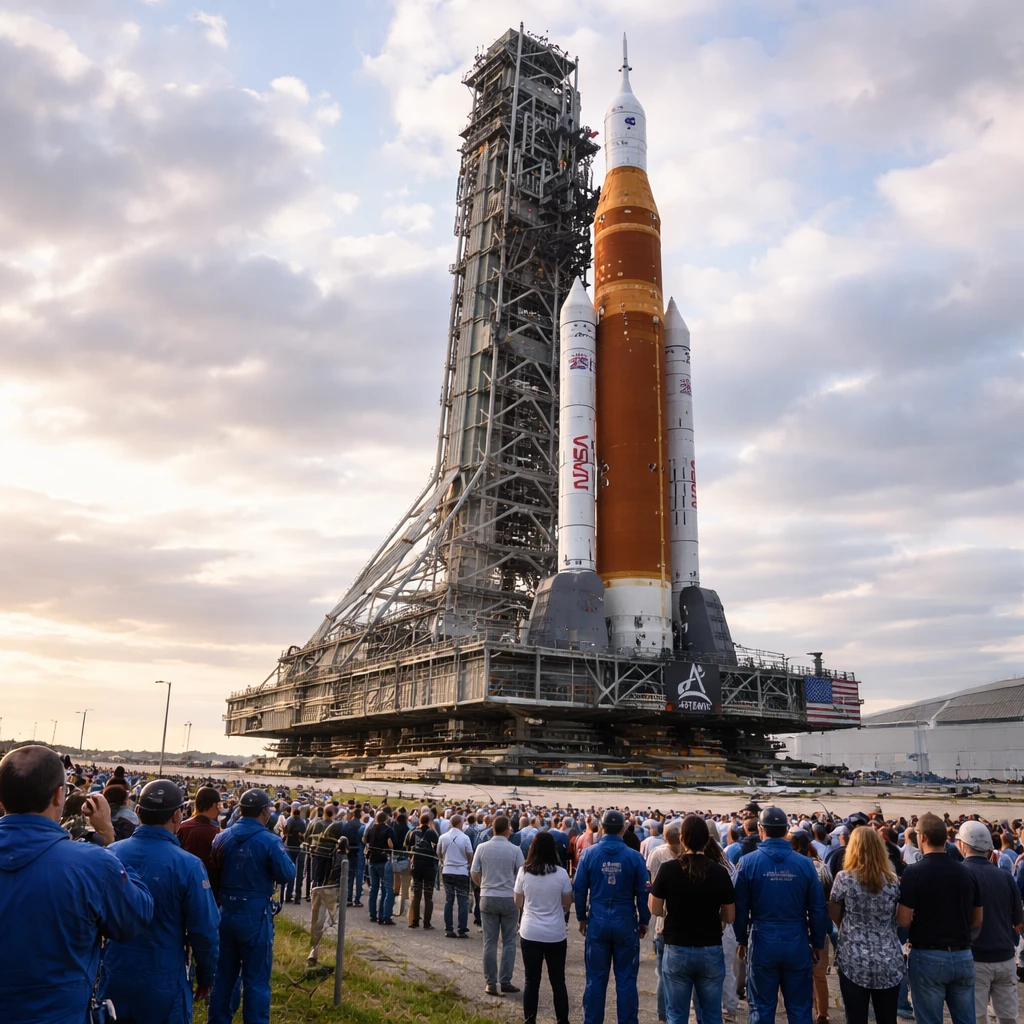

At dawn on a chilly Saturday morning in Florida, NASA's colossal new lunar rocket commenced its slow trek from the Kennedy Space Center's Vehicle Assembly Building (VAB) to the launch pad. The 98-meter (322 feet) tall Space Launch System (SLS) rocket, topped with the Orion crew capsule, moved at approximately 1.6 kilometers per hour (1 mile per hour) along the seven-kilometer (4-mile) route. This journey, which could extend throughout the day until dusk, signals the final stage of preparations for NASA's upcoming crewed mission to the Moon.
Thousands of NASA personnel stationed at Kennedy and their families gathered well before sunrise to observe the landmark event. This transfer reflects a major step forward in a project years in the making, stealing headlines from the echoes of the 1960s. The crowd assembled in the historic VAB, originally constructed to accommodate Saturn V rockets that propelled 24 astronauts on Apollo-era lunar missions. Key figures including NASA Administrator Jared Isaacman and the quartet of astronauts assigned to the mission led the cheering crowd as the SLS System was moved from its bay.
"What an incredible day to be present," expressed mission commander Reid Wiseman, capturing the awe felt by many. "It's breathtaking to see this beast move."
Weighing roughly five million kilograms (11 million pounds), the SLS rocket and its Orion capsule travel on a behemoth transporter. This vehicle has seen action dating back to the Apollo and Space Shuttle programs but has since been modified to accommodate the greater weight of the newest launcher.
The SLS's inaugural flight occurred in November 2022, when it sent an uncrewed Orion capsule on a lunar orbit mission. NASA officials have highlighted the difference in stakes for this upcoming flight, which will carry astronauts aboard for a roughly ten-day mission circling the Moon. "This moment feels very distinct from the first. We're now placing humans inside the rocket to travel around the Moon," said John Honeycutt, a NASA official, prior to the rocket's rollout.
During the first trial flight, issues such as damage to the capsule's heat shield necessitated extensive investigation and remedial testing. These challenges postponed the first crewed lunar voyage until now. Notably, astronauts on this mission will orbit the Moon without landing; touchdown operations are slated for a subsequent Artemis mission in coming years.
Veteran NASA astronauts Reid Wiseman, Victor Glover, and Christina Koch will pilot the flight, accompanied by Canadian astronaut Jeremy Hansen, a seasoned combat pilot making his first journey into space. Together, they will be the first humans to journey to lunar orbit since the conclusion of the Apollo 17 mission in 1972. That program culminated with 12 astronauts setting foot on the Moon's surface beginning in 1969, with only four of the lunar walkers still living today. Buzz Aldrin, the eldest at 96 years old, celebrates his birthday this week.
Commander Wiseman shared, "They're quite excited about our return to the Moon. The goal is to see humans venture further from Earth, exploring the unknown."
NASA plans to conduct a fuel loading test on the SLS while on the launch pad in early February prior to announcing an official launch date. Administrator Isaacman remarked to the press, "We do not currently intend to announce a definitive launch date until after completing the fueling test."
The agency faces a narrow launch window of five days during the first half of February, after which the opportunity will shift into March schedules.