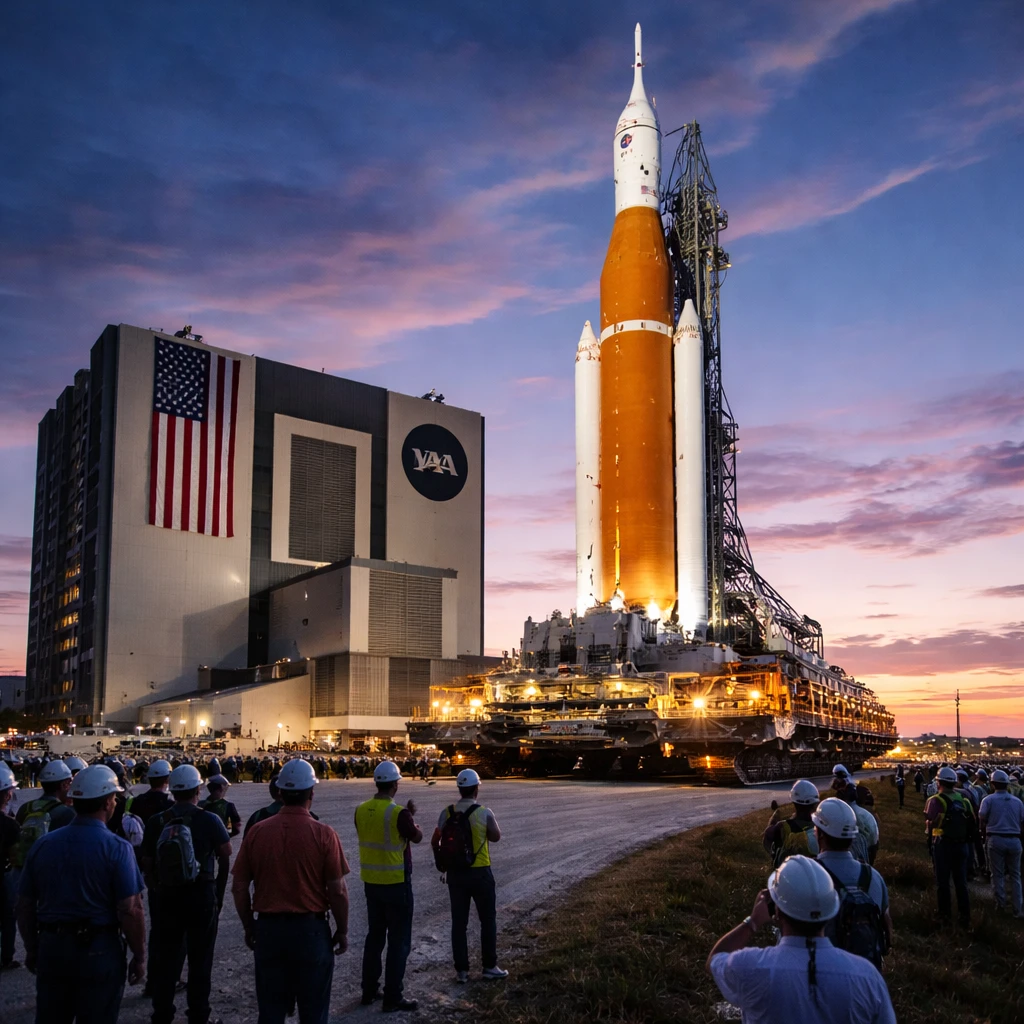

In a significant step forward for lunar exploration, NASA’s colossal Space Launch System (SLS) rocket commenced its movement toward the launch pad at Kennedy Space Center just after daybreak on Saturday. This highly anticipated transit covers approximately four miles (six kilometers) at a measured pace of 1 mile per hour (1.6 kilometers per hour) and is expected to continue until nightfall.
Standing at 322 feet (98 meters) tall and weighing an imposing 11 million pounds (5 million kilograms), the SLS rocket, crowned by the Orion crew capsule, was carefully transported using a specialized vehicle with origins in the Apollo and Space Shuttle programs. This transporter underwent enhancements to accommodate the increased weight and complexity of the modern rocket system.
The mood at the space center was electric as large groups of NASA employees and their families braved the early morning chill to witness this milestone. Their enthusiasm filled the air as they gathered outside the Vehicle Assembly Building, a facility dating back to the 1960s historically used for assembling the Saturn V rockets that powered Apollo missions. NASA’s current administrator, Jared Isaacman, alongside all four astronauts designated for the upcoming mission, led the crowd’s anticipation.
The rollout follows the inaugural SLS launch in November 2022, which involved an uncrewed Orion spacecraft orbiting the moon. This forthcoming mission distinguishes itself by carrying astronauts on a fly-around trajectory, a feat not attempted since the Apollo era. NASA’s John Honeycutt expressed that this mission “feels a lot different” due to the presence of crew members and the ambition of circling the moon.
Extensive processing and validation followed the initial SLS test flight, which encountered issues including heat shield damage. These complications necessitated thorough investigation and retesting, contributing to the delay of crewed lunar excursions until now. It is important to note that this mission’s flight path will not include lunar orbit insertion or a surface landing; such objectives are reserved for future Artemis missions, with crewed lunar touchdown targeted in the third flight several years hence.
The crew consists of seasoned NASA astronauts commander Reid Wiseman, pilot Victor Glover, and Christina Koch, who bring extensive flight experience. They will be accompanied by Canadian astronaut Jeremy Hansen, a former fighter pilot embarking on his inaugural space mission. Collectively, this team will mark the first human expedition to the moon since Apollo 17’s Gene Cernan and Harrison Schmitt, who concluded lunar landing operations in 1972. Historically, a total of twelve astronauts have explored the lunar surface, starting with Neil Armstrong and Buzz Aldrin in 1969.
Preparations now focus on a critical fueling test scheduled on the launch platform in early February, essential for confirming the ultimate launch date. As explained by launch director Charlie Blackwell-Thompson, the outcomes of this demonstration will delineate the final steps leading to liftoff. NASA has identified a tight five-day window in early February to carry out the launch before the calendar advances into March, imposing scheduling constraints.