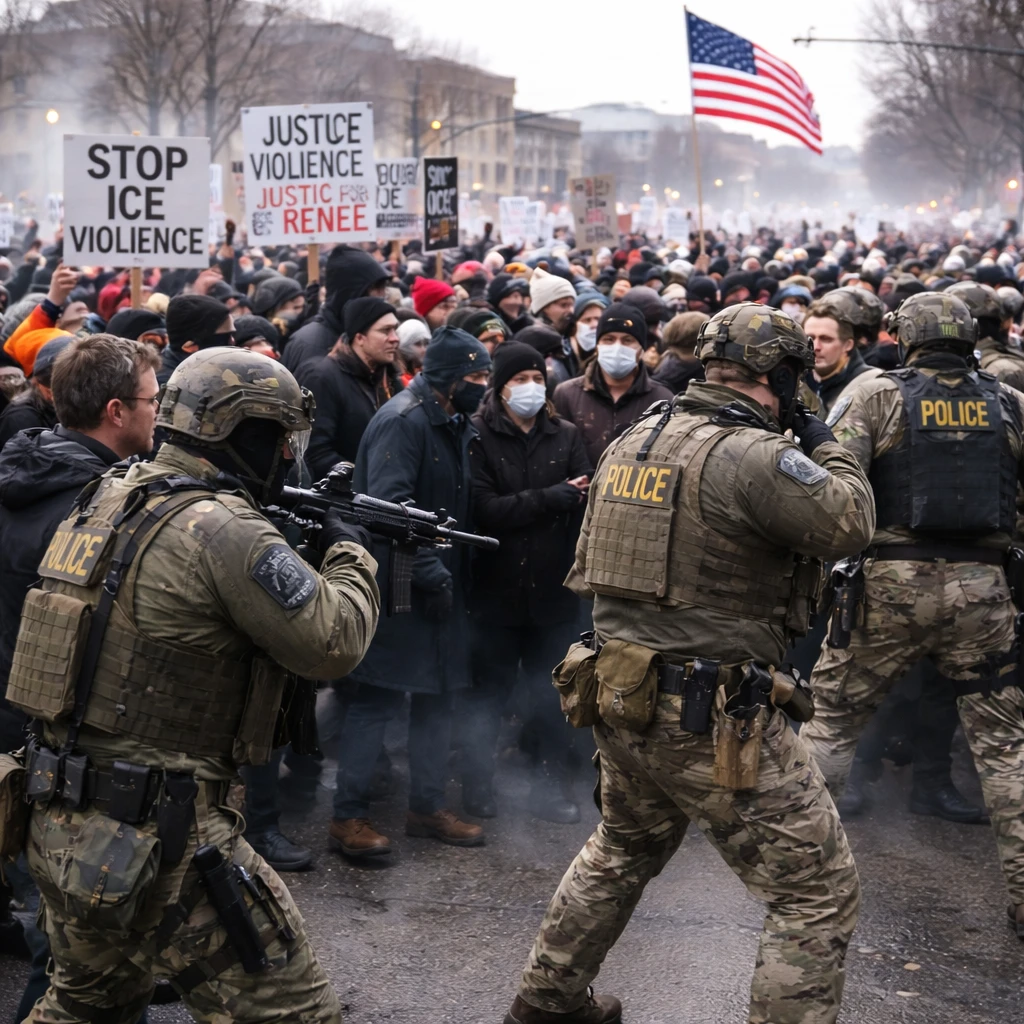
In response to the deadly shooting of Renee Good by a federal Immigration and Customs Enforcement (ICE) officer in Minneapolis, thousands assembled on Saturday in a large-scale protest that also echoed concerns over recent shootings in Portland, Oregon. The rally was part of hundreds of planned demonstrations across various U.S. cities during the weekend, reflecting widespread unease over immigration enforcement operations.
Minneapolis has been in a state of heightened alert since the incident with Ms. Good on Wednesday, a 37-year-old woman who was fatally shot by an ICE officer. Attendees like Meghan Moore, a Minneapolis mother of two, expressed fears regarding the current environment. Moore stated, "ICE is creating an environment where nobody feels safe and that’s unacceptable," underscoring the deep anxiety within local communities.
However, peaceful assemblies faced disruptions. On Friday evening, a demonstration of roughly 1,000 people by a Minneapolis hotel escalated into violence with protesters throwing ice, snow, and rocks at police officers. According to Minneapolis Police Chief Brian O’Hara, one officer sustained minor injuries from being hit with a piece of ice, and authorities cited and released 29 individuals in connection with the unrest.
Mayor Jacob Frey of Minneapolis highlighted the predominantly peaceful nature of the protests but noted that vandalism and danger to others would be met with law enforcement action. He criticized agitators intent on provoking large crowds and denied that Minneapolis would yield to such tactics. "This is what Donald Trump wants," Frey commented, referencing the president’s push for aggressive immigration enforcement in multiple cities. "He wants us to take the bait."
Governor Tim Walz of Minnesota echoed calls for nonviolence in response to the events. On social media, Walz remarked, "Trump sent thousands of armed federal officers into our state, and it took just one day for them to kill someone. Now he wants nothing more than to see chaos distract from that horrific action. Don’t give him what he wants."
The Department of Homeland Security confirmed that the operation deploying immigration officers in the Twin Cities was its largest of its kind. The federal government maintains that the shootings in Minnesota and Oregon were defensive reactions to vehicles employed as weapons against law enforcement officers.
Community members like Connor Maloney, attending the Minneapolis protests, cited frequent harassment by ICE agents as a significant concern. "It’s just sickening that it’s happening in our community around us," Maloney said, reflecting growing dissatisfaction and distress among local populations.
Amid sub-freezing temperatures, thousands of demonstrators including families with children marched, many holding signs reading "De-ICE Minnesota!" and "ICE melts in Minnesota." The procession traversed a street adorned with murals celebrating diverse cultures, symbolizing the city’s multicultural fabric.
Similar expressions of opposition were observed elsewhere, including Durham, North Carolina, where Steven Eubanks characterized the killing in Minneapolis as "horrifying" and a call to action. He emphasized, "We can’t allow it. We have to stand up."
An organization called Indivisible reported the scheduling of hundreds of protests across several states, including Texas, Kansas, New Mexico, Ohio, and Florida, amplifying the national dialogue surrounding immigration enforcement.
In Minneapolis, the protest was coordinated by various migrant rights groups and initiated near a park approximately half a mile from the residential area where Ms. Good was shot. Despite the large turnout, federal immigration agents maintained active operations within the city. An Associated Press photographer observed armed officers in Border Patrol uniforms confronting an individual who had been following them, issuing stern warnings before eventually moving away without a detainment.
Overall, the demonstrations within neighborhoods have been mostly nonviolent, with a minimal law enforcement presence compared to the post-George Floyd unrest in 2020. However, some skirmishes occurred near the airport on Thursday and Friday between smaller protest groups and officers guarding the federal building serving as the base for the enforcement crackdown.
Chief O’Hara noted that city police have responded to reports of abandoned vehicles, including one left in park and another with a dog trapped inside, apparently due to ICE agents detaining the drivers. Response calls to 911 have increased, with residents alerting police to ICE activity, arrests, and unattended cars.
The federal crackdown involves over 2,000 officers deployed throughout Minnesota, targeting immigration fraud linked to the Somali community, marking a significant escalation in ICE operations.
In a separate development, three Minnesota representatives—Ilhan Omar, Kelly Morrison, and Angie Craig—attempted to inspect the ICE facility within Minneapolis’ federal building on Saturday morning. Though initially allowed entry, they were asked to leave after approximately 10 minutes, an action the lawmakers criticized as obstruction of congressional oversight. This incident follows a federal court ruling last month blocking the Trump administration's restrictions on congressional visits to immigration detention centers, stemming from a lawsuit filed by a dozen members of Congress.
It should be noted that the individuals shot in Portland were not participating in protests, clarifying some earlier misconceptions.
This ongoing situation intertwines federal immigration enforcement policies with local community responses, highlighting tensions that resonate across social, political, and legal domains throughout the nation.
January 10, 2026
News & Politics
Nationwide Rallies Erupt Following Fatal Shootings Involving Federal Immigration Agents
Protesters Demand Peaceful Action Amidst Heightened Tensions in Minneapolis and Portland
Leila Farooq
Telecom & Media Analyst
Summary
Demonstrations erupted on a national scale after the fatal shooting of Renee Good by a federal immigration enforcement officer in Minneapolis and the shooting of two individuals in Portland, Oregon. While the majority of protests remained peaceful, some incidents of violence prompted law enforcement responses. State and city officials emphasized calls for calm and warned against agitation that could escalate violence, as the federal deployment of immigration officers continues amid local unrest.
Key Points
Massive protests occurred nationwide in response to the fatal shooting of a woman by an ICE officer in Minneapolis and shootings in Portland, emphasizing community unrest regarding federal immigration enforcement efforts.
Authorities urge peaceful protest while responding to isolated incidents of violence, balancing law enforcement presence with maintaining order during heightened tensions in affected cities.
The Trump administration's largest immigration enforcement operation in the Twin Cities involves over 2,000 officers, demonstrating significant federal resource allocation to immigration crackdowns, particularly focused on alleged fraud among Somali residents.
Risks
- Escalation of violent confrontations between protesters and law enforcement could lead to property damage, injuries, and increased social instability, impacting local economies and public safety sectors.
- Federal and local government tensions regarding immigration enforcement and oversight may result in legislative or operational uncertainties, affecting public administration and legal systems.
- Continued ICE activity and public backlash could disrupt community cohesion and influence public sentiment, potentially affecting political dynamics and policymaking in immigration and law enforcement sectors.
Disclosure
This article is based entirely on information provided within the initial reporting and contains no additional facts or external speculation beyond those details.