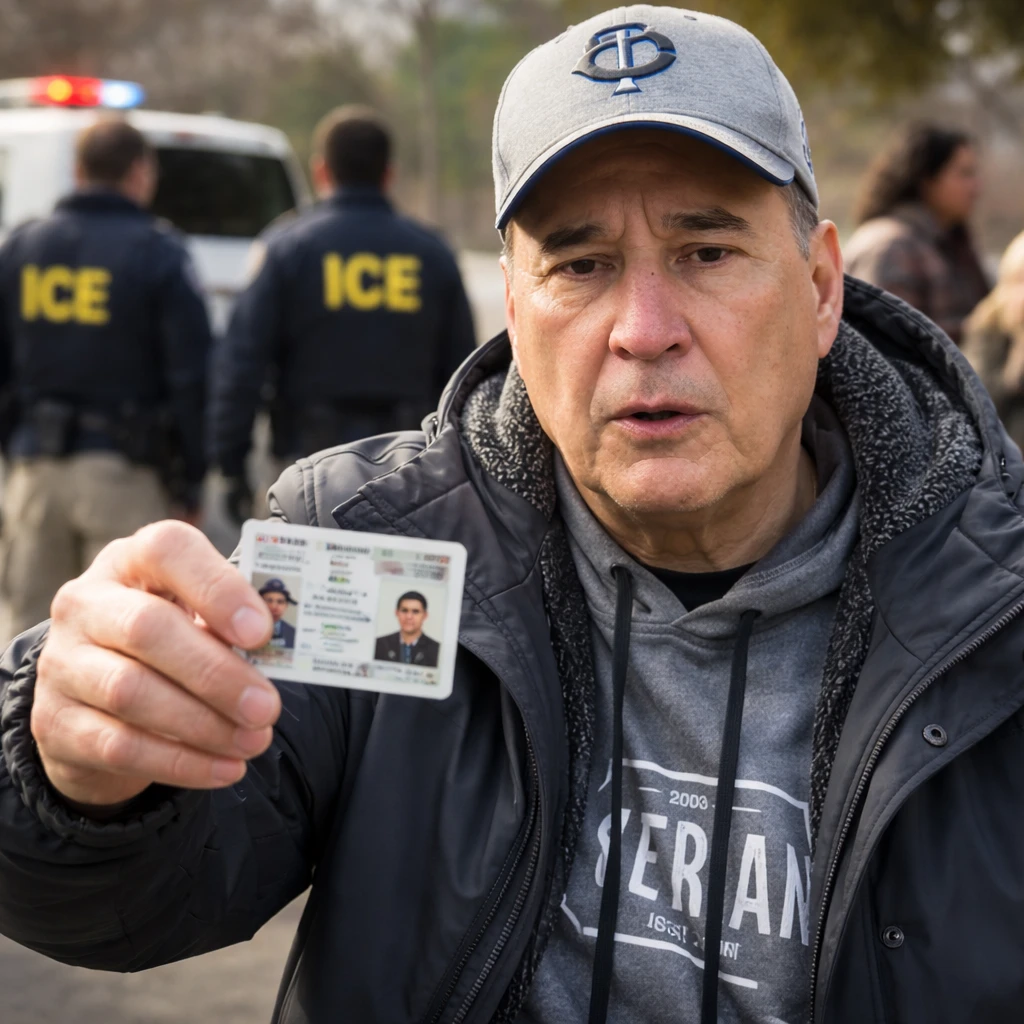

As Minneapolis experienced an unprecedented surge of U.S. Immigration and Customs Enforcement (ICE) activity, Shane Mantz, a Choctaw Nation member and pest-control company manager, quickly retrieved his tribal citizenship card from a drawer and kept it close. Mantz, who is sometimes mistaken for Latino, worries about being inadvertently caught in ICE raids and has made carrying tribal identification a routine precaution.
This action is echoed by many Native Americans nationwide who now carry tribal documents as a safeguard to prove their citizenship if questioned by federal immigration officers. In coordination with this growing demand, dozens among the 575 federally recognized Native nations are adjusting their procedures to facilitate easier access to tribal IDs. Measures include fee waivers, reductions in the age required to obtain an ID—ranging between 5 and 18 years depending on the tribe—and faster card production processes.
David Wilkins, who studies Native governance and politics at the University of Richmond, notes that this widespread use of tribal IDs as evidence of U.S. citizenship and defense against federal law enforcement is unprecedented historically. He describes the situation as deeply frustrating and disheartening.
Fundamentally, many Native Americans find it deeply ironic and indignifying that they must now provide documentation asserting citizenship on land their ancestors inhabited long before the United States existed. "As the first people of this land, there’s no reason why Native Americans should have their citizenship questioned," says Jaqueline De León, a senior attorney at the Native American Rights Fund and member of Isleta Pueblo.
The Department of Homeland Security (DHS) responded via email stating that its agents receive appropriate training to determine alienage and removability in line with constitutional provisions. The agency emphasized that its law enforcement actions follow Fourth Amendment guidelines and that the Supreme Court has recently upheld the use of apparent race and ethnicity as factors in detainment decisions, as affirmed in a September ruling.
Historically, since the late 19th century, the U.S. government has collected extensive genealogical records establishing Native Americans’ blood quantum and eligibility for federally mandated services such as healthcare, housing, and education. These records were also tools for enforcing assimilation policies and gradually diminishing tribal sovereignty and communal landholdings. In reaction, many tribes began issuing their own forms of identification in the late 1960s. Over the past two decades, tribal photo IDs have become common and serve multiple purposes including voting in tribal elections, demonstrating eligibility for employment in the U.S., and facilitating domestic air travel.
Today, approximately 70% of Native Americans reside in urban environments, with the Twin Cities area housing one of the nation’s largest urban Native populations. In early January, ICE launched what was described as the "largest immigration operation ever" in Minneapolis. Heavily armed and masked agents patrolling neighborhoods in unmarked vehicles became a frequent presence. By the end of that week, ICE had reported over 3,400 arrests involving at least 2,000 ICE officers and 1,000 Border Patrol personnel.
In response, representatives from more than ten tribes traveled great distances to Minneapolis—the birthplace of the American Indian Movement—to process tribal ID applications on-site for urban members. These tribes included the Lac Courte Oreilles Band of Ojibwe from Wisconsin, the Sisseton Wahpeton Oyate of South Dakota, and the Turtle Mountain Band of Chippewa from North Dakota. Faron Houle, a Turtle Mountain citizen, renewed his tribal ID and obtained new cards for his adult son and daughter, expressing his apprehension that the ICE tactics stem from racial profiling.
Throughout January, public venues such as coffee shops, hotel ballrooms, and the Minneapolis American Indian Center hosted gatherings to foster solidarity among urban Native populations and coordinate resources. Christine Yellow Bird, director of the Mandan, Hidatsa, and Arikara Nation’s Fargo satellite office, made multiple trips to Minneapolis to assist residents unable to travel back to their reservations. Yellow Bird describes the tribal ID as both a source of pride and an unexpected tool for personal safety.
Concerns about ICE harassment are not new for Native communities. Navajo Nation President Buu Nygren reported instances of tribal members being detained by ICE officers in the Southwest, leading tribal leadership to advise carrying tribal identification at all times. In a notable incident last November, Elaine Miles, an Oregon tribal member and known actress, was stopped by ICE officers who questioned the authenticity of her tribal ID.
Adding to this tension, the Oglala Sioux Tribe recently barred ICE from their large reservation spanning South Dakota and Nebraska, and the Standing Rock Sioux Tribe reported a member's detention in Minnesota. Additionally, Peter Yazzie, a Navajo from Arizona, described an encounter in which he was arrested after ICE officers considered discrepancies in documentation names during a gas station stop. Yazzie was held for several hours despite providing a driver’s license, a birth certificate, and his federal Certificate of Degree of Indian Blood, highlighting concerns over arbitrary enforcement practices.
Mantz, whose daily work places him in Minneapolis neighborhoods with significant ICE activity, reiterates his resolve to carry tribal identification continually, while expressing frustration over the necessity of proving identity in such contexts. Prioritizing similar documentation for his children has become a personal priority as well.
"It gives me some peace of mind. But at the same time, why do we have to carry these documents? Who are you to ask us to prove who we are?" Mantz questioned, capturing the paradox faced by Native Americans striving to assert their rightful place in the United States.