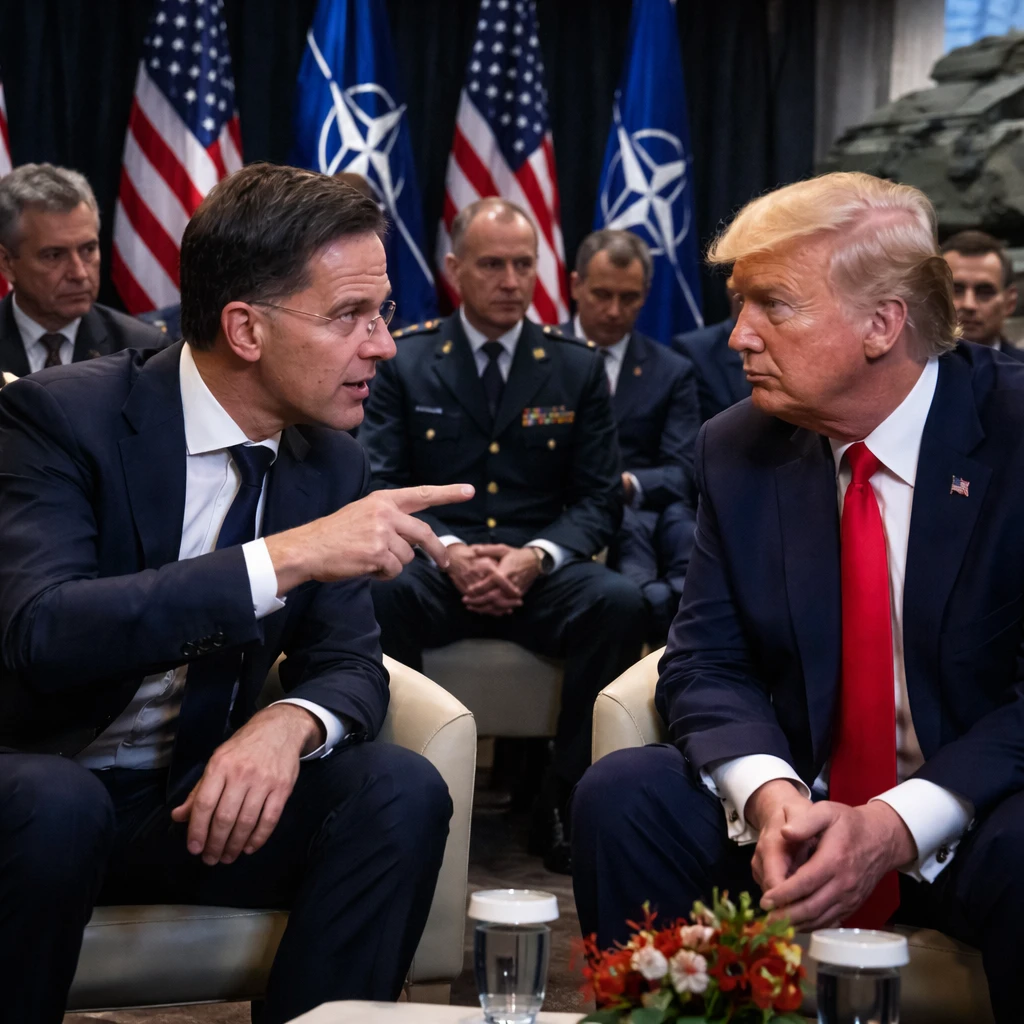

Across Europe and Canada, significant financial resources are being allocated to bolster Ukraine's defence and to augment the NATO members' own military budgets. This surge in defence spending underscores a strategic commitment to fortify territorial security amid ongoing regional tensions. However, despite these considerable investments, NATO's standing as a cohesive military bloc under American leadership has experienced substantial deterioration over the past year, with trust among its 32 member countries notably weakened.
A particularly conspicuous manifestation of these internal strains has been the controversy surrounding U.S. President Donald Trump's proposals to acquire Greenland, an autonomous territory of Denmark, itself a NATO member state. This dispute exposed deeper fissures within the alliance. Further straining relations, President Trump's disparaging comments about allied troops involved in Afghanistan further aggravated intra-alliance tensions. Although immediate tensions over Greenland have momentarily diminished, the underlying conflicts have inflicted lasting damage on NATO's collective deterrence ability, as analysts contend.
"This event is significant because it crossed a boundary that cannot be restored," commented Sophia Besch from the Carnegie Europe think tank in an evaluation of the Greenland incident. "Even without applying direct forces or sanctions, such a breach inflicts enduring harm on the alliance's integrity."
The repercussions of internal discord have not escaped the attention of Russia, NATO's principal antagonist. Kremlin officials have closely observed the alliance's instability, interpreting it as a possible weakening of resolve. The foundation of NATO's deterrence strategy depends critically on convincing Russian President Vladimir Putin that any escalation of conflict beyond Ukraine will provoke a unified and decisive NATO response. Current indications suggest this message lacks convincing strength.
Russian Foreign Minister Sergey Lavrov remarked recently, "Europe is experiencing a profound upheaval, and we are observing these developments closely."", underscoring the strategic ramifications of NATO's discord.
Historically, European NATO members and Canada faced prolonged criticism from U.S. officials for insufficient defence budget allocations, with President Trump intensifying these complaints during his term. Responding to such pressures, in July, these allies committed to a substantial increase in defence spending, targeting an investment equivalent to 5% of their gross domestic product by 2035. This commitment is designed not only to match closer to the United States' expenditure of roughly 3.5% of GDP but also to encompass an additional 1.5% devoted to infrastructure and security enhancements, including modernization of bridges, airfields, and seaports.
Mark Rutte, NATO Secretary-General, has interpreted these financial commitments as indicators of the alliance's strengthened military capacity, even acknowledging President Trump’s influence on this turn. However, the tension between promoting alliance cohesion and managing political complexities, such as the Greenland dispute, has led to cautious public commentary from NATO officials.
The structural foundation of NATO, established in 1949 to counter Soviet threats during the Cold War, relies on American troop presence in Europe and a collective defence principle outlined in Article 5 of its founding treaty. This article mandates a collective response to any armed attack against member nations, emphasizing inviolable territorial sovereignty. President Trump's proposals concerning Greenland contradicted this principle, challenging the unity essential to Article 5, despite the legal limitations on internal disputes triggering the article's provisions.
U.S. Senators Jeanne Shaheen and Lisa Murkowski criticized these presidential threats in an op-ed, emphasizing that ‘‘coercive actions against allies undermine American interests, diminish deterrence, and signal instability to adversaries seeking to exploit alliance fragility.”
Even prior to the escalation surrounding Greenland, European allies retained considerable skepticism about the extent of U.S. commitment to their defence. President Trump’s recent questioning of the contributions made by European and Canadian troops in Afghanistan added to these concerns, though he later moderated some remarks.
In a Senate Foreign Relations Committee hearing, U.S. Secretary of State Marco Rubio countered criticisms by asserting that ‘‘strengthening NATO partners broadens U.S. strategic flexibility globally,” framing alliance developments as a practical adaptation rather than an abandonment.
Despite increased defence expenditures, NATO confronts an emboldened Russia. EU foreign policy leader Kaja Kallas articulated that Russia remains a persistent, long-term security challenge, facing Europe with multifaceted threats including cyberattacks, sabotage, political interference, military intimidation, and territorial aggression.
Recent European reports of sabotage and unauthorized aerial activities over critical infrastructure suggest ongoing covert operational challenges. Russian authorities deny involvement, but these incidents exacerbate regional tensions. Secretary-General Rutte has warned of Europe's vulnerability to large-scale conflict reminiscent of historical calamities.
Conversely, Russian officials interpret the alliance's disputes, particularly the Greenland episode, as symptomatic of a deep NATO crisis, with Russian media deriding the perceived loss of trans-Atlantic unity.
Looking ahead, discussions among NATO defence ministers scheduled for February include U.S. Defence Secretary Pete Hegseth's engagement on key security topics including Arctic defence. Uncertainty surrounds potential shifts in the U.S. military footprint in Europe, with recent withdrawals of troops causing unease among NATO members such as Romania. This ambiguity fuels questions about long-term U.S. commitment to European security, thereby undermining the alliance’s deterrence posture.
A European Union Institute for Security Studies report recently highlighted that the ambiguity of U.S. support increases the susceptibility of NATO to provocations, due to perceptions of disunity and irresolution. The report concluded that Europe must reconcile with a more stringent geopolitical reality where adversaries may feel emboldened to test alliance cohesion without risk of triggering a coordinated response.