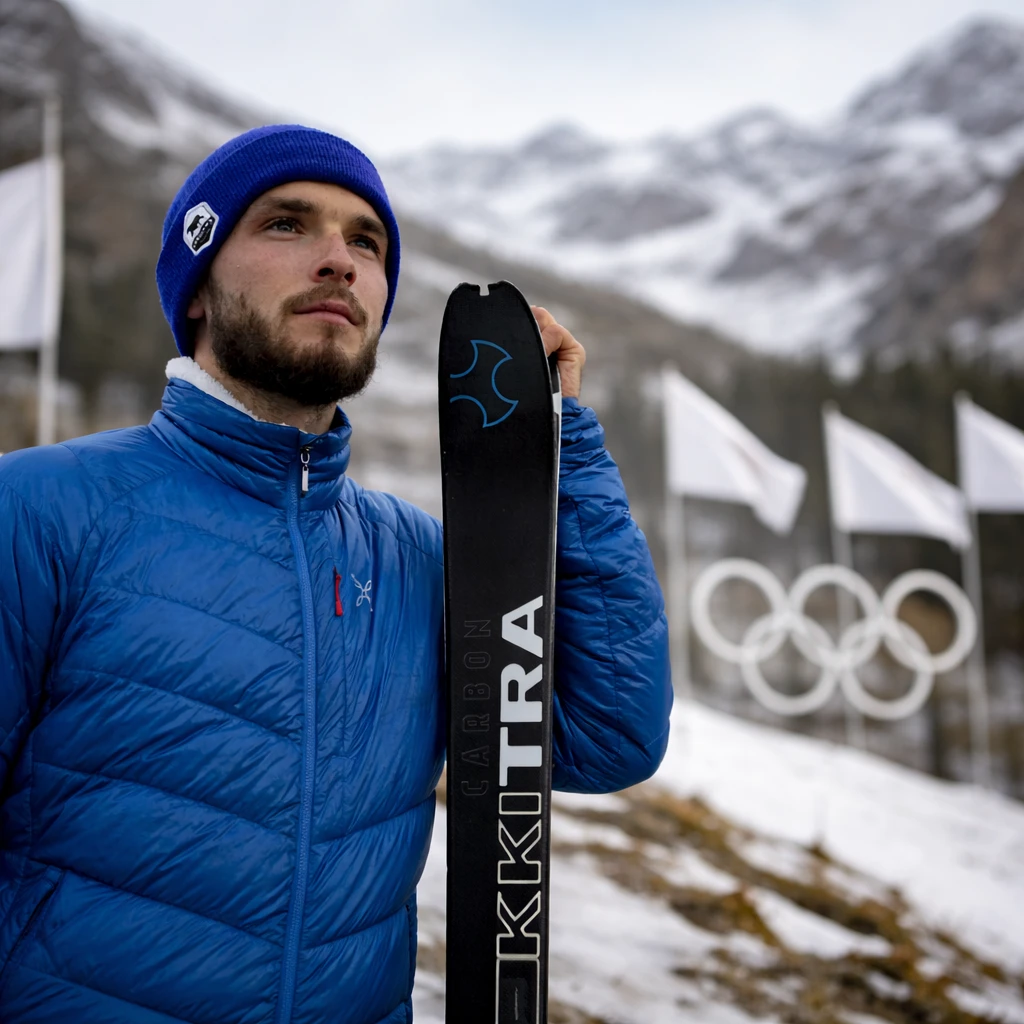
In the rugged terrain of Russia's far eastern Kamchatka Peninsula, Nikita Filippov trains rigorously for the new Olympic discipline of ski mountaineering. At 23, he has emerged as a strong contender in the combined uphill sprint and downhill skiing event scheduled for the Milan Cortina 2026 Winter Olympics.
However, Filippov, like other Russian athletes, faces an unusual circumstance at the upcoming Games. Due to ongoing geopolitical tensions and resulting sanctions after Russia's military incursion into Ukraine in 2022, he will compete as an "Individual Neutral Athlete."
This status means that Filippov and his compatriots are officially not representing Russia. They are prohibited from wearing national insignia, and if victorious, their national anthem will not be played during medal ceremonies. Despite these constraints, Filippov expressed a determined mindset at a training camp in the Caucasus mountains. "It provides additional competitive motivation because I want to demonstrate that we remain strong and can outperform anyone, even without our flag or anthem," he said. "I believe that everyone recognizes our origin, and perhaps it even increases attention toward us."
After Russia's actions four days following the 2022 Winter Olympics in Beijing, numerous sports organizations instituted bans on Russian athletes competing under their national banner. Leading up to the 2024 Summer Olympics in Paris, the International Olympic Committee (IOC) progressively allowed athletes from Russia and Belarus to qualify as neutrals.
At Paris 2024, fifteen Russians competed under this neutral designation and secured a single medal in tennis. However, for Milan Cortina, the number of Russian neutral athletes might be smaller. Similar to the previous Summer Games, these athletes will not march together as a national delegation during the opening ceremonies.
Filippov, the first Russian neutral athlete to secure a berth for Milan Cortina, indicated that the lack of official representation would not hinder him. "I anticipate having more rest and energy compared to other athletes during the competition," he noted.
The final count of Russians competing in Milan remains uncertain. Russian Sports Minister Mikhail Degtyarev estimated a maximum of 15 to 20 athletes could qualify, yet as of now, only three Russians and one Belarusian have accepted invitations to participate.
The IOC, under the leadership of new president Kirsty Coventry, supports Russian athletes competing as neutrals in most events, excluding team sports such as hockey. Consequently, renowned NHL players like Alexander Ovechkin will not be present in Milan.
Among the hopefuls, figure skaters Adeliia Petrosian and Petr Gumennik qualified in September and are considered strong medal prospects. Other Russian athletes' participation will hinge on qualification standings and IOC approval. Notably, cross-country skiers Savelii Korostelev and Dariya Nepryaeva recently returned to international competition and achieved top-10 finishes in the Tour de Ski series, marking their first appearances since 2022.
The IOC's neutral status excludes any athlete under contract with Russian or Belarusian security or military agencies or those who have publicly supported Russia's Ukraine actions. Ukrainian officials have challenged the neutrality of some Russian competitors who have participated in Olympic qualifying events.
Despite various legal setbacks to policies barring Russian athletes, most winter sports organizations have permitted these athletes to compete in qualifiers recently.
Yet, Russian athletes have faced additional hurdles. For instance, no Russians participated in the recent luge World Cup in Latvia due to their foreign minister banning 14 Russian athletes from entering. Visa complications also prevented two Russian ski jumpers from competing in multiple European World Cup events.
It's notable that Russian athletes have not competed under their national flag at the Winter Olympics since 2014, when Russia hosted a doping-tainted Games in Sochi. Subsequent doping-related verdicts required Russian athletes to compete as "Olympic Athletes from Russia" in Pyeongchang 2018 and under the "Russian Olympic Committee" banner in Beijing 2022, both without the anthem playing. The World Anti-Doping Agency (WADA) maintains Russia's national testing agency as "non-compliant," citing an inability to conduct on-site inspections, a status Russia denies.
The geopolitical situation escalated following the Beijing Games, with Moscow initiating a "special military operation" in Ukraine. This action precipitated a fresh series of sports bans and sanctions.
Concerns about athlete welfare persist, especially following a doping scandal among figure skaters that overshadowed Beijing 2022. Adeliia Petrosian trains under coach Eteri Tutberidze, known for overseeing Kamila Valieva, whose positive doping test at just 15 led to contentious legal battles and a ban. Valieva's handling drew public criticism from then-IOC President Thomas Bach for perceived insensitivity.
Petrosian is notable for executing one of the few female quadruple jumps in competition, though her neutral status limits her international exposure outside Russia.
As the Winter Games in Milan Cortina approach, Russian athletes face an array of diplomatic and competitive challenges, competing in isolation without many of the traditional national symbols and support, while striving to demonstrate their individual and collective prowess on the global stage.