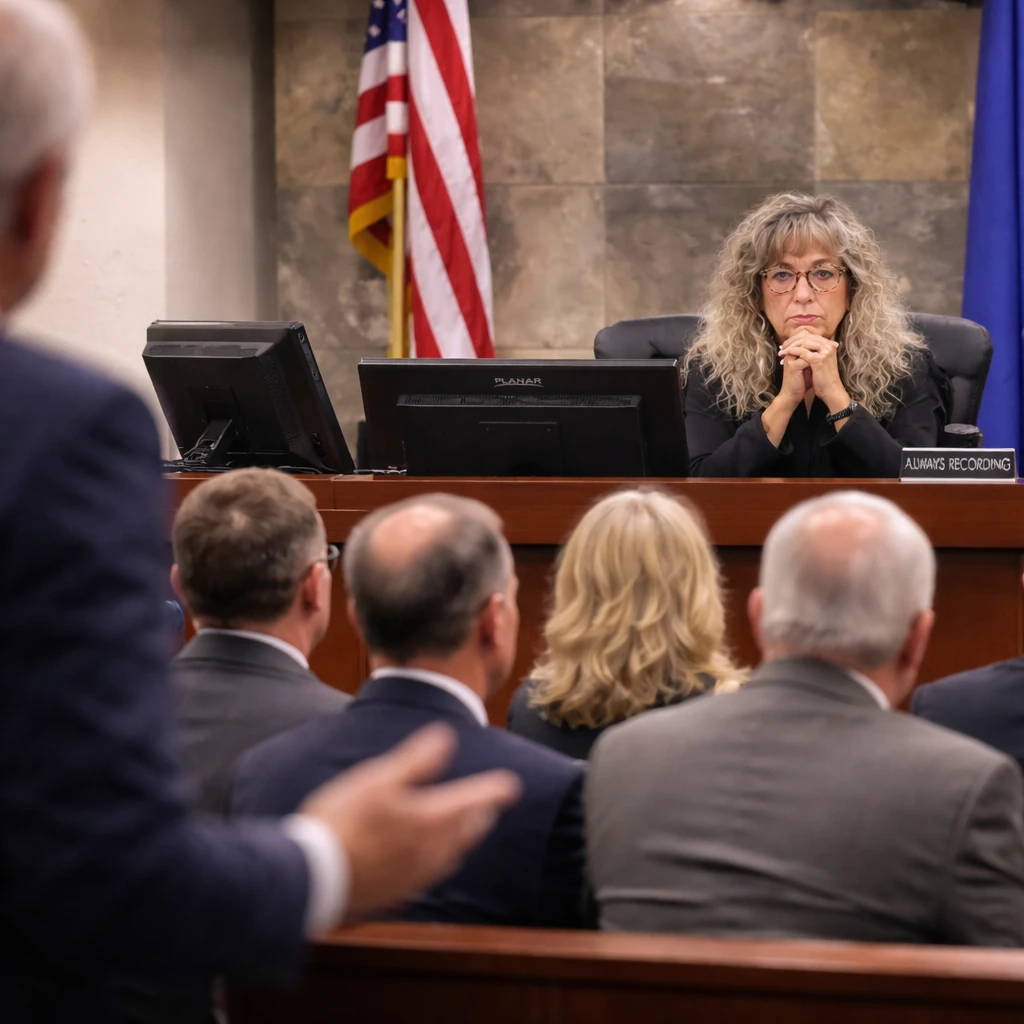
The prosecution of six Nevada Republican electors, accused of unlawfully attempting to assign the state's 2020 presidential electoral votes to Donald Trump, resumed in Clark County on Monday. This follows a ruling by the Nevada Supreme Court confirming that Clark County is the appropriate venue for the case.
During the hearing, defense attorneys challenged the charges of offering a false instrument for filing and uttering a forged instrument, focusing particularly on the requirement that fraud intent must be proven for the latter charge. Clark County Judge Mary Kay Holthus expressed doubt about the state's ability to establish such intent, remarking that it seemed improbable the electors truly believed their actions would mislead others into thinking Trump had legitimately won Nevada.
"They're not genuinely thinking they're going to deceive anyone or make it appear that Trump was elected when he was not," Holthus commented. "This is my core concern, as it seems almost illogical that they would have done this with intent to defraud."
Prosecutors have asserted that the intent to defraud can be inferred from the transmission of the disputed documents to several high-level recipients, including the state's chief federal judge, the secretary of state's office, the vice president, and the National Archives.
Judge Holthus has directed prosecutors to provide a detailed brief by early March presenting evidence pertaining to the alleged fraudulent intent of the electors. The next court hearing is scheduled for April 10.
The hearing revisits events from over five years ago, when these six Republican electors convened an unrecognized electoral vote certification ceremony in Carson City. At this event, they signed documents purporting to legally award Nevada's electoral votes to Trump and then-Vice President Mike Pence. This action directly contradicted the legitimate certification ceremony held by the Democratic electors, who were legally bound to cast their votes for Joe Biden, the candidate who won Nevada's popular vote.
The group of Republican defendants includes Nevada GOP Chairman Michael McDonald, Nevada GOP Vice Chair Jim Hindle, Republican National Committeeman Jim DeGraffenreid, Clark County GOP Chairman Jesse Law, Shawn Meehan, and Eileen Rice. Similar cases involving so-called "fake electors" are progressing slowly in other states like Arizona and Wisconsin, where prosecutors have encountered significant challenges, including case dismissals.
Previously, Judge Holthus dismissed the case in 2024 on the basis of venue, concluding Clark County was an improper jurisdiction. However, the Nevada Supreme Court later overturned this decision in November. The case is now scheduled for trial in Clark County, which, unlike more conservative rural areas, may offer a less elector-friendly jury.
Had the high court ruled against the state, prosecutors had prepared a narrowed case in Carson City. Nevada law permits concurrent prosecutions to proceed as long as a jury has not been seated.
Monday's hearing focused particularly on an unresolved matter from the prior dismissal: the adequacy of evidence presented to the Clark County grand jury. Defense attorneys contended prosecutors had failed to supply complete and relevant evidence supporting their charges.
According to the defense, the document at issue is not inherently false but a legitimate document containing inaccurate information. Jesse Law's attorney, Maggie McLetchie, asserted during the hearing that defendants were exercising their First Amendment rights by petitioning the government and contesting the election results.
In opposition, state prosecutor Alissa Engler argued the document was false because it contained knowingly fabricated information. She stressed that the defendants intended for these forged documents to be treated as valid.
Defense counsel also criticized prosecutors for allegedly withholding correspondence from Kenneth Chesebro, identified as the originator of the fake elector strategy and a crucial witness, claiming such evidence would exonerate some defendants.
The defense argued prosecutors failed to demonstrate to the grand jury that the electors' signing ceremony was a contingency measure aimed at future legal challenges potentially overturning Nevada's election results. Notably, the Nevada Supreme Court had rejected related electoral challenges before the alternate certification ceremony happened, though an appeal to the U.S. Supreme Court remained a theoretical option, which was never pursued.