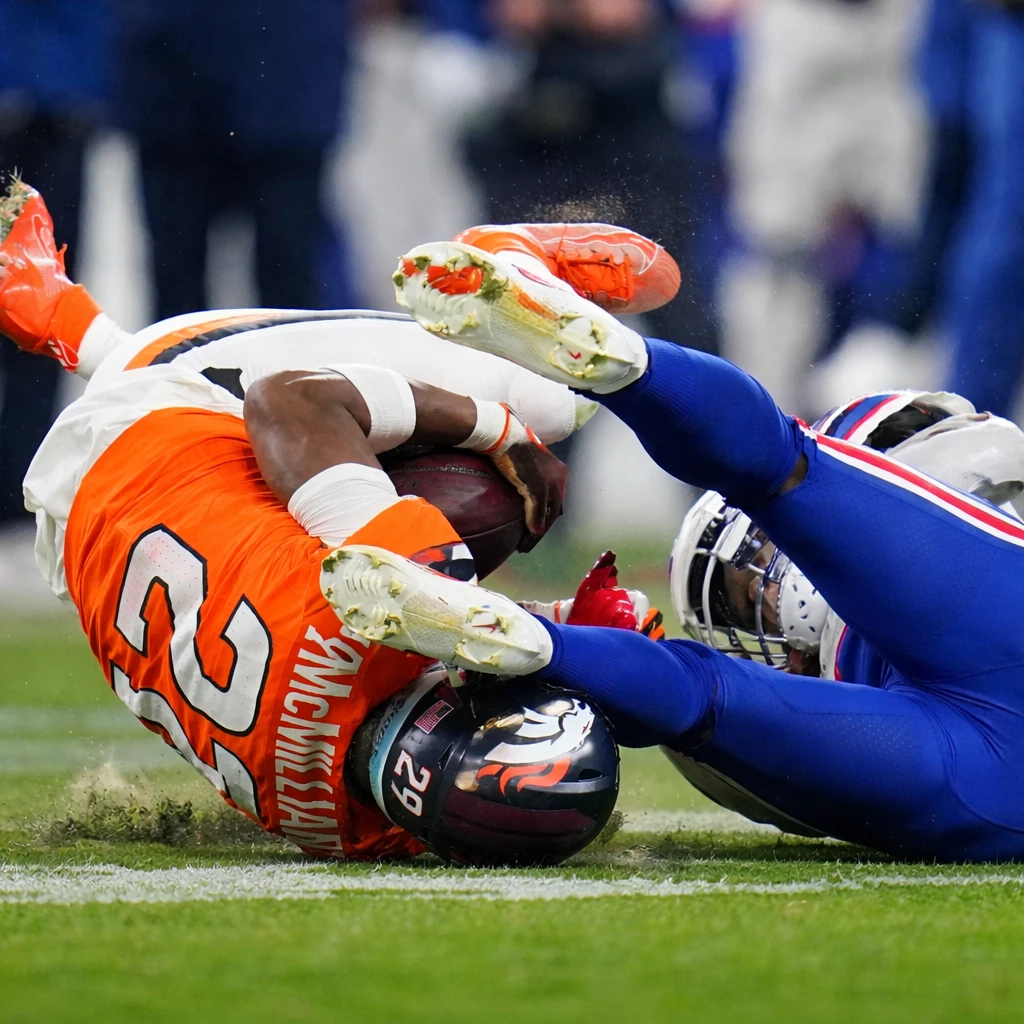

In the opening moments of overtime during the playoff matchup between the Buffalo Bills and Denver Broncos, a critical call ignited widespread debate concerning the meaning of a catch in NFL games. The contested interception occurred when Broncos defensive back Ja’Quan McMillian wrestled the ball away from Bills wide receiver Brandin Cooks while Cooks was attempting to secure a deep pass from quarterback Josh Allen.
Officials determined that McMillian had established possession of the football prior to Cooks being down by contact, awarding the interception to Denver at their own 20-yard line. Referee Carl Cheffers explained the ruling, stating, “Cooks was going to the ground as part of the process of the catch and he lost possession of the ball when he hit the ground. The defender gained possession of it at that point. The defender is the one that completed the process of the catch, so the defender was awarded the ball.”
Bills head coach Sean McDermott was unable to challenge the call due to the limitations of the NFL’s overtime rules. Instead, he called a timeout to allow the officiating crew and replay officials additional time to review the play, despite the fact that the NFL’s expedited review process in New York had already confirmed the original call. McDermott viewed the timeout as an opportunity to seek clarity on a pivotal moment in the contest.
Following the timeout, McDermott expressed frustration with the swiftness of the decision-making process, emphasizing that regular-season games sometimes receive more comprehensive review on routine plays. He remarked, “When I called the timeout, Carl came over and those guys were great. They were great, and I said, ‘Hey, what did you see?’ and then quickly, somebody said: ‘Hey, New York has confirmed. New York has confirmed.’ From that point, it was a moot point. We were moving on. Had I not called a timeout, they were just moving on, it appeared. This is not about, ‘Hey, we lost.’ It’s not about that at all. You play the game, you play it fair and square. I just, again, wish just for the sake of the players and all the time and energy that was spent—three hours, 70-plus minutes of a game. That was a pivotal play, that’s all I’m saying.”
The call followed the letter of the defined catch rule, yet many observers publicly questioned the interpretation. Retired three-time All-Pro cornerback Richard Sherman posted on social media expressing disbelief, stating, “I have never seen a contested catch like this ever be called anything but a catch. Even as a DB you know that if it’s even a tie it will go to the WR. Can’t believe this decided the game.” Similarly, ESPN analyst Dan Orlovsky called the ruling baffling, noting, “This in an NFL playoff game got ruled an interception and ended Buffalo’s season?!? This is a catch every time.”
The ambiguity surrounding catch calls is not new, with similar plays producing varied rulings in recent contests. In the Rams-Bears game earlier in the postseason, wide receiver Davante Adams retained possession long enough to have his knee down before losing the ball, resulting in a catch ruled by officials and upheld on replay, which facilitated Los Angeles’ eventual touchdown drive. Conversely, a Week 14 game between the Baltimore Ravens and Pittsburgh Steelers featured a batted ball initially awarded as an interception, but it was overturned because quarterback Aaron Rodgers maintained control of the pass through his fall to the ground.
Another example occurred in Week 12 when Rams defensive back Cobie Durant stripped the ball from Buccaneers tight end Cade Otton during a tackle; despite Otton’s apparent knee down, the play stood as an interception and touchdown for Los Angeles. These instances demonstrate the ongoing complexity and occasional inconsistency in applying catch rules during dynamic plays.
The NFL’s catch rule has evolved, particularly after high-profile moments like Dez Bryant’s controversial non-catch in the 2015 playoffs, which prompted the league to revise the criteria and eliminate the previously included “survive the ground” stipulation in 2018. The official rule states that a catch occurs when a player:
- Secures control of the ball in his hands or arms before it touches the ground;
- Touches the ground inbounds with both feet or any part of his body other than his hands;
- After satisfying the previous elements, either clearly performs any act common to the game (such as advancing the ball, taking additional steps, tucking the ball away, or avoiding an opponent), or maintains control long enough to do so.
Additionally, the rule clarifies that movement of the ball does not necessarily mean loss of control and outlines scenarios where a player loses control upon contact with the ground without satisfying the catch process. The rule also addresses simultaneous catches, specifying that possession belongs to the offense if both players gain control simultaneously.
Despite these comprehensive guidelines, determining a catch remains challenging in live-game conditions and sometimes even upon detailed replay review. The recent Broncos-Bills playoff incident has again underscored the interpretive difficulties and the high stakes associated with such vital decisions in football’s most critical games.