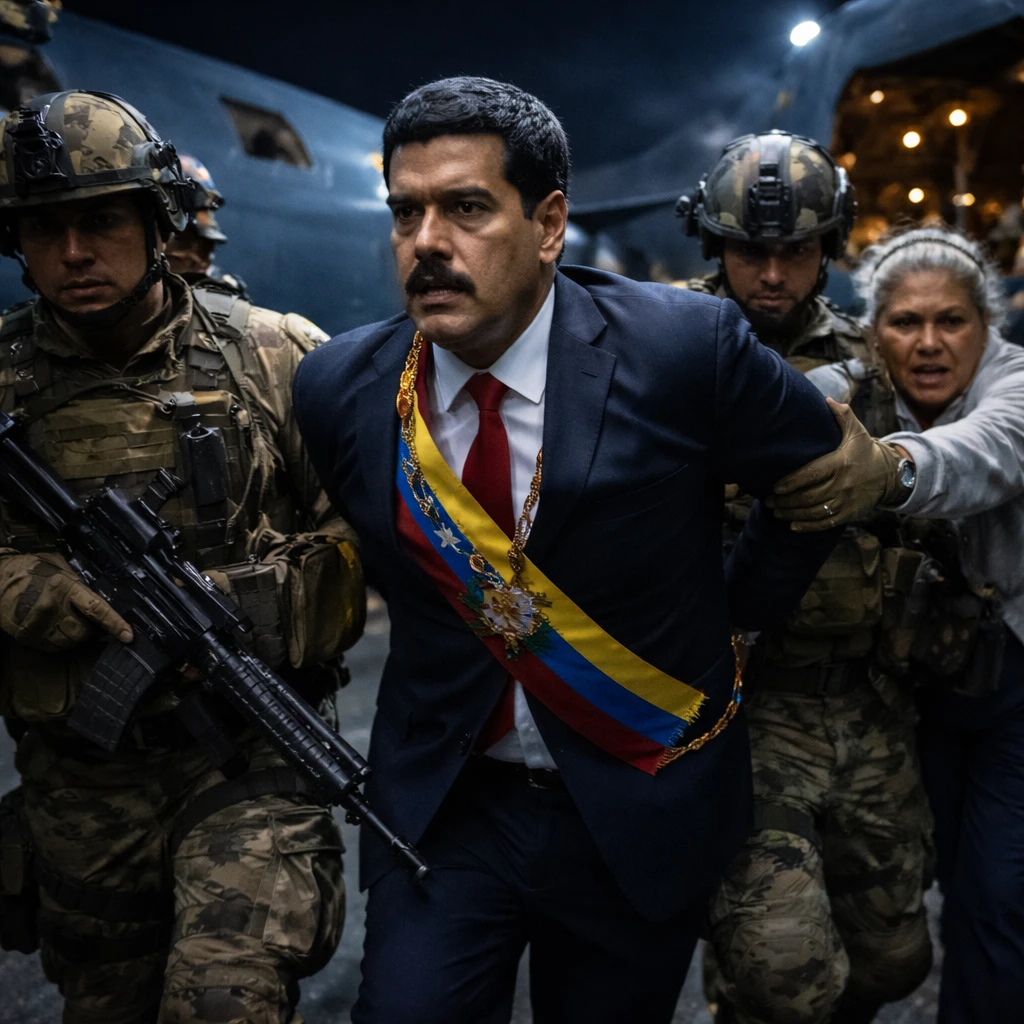

In a dramatic development from Caracas, Venezuelan leader Nicolás Maduro, removed from power, was taken into custody by U.S. forces during an audacious early morning military operation. He arrived in the United States on Saturday afternoon to confront serious criminal allegations, including involvement in a narcotics terrorism conspiracy alongside his wife, Cilia Flores.
The extraction took place in the Venezuelan capital where Maduro and Flores were seized from their residence within a military compound. The Maduro government condemned the incursion as an "imperialist" violation. This operation culminates months of covert planning by the Trump administration aiming to install regime change, representing the most direct U.S. intervention in Venezuela since the 2003 Iraq invasion.
Questions about the operation’s legality have arisen, as it was executed without congressional authorization. Venezuelan Vice President Delcy Rodriguez, designated as interim president by the country’s Supreme Court, called for Maduro’s release and reaffirmed his legitimacy as the nation's leader.
Rodriguez alleged casualties among Venezuelan civilians and military personnel, though she did not specify numbers. President Donald Trump disclosed that some American troops sustained injuries but denied any fatalities. Following the capture, Trump outlined plans to control Venezuela’s oil infrastructure and distribute its resources globally.
Upon landing in a modest New York-area airport, Maduro was transported by helicopter to Manhattan. There, a law enforcement convoy, featuring an armored vehicle, conveyed him to a Drug Enforcement Administration (DEA) office. Footage from a White House-managed social media account showed Maduro smiling as two DEA agents escorted him.
Trump publicly declared that the United States would govern Venezuela until a stable transition could be arranged, dismissing opposition leader María Corina Machado as lacking adequate support and respect. The administration framed the ousting as a strategy to curb narcotics trafficking into the U.S., while securing political influence and energy resources in Venezuela.
Despite Trump's assurances of American leadership inside Venezuela, state-controlled television continued to broadcast pro-Maduro messages, and supporters held protests on Caracas streets. Trump emphasized the success of the operation as a deterrent to threats against American sovereignty.
Maduro and other Venezuelan officials were indicted in 2020 for narcotics-related conspiracies, with a fresh indictment describing the regime as corrupt and sustained by drug trafficking responsible for inundating the U.S. with cocaine. The U.S. government does not acknowledge Maduro as Venezuela’s legitimate president.
The Trump administration intensified military presence in the region and targeted suspected drug shipments across Caribbean and Pacific waters. A recent CIA-conducted drone strike on Venezuelan soil marks a notable escalation in these covert actions.
The covert operation, occurring indepth around the 36th anniversary of the 1990 U.S. invasion of Panama, involved extensive preparations. Military forces disabled most of Caracas’ city lights to conceal their approach. General Dan Caine, Joint Chiefs of Staff chairman, detailed months of rehearsals focusing on precise intelligence, including Maduro’s routines and personal details to ensure operational success without error.
Smoke from multiple explosions and overhead aircraft activity unsettled Caracas residents, with Maduro’s administration accusing the U.S. of targeting both civilian and military sites, framing the events as an imperialist assault that provoked widespread civil unrest.
As U.S. authorities lifted airspace restrictions around Venezuela and the Caribbean early Sunday, U.S. Transportation Secretary Sean Duffy indicated a reduction in further immediate military operations. Domestically, Venezuela's political process designated Vice President Rodriguez as interim president, though she publicly affirmed Maduro as the sole legitimate president.
Despite these upheavals, Caracas exhibited an unusually subdued atmosphere, with limited vehicle traffic, closed businesses, and sparse public activity. Security forces and civilians guarded key sites, and some public spaces remained shuttered. Local residents described pervasive anxiety and uncertainty about the future.
The operation's legality under international law remains contested. Analysts like Ilan Katz highlighted potential breaches of international statutes by the U.S. Pope Leo XIV addressed the crisis, urging peace and respect for Venezuelan sovereignty. Meanwhile, the U.N. Security Council scheduled an emergency session to discuss the U.S. actions at Colombia's request.
Within the U.S., bipartisan concerns have emerged regarding the administration’s unilateral military engagement. Congressional leaders demand clarifications on legal justifications and strategic intentions to maintain regional stability, emphasizing the absence of congressional approval for such forceful operations.
Venezuela’s government, dominated by Maduro's party since 1999, has faced ongoing legitimacy questions following disputed elections and suppressions of opposition participation. Maduro’s reelection in 2018 and the 2024 vote were widely criticized as lacking transparency and fairness, intensifying political divisions.
The evolving situation in Venezuela poses significant uncertainties for regional security, economic stability, and the global oil market, as U.S. intentions alongside Venezuelan governmental responses continue to unfold.