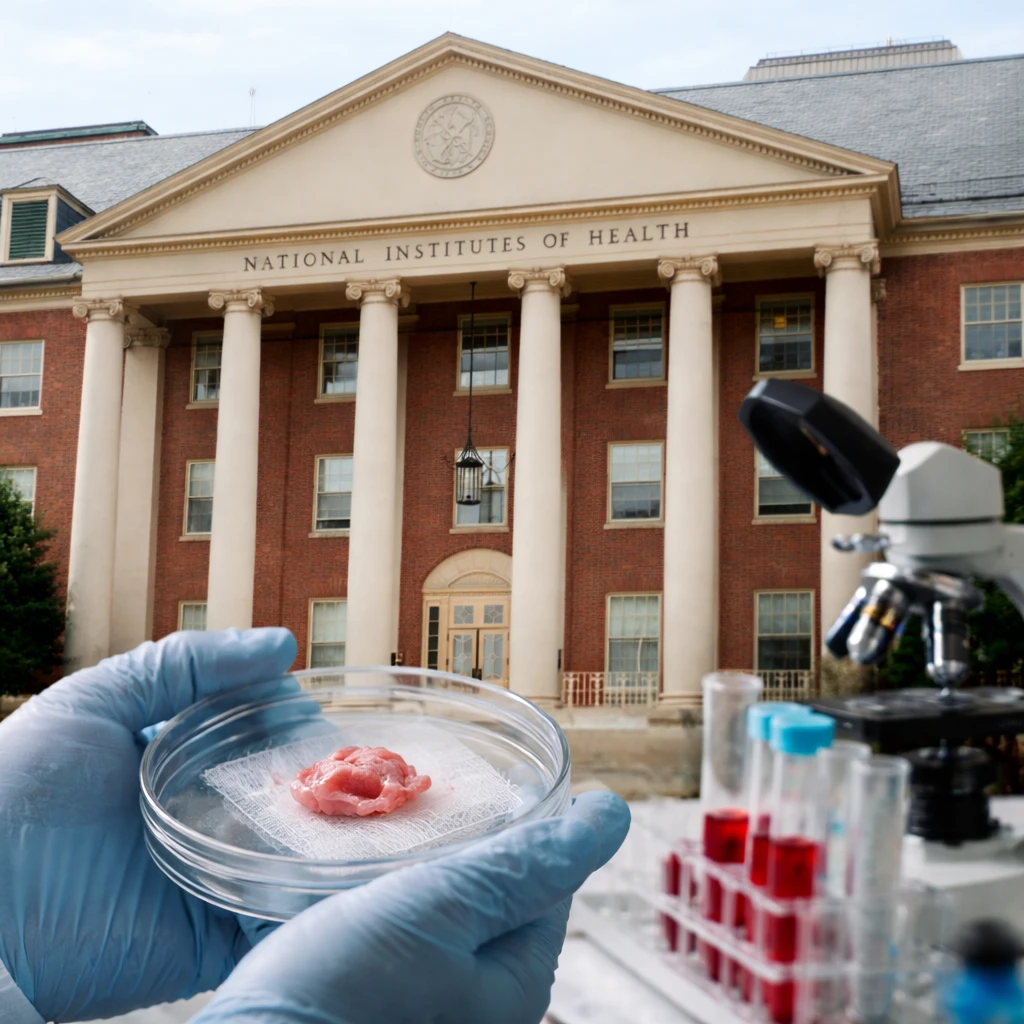
The National Institutes of Health (NIH) announced on Thursday a significant policy shift regarding the use of human fetal tissue in research projects it funds. Specifically, the NIH will no longer support studies that utilize fetal tissue obtained from abortion procedures. This development extends previous restrictions introduced under former President Donald Trump’s initial term, which had already limited the use of such tissue in research conducted on NIH premises and imposed additional procedural hurdles for outside scientists seeking NIH grants involving this material.
Historically, the U.S. government has sponsored research involving human fetal tissue for multiple decades, with support crossing both Republican and Democratic administrations. This tissue, which otherwise would have been discarded, has played a crucial role in scientific efforts to develop treatments and understand diseases such as HIV and cancer. Despite its scientific utility, critics contest the use of fetal tissue in research, arguing that modern alternatives have emerged. However, many researchers maintain that satisfactory substitutes are not consistently available across all applications.
NIH Director Jay Bhattacharya acknowledged the agency’s longstanding policies focused on the responsible and restricted employment of human fetal tissue in biomedical investigations. Data indicate that since 2019, the prevalence of such research projects has diminished notably; for example, in fiscal year 2024 only 77 NIH-funded projects reportedly involved fetal tissue, within the agency’s larger $47 billion budget.
The latest policy pronounces a blanket prohibition of fetal tissue use across all NIH-funded research endeavors, removing exceptions that were previously reinstated by the Biden administration after the Trump-era restrictions had initially taken effect. Importantly, this policy does not terminate the use of "cell lines" that were originally derived from fetal tissue years ago. These cell lines, such as embryonic stem cells, are cultured in laboratories as cloned populations of cells capable of continuous growth, allowing ongoing scientific study without requiring fresh fetal tissue samples.
Looking forward, NIH plans to engage public and scientific stakeholders to explore strategies that might reduce or ultimately replace reliance on human embryonic stem cells in federally funded research. This indicates an interest in advancing scientific approaches that align with regulatory and ethical frameworks while sustaining biomedical progress.
The ramifications of this policy shift are particularly relevant to sectors involved in biomedical research and pharmaceuticals, especially those focused on immunology, oncology, and infectious diseases. The availability and development of alternative biological materials will be closely observed by researchers and industry participants adapting to these regulatory changes.
Though the NIH’s decision primarily reflects ethical and political considerations, it presents practical challenges in maintaining continuity and innovation in research areas previously dependent on fetal tissue. The evolving policy landscape requires careful navigation to balance scientific advancement with societal and regulatory expectations.
January 22, 2026
News & Politics
NIH Halts Use of Abortion-Derived Fetal Tissue in Federally Funded Research
Policy Change Extends Previous Restrictions, Impacting Biomedical Research Fields Including HIV and Cancer Studies

Derek Hwang
Materials & Mining Analyst
Summary
The National Institutes of Health (NIH) has implemented a new policy that ends the use of human fetal tissue obtained from abortions in all federally funded research. This decision follows earlier restrictions instituted during the previous administration and applies to both government and non-government sponsored projects. The fetal tissue has historically been instrumental in advancing research in areas such as HIV and cancer, though the policy reflects ongoing debate about ethical considerations and the availability of alternative research materials.
Key Points
The NIH's updated policy halts the use of abortion-derived fetal tissue in all federally funded research, extending prior limitations.
Human fetal tissue has been essential in research for diseases like HIV and cancer, but its usage in NIH-funded projects has declined since 2019.
The new directive does not restrict use of existing cell lines derived from fetal tissue, maintaining some continuity for ongoing research efforts.
Risks
- Potential disruption in biomedical research fields reliant on fetal tissue, including HIV and cancer studies, may arise as alternatives are sought.
- The transition away from fetal tissue use could slow progress in certain scientific areas until substitute materials or methods are validated.
- Regulatory changes may introduce uncertainty for pharmaceutical and biotech sectors, affecting research pipelines and funding allocations.
Disclosure
This article is based entirely on information provided by the National Institutes of Health and public policy announcements. No external sources or speculative content have been incorporated.