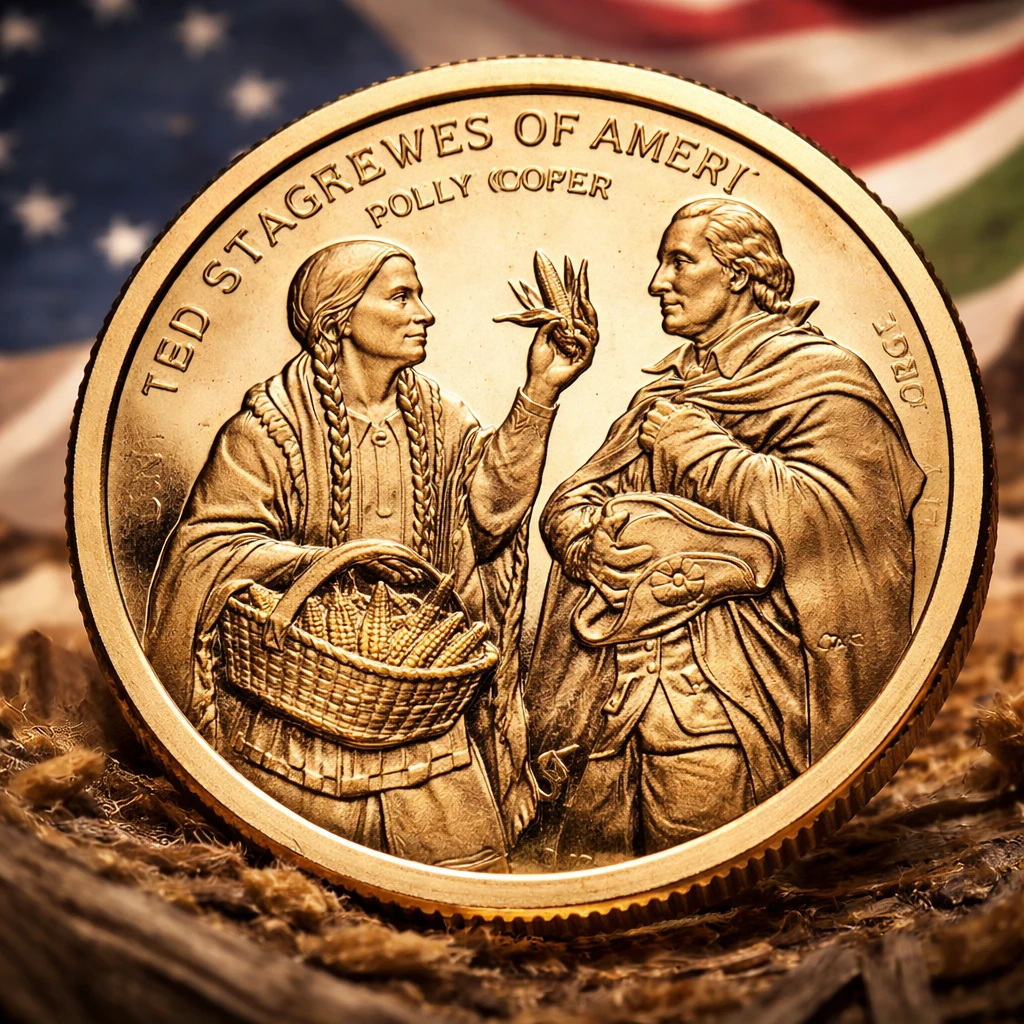

The upcoming 2026 Sacagawea $1 coin issued by the United States Mint will prominently display Polly Cooper, an esteemed figure from the Oneida Nation. Cooper is credited with providing essential help to George Washington’s Continental Army during a dire period in the Revolutionary War. This release, timed to coincide with the 250th anniversary of the Declaration of Independence, pays tribute to her critical role during a 1778 mission from Oneida lands in present-day central New York to the rebel army's winter quarters at Valley Forge, Pennsylvania, where the soldiers struggled with scarcity of food and supplies.
Ray Halbritter, a representative of the Oneida Indian Nation of New York, emphasized the broader significance of Cooper's actions: ‘‘Polly Cooper embodies courage that extends beyond the battlefield, demonstrating compassion and a readiness to support others — virtues deeply embedded in Oneida culture and their tradition of hospitality.’’
Accompanying Cooper on the arduous, frigid journey was a group of 47 Oneida warriors, who transported bushels of white corn to sustain the starving troops. According to Oneida oral histories, Cooper intervened to stop the hungry soldiers from eating the white corn raw, which risked making them ill. She instructed them in preparing hulled corn soup, a nourishing remedy under those harsh conditions.
The coin’s design showcases Cooper extending a basket of corn to Washington, a motif developed collaboratively between the Oneida community and the U.S. Mint. The obverse side retains the celebrated image of Sacagawea, the young Native American woman who served as a vital guide for the Lewis and Clark expedition.
This edition is part of the Native American $1 Coin Program, initiated by congressional legislation in 2007 to honor individual Native Americans and tribal nations. Previous issues have featured figures such as Osage ballerina Maria Tallchief, Jim Thorpe of the Sac and Fox Nation — an Olympic champion and multi-sport professional athlete — and significant historical events like the 1778 treaty with the Delaware Nation, the first among over 400 treaties negotiated between the United States and Native tribes, though not all were ratified.
Senator Markwayne Mullin, an Oklahoma Republican and citizen of the Cherokee Nation, remarked that the program brings to light those who laid the groundwork for a nation founded on the principles of liberty and self-governance.
Conversely, certain coin designs once authorized for the 250th anniversary were cancelled under the Trump administration, including proposed coins honoring suffragettes and civil rights figure Ruby Bridges. Attempts to obtain comments from the U.S. Treasury Department, which manages the Mint, were unsuccessful.
The Oneida Indian Nation of New York refers to itself as ‘‘America’s first ally.’’ Their alliance with the Continental Army, a break from the broader Haudenosaunee Confederacy, entailed significant sacrifice. As Halbritter explained, this alliance exposed the Oneida to retaliation from the British and other Haudenosaunee nations, resulting in the loss of nearly a third of the tribe's population by the war’s end.
Historian Colin Calloway of Dartmouth College, an expert on Indigenous history during the revolutionary era, noted that despite their alliance with the Americans, the Oneida did not escape the hardships experienced by tribes siding with the British. He described a strong impetus behind the revolution: the desire to displace Native peoples from their lands. In the decades following the conflict, the state of New York and private speculators confiscated millions of acres of Oneida territory, ultimately forcing many Oneida to relocate to reservations in Wisconsin and Ontario, Canada.
Calloway further cautioned that narratives like those surrounding Sacagawea and early colonial-Indigenous relations risk obscuring complex realities. Similarly, Cooper’s story might be co-opted to suggest a harmonious and mutual relationship between settlers and Indigenous peoples that was not historically accurate. Nevertheless, the coin acknowledges the Oneida’s essential contribution to America's fight for independence. Halbritter summarized, ‘‘The entire nation benefits from Polly Cooper’s actions because her courage helped secure the victory that led to the United States' founding.’’