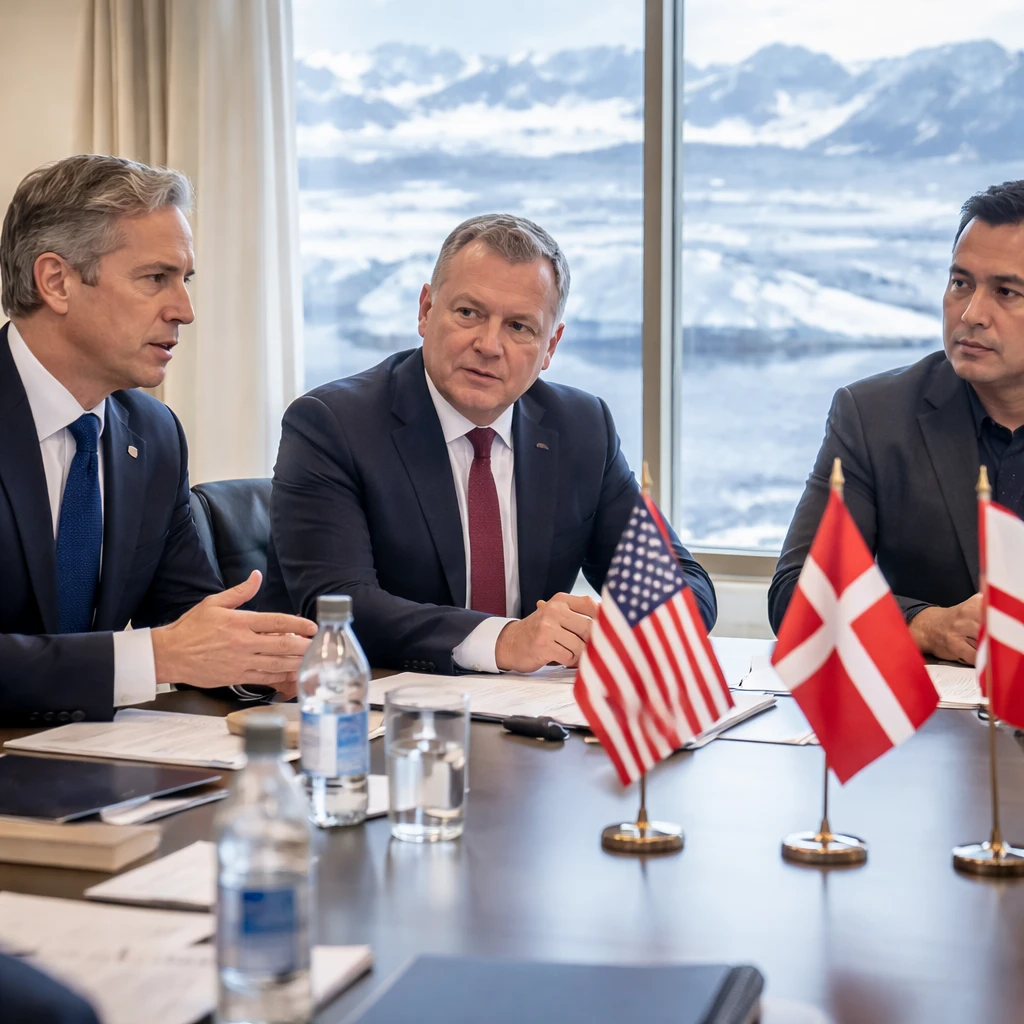
Washington has become the venue for the initiation of technical discussions among the United States, Denmark, and Greenland regarding Arctic security cooperation, according to statements made by Secretary of State Marco Rubio on Wednesday. The talks follow an earlier gathering in Washington where Denmark's and Greenland's foreign ministers, along with U.S. Vice President JD Vance and Secretary Rubio, agreed to establish a working group to tackle existing points of contention between these parties.
The impetus for such a collaborative mechanism came after President Donald Trump publicly advocated for the United States to acquire Greenland, a territory governed by Denmark with a degree of autonomy. These overtures were primarily justified by the need to counter perceived strategic threats posed by Russia and China. However, this proposal met decisive rebuttal from Greenland, Denmark, and their European counterparts.
Rubio characterized the newly formed working group as commencing immediately and described it as a regularized forum intended for constructive dialogue. He emphasized an approach designed to avoid media spectacle, which he believes facilitates more flexible and positive outcomes in negotiations.
The Danish Foreign Ministry elaborated that the discussions on Wednesday centered on identifying methods to address American security concerns in the Arctic while duly honoring the Kingdom of Denmark's sovereignty over Greenland—an issue highlighted as a non-negotiable boundary by Danish authorities.
These developments occur amid the backdrop of renewed U.S. interest in Greenland, which has recently stirred tensions in relations between the United States and its European allies. President Trump had earlier threatened to impose new tariffs on Denmark and several other European nations that objected to his Greenland acquisition plan, threatening to disrupt trade and diplomatic relations. These tariff threats were later retracted following the formation of a "framework" agreement regarding access to Greenland's mineral resources, facilitated in part through NATO's Secretary-General Mark Rutte. Details of this framework remain limited.
Additionally, the President signaled at the World Economic Forum in Davos that any prospect of using military force to secure Greenland has been withdrawn, responding to European pushback against his earlier rhetoric.
The softening of language and rescission of tariff threats came after significant market reactions, with Wall Street experiencing substantial losses over fears that Greenland-related tensions might trigger a trade war and weaken the NATO alliance, which has long been pivotal to transatlantic security post-World War II.
Secretary Rubio sought to temper concerns, expressing optimism that ongoing efforts will yield satisfactory results for all involved parties and predicted forthcoming affirmations from European counterparts supporting a positive resolution.
During a Senate Foreign Relations Committee session, Rubio also addressed an exchange with Senator Tim Kaine regarding President Trump's verbal slip in which Greenland was mistakenly referred to as Iceland during remarks in Davos. Rubio downplayed the mistake, likening it to typical presidential misstatements and implicitly referencing previous presidents who have committed similar or more significant verbal errors.