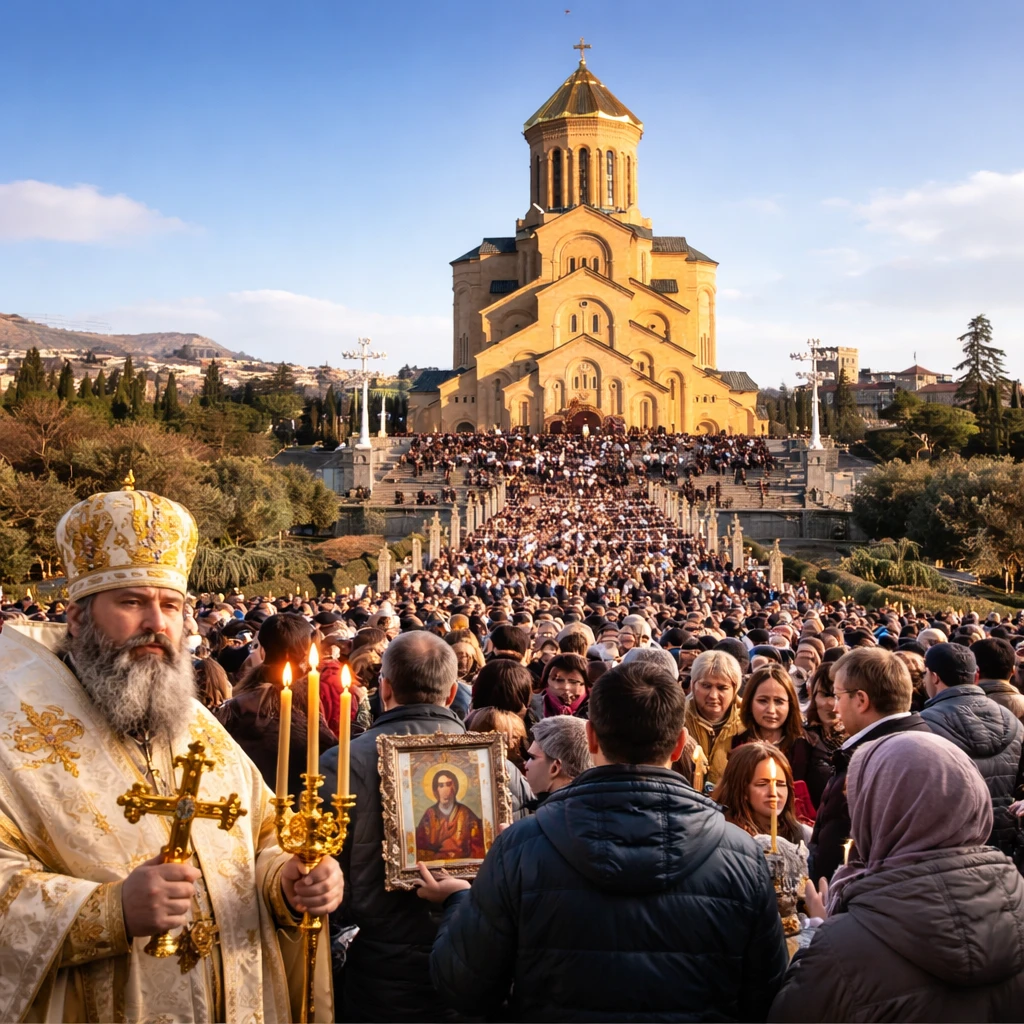
Orthodox Christian populations spanning numerous countries marked the Nativity on January 7 this year, diverging from the December 25 celebrations recognized by much of the global Christian community. This discrepancy stems from the adherence of many Eastern Orthodox churches, including the Russian Orthodox Church and other related communions, to the long-standing Julian calendar, which trails the Gregorian calendar — used by Catholic and Protestant denominations — by thirteen days. Additionally, the Ethiopian Orthodox Church and certain Oriental Orthodox communities, distinct but sharing many practices with Eastern Orthodoxy, also maintained the January 7 commemoration.
Contrastingly, Eastern Orthodox groups aligned with the Greek tradition employ the revised Julian calendar, which effectively corresponds with the Gregorian calendar, leading them to observe Christmas simultaneously with Western churches on December 25.
Central to this difference is the conceptualization of December 25 as the date of Christmas or the Feast of the Nativity. While consensus exists on December 25 as the designated day, the calendars used differ — prompting the same date to fall on January 7 in churches that follow the Julian calendar.
Historically, the early Christian church within the Roman Empire established its liturgical calendar based on the Julian system. However, as centuries passed, misalignment with the solar year emerged, prompting Pope Gregory XIII in the sixteenth century to institute a calendar reform. The Gregorian calendar remedied the drift by discontinuing days and refining leap year calculations, eventually adopted by Catholic, Protestant, and secular institutions worldwide. Eastern Orthodox churches, however, largely retained the Julian calendar through the early 20th century.
In 1923, an inter-Orthodox conference adopted a revised Julian calendar that closely mimics the Gregorian calendar. Subsequently, many Orthodox churches within the Greek, Romanian, Bulgarian, and other contiguous traditions transitioned to this calendar, updating their Christmas observance to December 25.
Conversely, major Orthodox bodies such as the Russian Orthodox Church, the largest Eastern Orthodox communion, continued observing Christmas on January 7 according to the original Julian calendar. Other churches, including Serbian and Georgian Orthodox communities, maintain the same practice. Within Ukraine, practices vary; some congregations have adopted December 25 celebrations, while others persist with the January 7 schedule. Another distinct practice occurs in the Armenian Orthodox Church, which observes Christmas on January 6.
In North America, Orthodox Christian Christmas observances differ among jurisdictions. Greek and Antiochian Orthodox parishes celebrate the holiday on December 25. Meanwhile, certain Slavic Orthodox groups, including Serbian and certain smaller Russian churches, hold celebrations on January 7.
Orthodox Christmas festivities commonly revolve around worship and ceremonial rites. Traditions vary by community, but often a principal worship service is held on the preceding evening. For example, Serbian Orthodox services may begin with an outdoor ritual involving the burning of an oak branch or sapling, accompanied by a vocal proclamation of Christ's nativity.
The variations in calendar adherence and liturgical tradition underscore the diversity within global Orthodox Christianity and signify the cultural and religious distinctions influencing the timing of Christmas celebrations. These differing observances impact not only religious schedules but may also affect social and economic activities connected to the holiday period within various communities.
January 7, 2026
News & Politics
Orthodox Christians Globally Observe Christmas on Separate Dates Due to Calendar Differences
Divergent liturgical calendars lead millions to commemorate the Nativity nearly two weeks apart

Avery Klein
Senior Equity Analyst
Summary
Millions across various Orthodox Christian communities worldwide celebrated Christmas on January 7, following the Julian calendar, approximately thirteen days behind the December 25 observance used widely in Western Christianity. This distinction arises from the ongoing use of different calendars by Eastern Orthodox churches, while some have adopted revised systems aligning with the Gregorian calendar. Varied traditions within Orthodox Christianity result in diverse celebrations of the Nativity, affecting observances from North America to Eastern Europe and Africa.
Key Points
Orthodox Christian communities worldwide celebrate Christmas on different dates due to the use of distinct liturgical calendars, primarily the Julian and Gregorian calendars.
Major Orthodox churches such as the Russian and Serbian Orthodox maintain January 7 as Christmas Day, while others in the Greek tradition observe December 25, reflecting a split in calendar adoption.
In North America, Orthodox Christmas observance varies based on ethnic and jurisdictional lines, affecting religious and cultural practices within diverse congregations.
Risks
- Calendar-based differences in Christmas observance can lead to confusion or scheduling conflicts in multicultural or interfaith contexts, impacting community events and potentially economic activities such as retail sales tied to holidays.
- Divergent celebration dates may affect religious tourism and associated sectors unevenly, depending on which calendar a community follows.
- Variation in observance dates could complicate coordination for organizations, businesses, or governments operating across regions with different dominant liturgical calendars.
Disclosure
This analysis is based solely on publicly available information regarding liturgical calendar practices of Orthodox Christian communities and does not incorporate external data or speculative viewpoints. The content aims to provide an accurate depiction of the differences in Christmas observance dates among Orthodox churches.