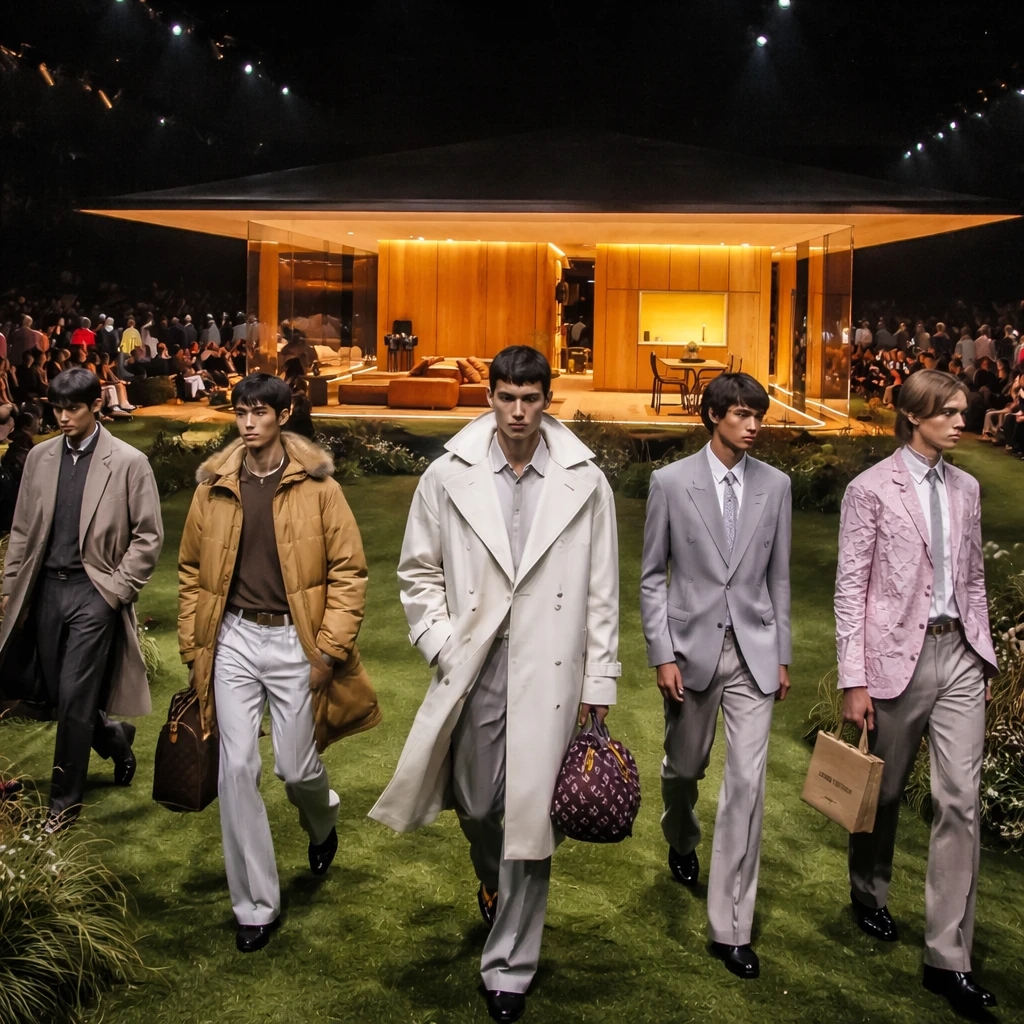

Paris Men's Fashion Week has positioned coat-centric designs as a dominant expression of authority this season, with collections across the board showcasing outerwear that makes a statement, expanding shoulder dimensions, and featuring sharply tailored pieces. These elements transform typically familiar garments such as trench coats, suits, denim, and workwear into apparel carrying a more resolute and structured presence.
As the fashion week progresses toward its conclusion, a prevailing theme emerges: an emphasis on menswear that prioritizes protection, functional performance, and real-life usability, yet retains the distinctive theatricality associated with Parisian fashion. This thematic direction was particularly pronounced in presentations by Dior Men and Louis Vuitton. At Dior Men, designer Jonathan Anderson reinterpreted classic sartorial norms with innovative proportions, while Louis Vuitton, led creatively by Pharrell Williams, presented a vision of luxury intertwined with practical convenience. The brand’s designs incorporated technological enhancements such as weatherproofing, reflective materials, reversibility, and engineered comfort, advancing heritage styles into contemporary functional garments.
Parallel conceptual approaches were evident through other designers including Ami Paris, Rick Owens, Yohji Yamamoto, and IM Men at Issey Miyake, who collectively focused on reconstructing shoulder structure, redefining body shapes, and embracing the concept of the uniform — viewed less as costume and more as modern-day equipment.
Influence of Celebrity Attendance
Celebrity engagement played a pivotal role in heightening the profile and influence of Paris men’s fashion offerings. Dior’s presentations attracted notable figures such as Robert Pattinson, Lewis Hamilton, and SZA, while Louis Vuitton's runway included a front row amalgamating personalities from music, film, and digital platforms including SZA, Usher, Future, and Jackson Wang. The show was further energized by a runway appearance from BamBam from the group GOT7. Such illustrious attendees amplify the visibility and cultural resonance of the collections, with the fashion themselves being central yet increasingly magnified by the visibility of those observing and disseminating content on global social media stages.
Season’s Focus on Enhancing the Classic Silhouettes
Rather than pursuing novelty for its own purpose, the designers demonstrated an interest in evolving established silhouettes by integrating enhanced performance capabilities. For instance, Louis Vuitton's collection featured recognizable staples such as double-breasted suits, blousons, and polished outerwear enriched by innovative textile technologies. Reflective details for enhanced safety during nighttime visibility and water-repellent hybrid jackets featured prominently, alongside lightweight waterproof fabrics sometimes adorned with crystal-like accents simulating the effect of raindrops.
Accessories were designed with functional adaptability in mind: hats engineered for easy shape restoration post-compression, and footwear that combined the flexibility of sneakers with the aesthetic of classic shoe forms, emphasizing not just appearance but also utility. This direction underlines a paradigm that defines luxury beyond aesthetics, emphasizing practical capability and adaptability.
Elevated Silhouettes: Broad Shoulders and Heightened Volume
The silhouette across multiple brands concentrated attention on the upper body, especially the shoulders, which emerged as the focal point blending structural innovation, protective attributes, and a display of assertiveness. Jonathan Anderson at Dior Men utilized forms reminiscent of mid-20th century attire, including nods to the 1940s and early 1960s, while simultaneously modifying proportions by shortening jackets or designing them to expose areas such as the hipbone. He further pushed boundaries by extending a round-neck sweater to ankle length, thus recontextualizing familiar garments through altered scale and novel fabric pairings.
Similarly, IM Men emphasized shoulder structure by incorporating design elements such as storm flaps merged into trench coats, amplifying volume. Yohji Yamamoto enhanced arm and leg padding to create a homogenized silhouette across diverse body types while controlling bulk via buttons and adjustable features. Despite stylistic differences ranging from sharp to romantic to unconventional, these designers aligned in their pursuit of reshaping the male form for this season.
A Mood of Protection: Uniformity and Modern Defensive Apparel
Another underlying current in the collections was the theme of protection, reflective of a world perceived as increasingly challenging and public-facing. Rick Owens conceptualized inspirations from law enforcement uniforms, channeling the complex interplay of authority and resistance through his garments. His runway conveyed tight underlayers augmented with cropped jackets, tactical hybrid pieces, leather, materials akin to Kevlar, and insignia-esque details, all without lapsing into overt costume.
Owens questioned “sheriffs or outlaws?” capturing the season’s tension between dominance and defiance. Yohji Yamamoto, drawing from military and workwear while advocating softer protection, employed layered garments meant to endure extensive outdoor conditions. IM Men advanced akin philosophies through draped, layered outfits suggesting protective clothing not for conflict but as nomadic shelter.
Commitment to Wearability and Everyday Refinement
Despite extensive experimentation, the collections retained a focus on practicality and everyday wear. Ami Paris, for instance, marked its anniversary celebrating classic Parisian style characterized by camel coats, stripes, denim, and clear tailoring, enhanced through refined proportions and contemporary styling. These designs promoted versatile mixing with subtle modifications, such as elongated coats constructed to align better over shoulders coupled with streamlined silhouettes.
Dries Van Noten accentuated this refinement through vibrant color use and meticulous craftsmanship. Julian Klausner structured his show around the theme of “coming of age,” illustrating men transitioning from youth with inherited coats to adopting knitwear as a signature style marker. His approach included structured-shoulder cardigans and patterned collars on slim coats and cloaks, reintegrating kilts and skirt-like elements. His saturated, pattern-rich coats, featuring motifs like Polaroid floral prints and patchworked panels, exemplify how layering, proportion, and finishing can reinvigorate a wardrobe within the Paris fashion milieu.
Role of Styling as a Communicative Device
The impact of styling was pronounced, serving as a primary means of conveying thematic intent alongside garment construction. At Dior, Anderson’s challenge to normality emerged through provocative elements like wild wigs and ruff collars that transformed traditionally formal attire into sharply edged presentations imbued with a hint of danger. Contrastingly, Louis Vuitton favored restrained styling, relying on innovative materials and construction to articulate the message of classic yet movement-friendly and weather-adaptive menswear.
Upcoming Showcase Influence
The collections by Dior and Louis Vuitton established the fundamental tone for the fashion week, which other designers echoed each in their own registers: Ami demonstrated wearability balanced with precision tailoring, Owens emphasized confrontational control, Yohji portrayed layered protection, and IM Men highlighted sculpted outerwear. As the fashion week approaches its conclusion on Sunday, forthcoming shows will be critical in determining whether this functional and shape-oriented shift in menswear will deepen further or remain a defining moment emphasizing the practical potential of luxury fashion.