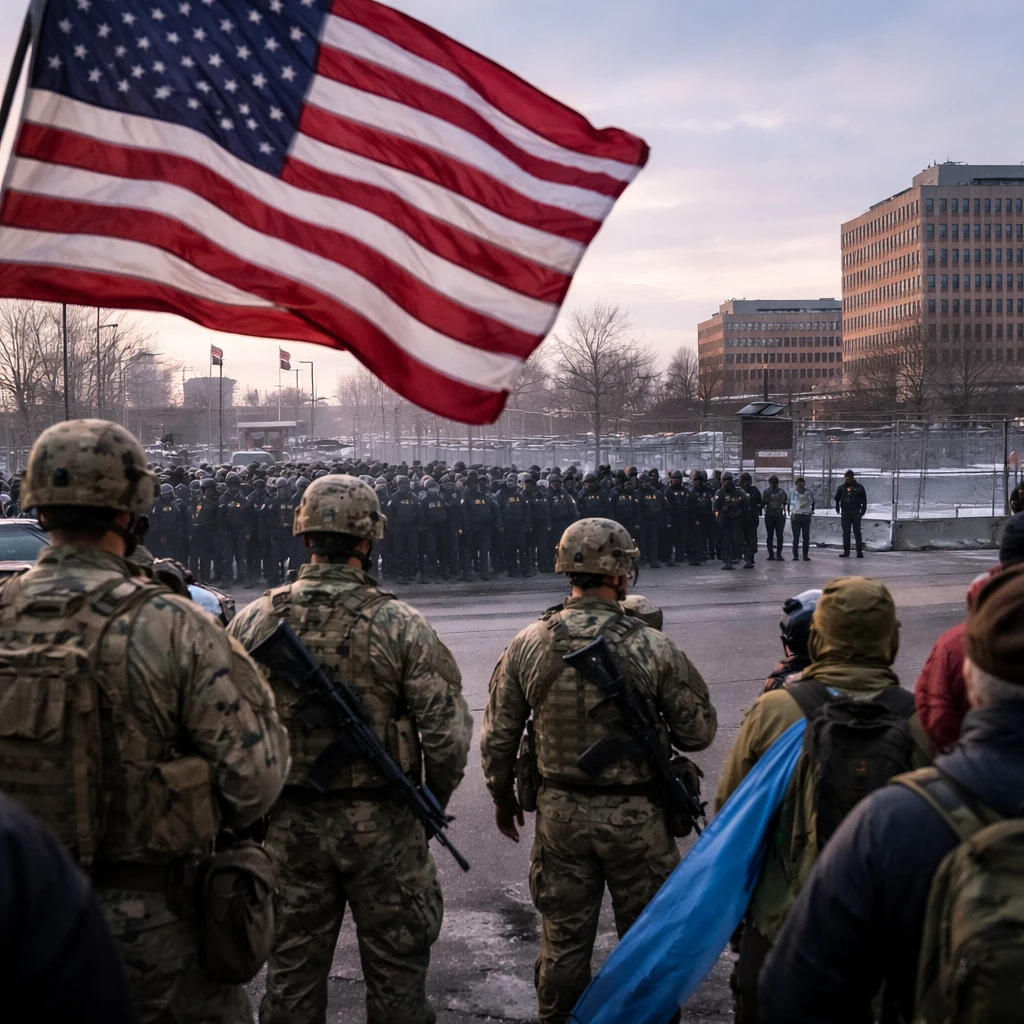

Pentagon Positions 1,500 Soldiers for Potential Deployment in Minnesota Amid Immigration Enforcement
January 18, 2026
News & Politics

Pentagon Positions 1,500 Soldiers for Potential Deployment in Minnesota Amid Immigration Enforcement

Two infantry battalions from Alaska-based 11th Airborne Division placed on alert if Insurrection Act is invoked

Summary

Approximately 1,500 active-duty Army personnel have been directed to remain on standby for possible assignment to Minnesota, where an extensive immigration enforcement effort is underway. This precaution follows recent presidential remarks about employing federal troops to restore order, with the Insurrection Act as a potential legal mechanism. State officials have cautioned against military deployment, urging de-escalation.

Key Points

The Pentagon has placed around 1,500 active-duty soldiers from the 11th Airborne Division on standby for potential deployment to Minnesota amid federal immigration enforcement operations.
These troops specialize in arctic conditions and await orders contingent on President Trump invoking the Insurrection Act, which authorizes active military participation in law enforcement.
Governor Tim Walz has publicly requested that the President refrain from dispatching additional troops, emphasizing the need to de-escalate tensions in the state.

The Department of Defense has directed around 1,500 active-duty soldiers to be prepared for potential deployment to Minnesota in response to ongoing federal immigration enforcement operations, according to two senior defense officials who spoke on condition of anonymity due to the sensitivity of the matter.

The troops assigned to be on alert are from two infantry battalions of the U.S. Army's 11th Airborne Division, a unit based in Alaska with specialized training focused on arctic warfare and environments.

One official explained that these soldiers have been instructed to maintain readiness to deploy if the President activates the 1807 Insurrection Act, a statute that permits the use of active duty military personnel in law enforcement roles under certain circumstances. This provision has historically been seldom used, making it a significant step.

The announcement arrives shortly after President Donald Trump publicly indicated his intention to invoke this law to manage protests related to his administration’s aggressive stance on immigration enforcement. On social media, the President warned that he could activate the Insurrection Act “if the corrupt politicians of Minnesota don’t obey the law and stop the professional agitators and insurrectionists from attacking the Patriots of I.C.E., who are only trying to do their job.”

Subsequently, the President appeared to temper the threat, stating at a White House press briefing that there was no current need to employ the act but affirmed its potency, saying, “If I needed it, I’d use it. It’s very powerful.”

According to Pentagon spokesman Sean Parnell, while he did not explicitly confirm the deployment orders, he emphasized that the military remains prepared to execute any directives from the Commander-in-Chief as required.

During his two terms, the President has repeatedly threatened to apply the Insurrection Act, including consideration for deploying forces during the 2020 demonstrations following George Floyd’s death in Minneapolis and for more recent immigration-related protests.

This law was last utilized by President George H.W. Bush in 1992 to quell disturbances in Los Angeles after the acquittal of officers accused of assaulting Rodney King.

Minnesota Governor Tim Walz, a Democrat and vocal critic of the President, has called on federal authorities to avoid escalating the situation by deploying troops, appealing for a reduction in tensions. He urged the President through social media to “turn the temperature down” and desist from what he described as a “campaign of retribution,” stating this approach does not reflect the state’s values.

Risks
  • The possible use of active military forces in civilian law enforcement under the Insurrection Act may heighten political and social tensions in Minnesota, impacting public safety sectors and local governance.
  • Ongoing federal immigration enforcement efforts combined with military readiness could contribute to volatility in community relations, potentially influencing sectors related to public administration and civil rights enforcement.
  • Uncertainty surrounding the invocation of the Insurrection Act creates an unpredictable environment for markets sensitive to political risk and regulatory intervention.
Disclosure
This article presents verified information regarding military readiness and political statements without introducing unverified speculation or commentary.
Search Articles
Category
News & Politics

News & Politics

Related Articles
Partisan Divide Deepens as White House Excludes Democratic Governors from NGA Meeting

The longstanding bipartisan forum of the National Governors Association (NGA) is facing disruption a...

Commerce Secretary Lutnick Clarifies Epstein Island Lunch Amid Scrutiny Over Relationship

Commerce Secretary Howard Lutnick acknowledged having a family lunch with convicted sex offender Jef...

FDA Initiates Review of BHA Food Additive Safety

The U.S. Food and Drug Administration (FDA) has announced plans to conduct a comprehensive reassessm...

Using Fireplace Ashes in Your Garden: Benefits and Considerations

Amidst a notably cold winter leading to increased fireplace use, many homeowners are seeking sustain...