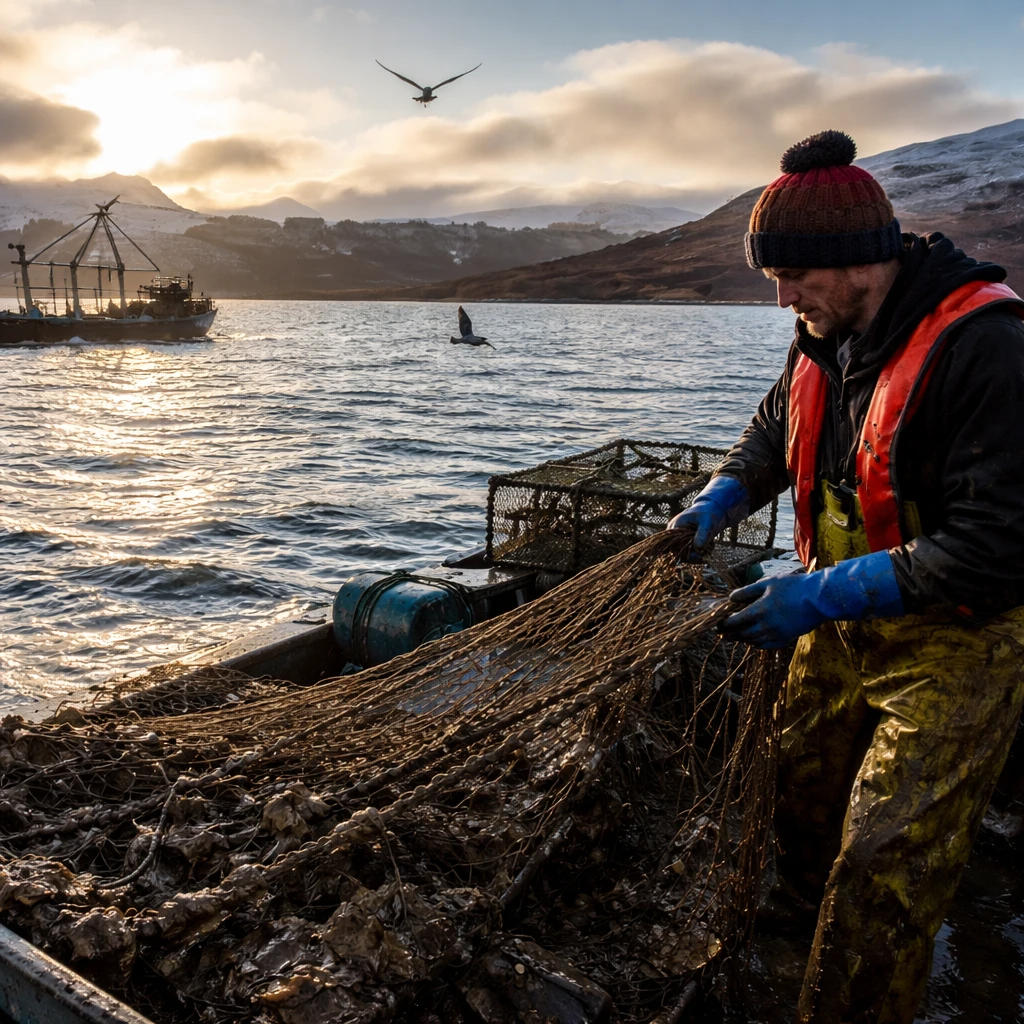

Bally Philp carefully inspects each baited creel trap as he hauls them from the waters near Scotland’s Isle of Skye. Unlike many Scottish coastal areas, this region benefits from some protections against industrial fishing methods that have ravaged seabed habitats elsewhere. Yet, Philp, with over 30 years in the fishing industry, has witnessed a pronounced decline in fish abundance across most inshore waters.
"Our West Coast inshore archipelagos once teemed with fish," Philp recalled. "Now, there are essentially no commercial quantities of fish left inshore."
Scotland has designated 37% of its marine environment as protected, but environmental organizations highlight that meaningful management and enforcement exist in only a fraction of these zones. Indeed, bottom trawling and scallop dredging—practices that scour the seafloor—are permitted in approximately 95% of Scotland’s coastal waters, inclusive of many protected areas, according to marine conservation advocates.
Bottom trawling involves towing heavy nets across the seabed, causing direct destruction of marine habitats. This method is particularly fuel-intensive, generating nearly threefold the carbon emissions compared to other fishing techniques, while disturbing sediment that stores carbon and releasing it back into the ocean. Additionally, trawlers often discard significant portions of their catch, with low survival rates for these discarded species.
This issue is not confined to Scotland alone. Across Europe and globally, bottom trawling continues unabated inside marine protected areas, often without regulation, as industrial vessels operate within waters ostensibly set aside for conservation. A 2024 analysis by the Marine Conservation Society and Oceana documented that over 90% of protected marine sites across seven European nations—including the Netherlands, Germany, Denmark, and Spain—experienced bottom trawling activities from 2015 to 2023. Collectively, vessels accounted for 4.4 million hours of bottom trawling within these safeguarded waters.
The extensive environmental degradation observed illustrates the consequences of lax regulation in fisheries. Historically, in 1984, Scotland rescinded a longstanding ban on bottom trawling that spanned three miles from much of its coastline. Subsequently, fish landings in areas like the Clyde drastically plummeted, with current catches representing only minute fractions of historical levels.
Philp's early career on trawlers in the late 1980s coincided with a shift in fishing practices. Fish species often became bycatch—unintended and unwanted catch—frequently discarded because strict quota systems made landing them illegal. He personally witnessed streams of dead fish thrown back into the sea, an experience he described as heartbreaking.
Turning away from bottom trawling, Philp has dedicated himself to fishing with baited traps, a method minimizing habitat impact and markedly improving survival rates of any bycatch returned to the sea. However, this approach confines him to a narrowing band of sustainable fishing grounds. Reefs around the UK have suffered immense damage, primarily due to scallop dredging, rendering areas like Loch Alsh—where Philp currently operates—critical as some of the last refuges of more intact marine habitats.
Belonging to a lineage of fishers, Philp expresses concern about the future of the industry. Having taught his sons how to fish, he discourages them from pursuing it professionally, noting the considerable decline from what was once a thriving tradition. "We're at the tail end of what was once a flourishing industry," he lamented. "Without significant change, it’s difficult to imagine future generations entering this line of work."
Alasdair Hughson, a scallop diver based in Dingwall, also faces the repercussions of degraded coastal waters. He spends the majority of his working week at sea, often traveling extensive distances from home because nearby areas can no longer support viable scallop populations. He reflected that the escalation in vessel size and mobility to access distant fishing grounds was a direct consequence of habitat transformations caused by intensive dredging.
The ecological and economic costs of bottom trawling extend beyond the immediate impact on fisheries. A 2023 analysis by the Marine Conservation Society indicated that banning bottom trawling in UK offshore protected zones could yield a net benefit reaching 3.5 billion pounds over two decades. This valuation encompasses enhancements in carbon sequestration, pollution remediation, nutrient cycling, and recreational opportunities.
Marine biologist Caitlin Turner elaborated on the repercussions of habitat damage, emphasizing cascading effects on marine ecosystems. Destruction of small juvenile fish habitats reduces survival and reproductive success, ultimately diminishing the abundance of larger predatory species, thereby disrupting ecological balance.
Turner further highlighted concerns for Scotland’s tourism sector, noting that many visitors to destinations such as the Isle of Skye encounter menus featuring seafood largely sourced from imports. In 2019, over 80% of seafood consumed in the UK was caught or farmed beyond UK waters, according to the World Wildlife Fund. This reliance underscores the challenges local fisheries face in meeting both resident and tourist demand.
Miles Craven, executive chef at Wickman Hotels on the Isle of Skye, observed the increasing difficulty in sourcing local seafood over the past eight years, reflecting on rising consumer demand against declining local supply.
The Scottish government had previously signaled plans to initiate consultations on fisheries management protocols within coastal protected areas in late 2025. However, in December, officials announced a postponement of at least six months, attributing delays to upcoming parliamentary elections and late delivery from external contractors.
Meanwhile, conservationists and local groups are actively pursuing restoration projects, including efforts to revive sea grass and oyster populations. Yet, experts maintain that such measures fall short without a reinstated coastal ban protecting a minimum of 30% of Scotland’s inshore seas, aligning with international biodiversity targets set for 2030.
A government spokesperson noted that currently 13% of inshore protected waters prohibit certain bottom trawling and dredging activities, with expectations that forthcoming regulations will enable Scotland to surpass the 30% protection threshold by 2030.
Philp voiced deep frustration over the slow pace of implementing effective fisheries management. "The more I learn about the complexities and potential solutions, the more despair I feel that we are not acting swiftly," he stated. For many small-scale fishers, this delay prolongs the ineffectiveness of marine protected areas designated years ago but lacking enforcement.
"I am confident we can turn things around," Philp concluded. "It is disheartening that solutions are not being executed promptly."