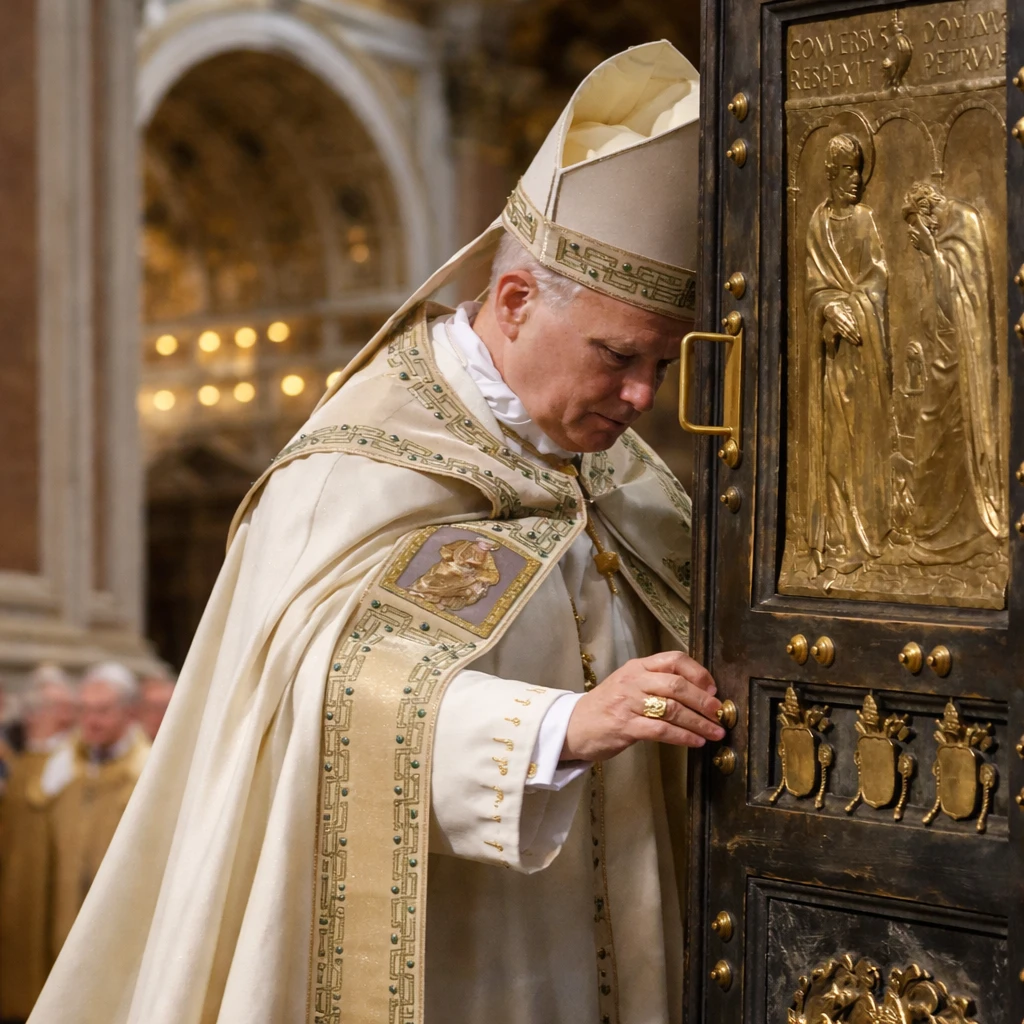

On Tuesday, Pope Leo XIV brought the Vatican's 2025 Holy Year to a close, delivering a pointed critique of contemporary consumerist culture and rising anti-foreigner attitudes. This event marked the conclusion of a Jubilee that had drawn approximately 33 million pilgrims to Rome, and featured an extraordinary transition in papal leadership from one American pontiff to another.
In a solemn ceremony at St. Peter's Basilica, witnessed by cardinals and numerous diplomats, the Pope knelt in prayer upon the stone floor at the entrance to the Holy Door. Rising thereafter, he closed the pair of doors, a gesture symbolizing the end of a Jubilee year unique in modern history. This Holy Year had been inaugurated by a frail Pope Francis in December 2024, persisted through his subsequent funeral and conclave, and was only now concluded by his successor. Such a handover during a Jubilee has occurred only once before, dating back to 1700.
Tuesday's closing ceremony coincided with Mass celebrating the Epiphany feast, capping a year filled with special audiences, liturgies, and meetings. These events dominated the early months of Leo's tenure as pope, temporarily sidelining his own proposed agenda.
Markedly, Pope Leo appears poised to embark on an active pontificate. He has invited cardinals worldwide to convene in the Vatican for a two-day meeting beginning Wednesday, with a focus on the governance of the Catholic Church, which counts roughly 1.4 billion adherents. Among the primary topics on the agenda is the liturgy, indicating Leo's engagement with ongoing debates surrounding the celebration of the traditional Latin Mass.
During his homily on the closing day, Pope Leo reflected on the Jubilee's spiritual call to embody Biblical teachings emphasizing hospitality to strangers and resistance to the allure of power. He warned against a "distorted economy" that commodifies all aspects of life, urging introspection among the faithful: "Has the Jubilee prompted us to reject efficiency that treats everything as a product and people merely as consumers?" The pontiff urged recognition of visitors as pilgrims, strangers as seekers, foreigners as neighbors, and all as companions on life's journey.
The 2025 Jubilee, an established tradition occurring every 25 years, invites Catholic faithful to undertake pilgrimages to Rome. By passing through the Holy Door of St. Peter's Basilica, pilgrims receive indulgences that pardon sins. This religious observance also presents an opportunity for Rome to utilize public funding to update and renovate infrastructure, with approximately 4 billion euros allocated for projects intended to restore and modernize the city.
The Vatican has reported a total attendance of 33,475,369 pilgrims during this Holy Year; however, organizers acknowledge this figure is an estimate potentially including overlap. No detailed separation between Jubilee pilgrims and general tourist counts during this period has been offered by the Vatican or Italian officials.
Historically, the practice of hosting Jubilees in Rome dates to 1300, when Pope Boniface VIII established the inaugural Holy Year, reinforcing Rome's role as Christianity's epicenter. Such events have often spurred significant public works, including notable projects like the Sistine Chapel commissioned in 1475 and extensive parking facilities developed for the Jubilee of 2000.
Some infrastructure endeavors have provoked controversy, such as the construction of Via della Conciliazione for the 1950 Jubilee, which involved demolishing an entire neighborhood. For 2025, the key urban project was a pedestrian piazza along the Tiber River connecting Via della Conciliazione with Castel St. Angelo, achieved by rerouting a major road through an underground tunnel.
Pope Leo has announced the subsequent Jubilee will occur in 2033, in commemoration of the year believed by Christians to mark the death and resurrection of Jesus Christ.