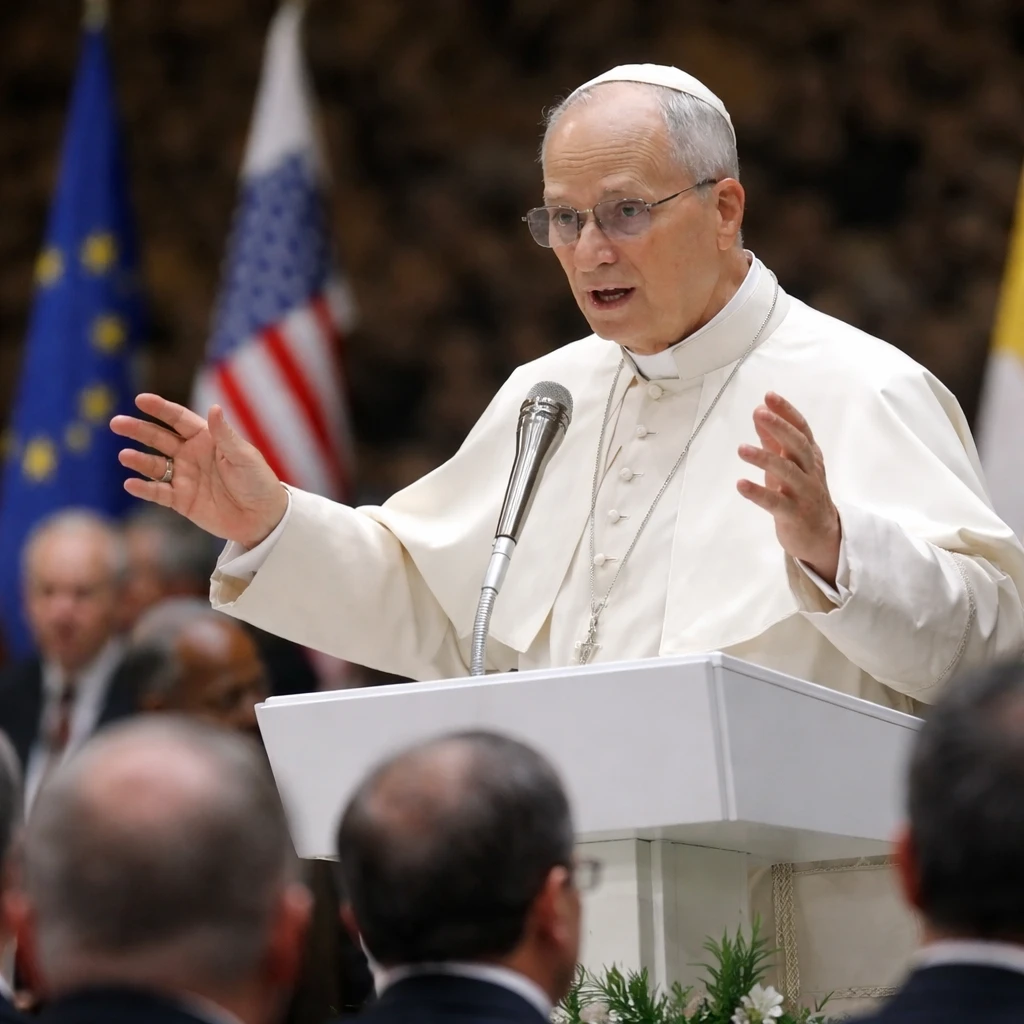

VATICAN CITY — Pope Leo XIV delivered a firm denunciation against the employment of military force by nations to impose their will on others, emphasizing the damaging implications for global peace and the international legal framework established after World War II.
Speaking during his annual audience with the Vatican diplomatic corps, traditionally serving as his foreign policy address, Leo departed from the usual diplomatic languages by delivering much of his speech in English. Though he refrained from naming specific countries, his remarks implicitly referred to the recent U.S. military operation aimed at ousting Venezuelan leader Nicolás Maduro, ongoing hostilities involving Russia in Ukraine, and other contemporary conflicts escalating global tensions.
“War has returned to prominence, and there is a growing enthusiasm for it,” the pontiff declared to diplomats from various nations, underscoring his concern about the increasing reliance on force over dialogue. He lamented a diplomatic shift from negotiation and consensus-seeking toward coercive tactics exercised by individual states or alliances.
According to Leo, this trend directly contravenes the fundamental principle affirmed after the Second World War—which prohibits the use of force to alter other nations' borders—resulting in a profound erosion of the rule of law fundamental to peaceful international coexistence.
“Peace is currently being pursued through armaments as a means to assert dominance,” he added, highlighting the critical threat this poses to civil order and lawful governance globally.
Setting the geopolitical context, the pope explicitly mentioned Venezuela, expressing a desire for a peaceful resolution that prioritizes the welfare of all populations over partisan agendas. He referenced the recent U.S. nighttime raid capturing President Maduro, noting the U.S. administration’s assertion of the legality of the operation based on fighting narcotics cartels considered unlawful combatants. Such interventions have drawn international criticism, with concerns raised regarding their impact on sovereignty and global legal norms.
Concerning Ukraine, Leo reiterated his urgent plea for an immediate ceasefire, calling on the international community to steadfastly pursue lasting solutions that safeguard vulnerable populations and restore hope to those afflicted by the conflict.
Addressing the situation in Gaza, the pope affirmed the Holy See's support for a two-state resolution in the Israeli-Palestinian dispute, emphasizing the rights of Palestinians to reside in Gaza and the West Bank within their own homeland.
Beyond geopolitical conflicts, the pontiff highlighted the widespread persecution of Christians as one of today’s most significant human rights challenges, estimating that one in seven Christians worldwide are affected. He cited regions including Bangladesh, Nigeria, the Sahel, Mozambique, and Syria, while also noting the existence of religious discrimination in Europe and the Americas where Christians face constraints in publicly expressing religious beliefs, particularly on matters defending the vulnerable, such as unborn children, refugees, migrants, and family values.
Reaffirming the church’s opposition to abortion and euthanasia, Leo expressed profound concern about initiatives aimed at facilitating cross-border access for abortions. Additionally, he characterized surrogacy as detrimental to human dignity, arguing that commodifying gestation undermines the value of both the child, reduced to a product, and the mother, whose biological role and bodily integrity are exploited. He emphasized that such practices distort the foundational familial bonds.
This address marked a comprehensive critique from the first pope of U.S. origin, expanding beyond typical diplomatic observations to encompass pressing global challenges related to peace, freedom, and human dignity.