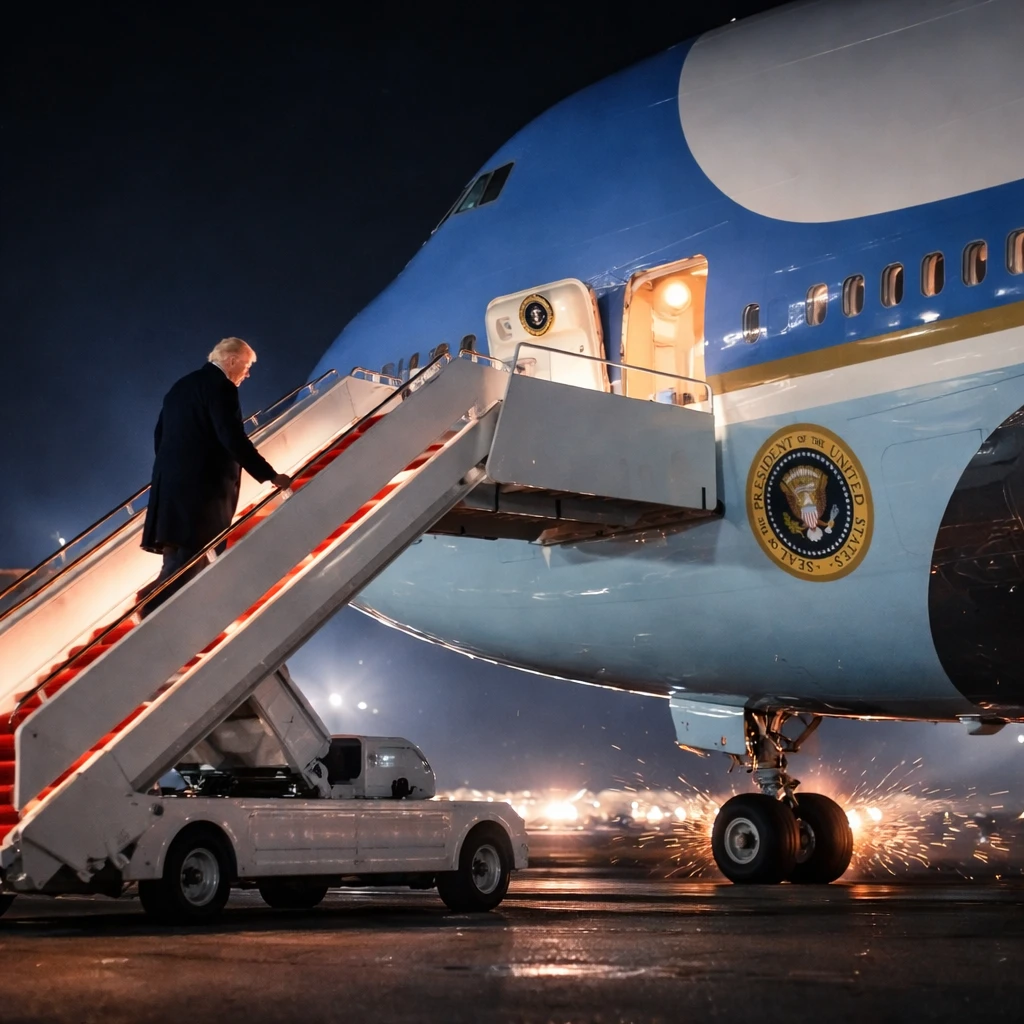

On Tuesday evening, shortly after taking off for Switzerland, President Donald Trump’s official aircraft, Air Force One, was compelled to return to Joint Base Andrews within an hour of departure. The incident was prompted by a minor electrical issue detected by the flight crew shortly after takeoff, leading to a cautious decision to land back at the base.
White House press secretary Karoline Leavitt confirmed that the crew identified the electrical problem and, prioritizing safety, opted to reverse course. Passengers aboard, including reporters, experienced a brief outage of the cabin lights in the press section soon after departure, although no immediate explanation was given at that moment. Approximately thirty minutes into the flight, the news was communicated that the aircraft would be heading back.
To continue his scheduled engagement at the World Economic Forum in Davos, which was to occur early Wednesday morning, President Trump transferred to an Air Force C-32. This is a modified Boeing 757 frequently utilized for domestic flights and journeys to smaller airports. The swap allowed the President to depart just past midnight, ensuring continuity of his diplomatic itinerary.
The current Air Force One fleet, comprising two planes in service for nearly forty years, is due to be replaced by newer models from Boeing. However, the modernization program has experienced multiple delays, prolonging the operational lifespan of these heavily customized aircraft. These planes are equipped with advanced defense and survivability measures, such as antimissile systems and radiation shielding, alongside robust communication technologies that enable the Commander in Chief to maintain command and control functions from anywhere globally.
In the previous year, a notable addition was made to the presidential fleet when Qatar’s ruling family gifted a luxury Boeing 747-8 to augment the Air Force One inventory. This aircraft is currently undergoing modifications to meet the stringent security standards required for presidential use. Reflecting on the day's events, Leavitt lightheartedly remarked to reporters aboard the returning Air Force One that the Qatari jet was "sounding much better" at that time.
Instances of Air Force aircraft encountering mechanical difficulties are not unprecedented. For instance, in February, an Air Force plane conveying Secretary of State Marco Rubio to Germany had to abort the trip due to technical faults. Similarly, last October, a military aircraft transporting Defense Secretary Pete Hegseth was forced into an emergency landing in the United Kingdom after a windshield crack was detected.