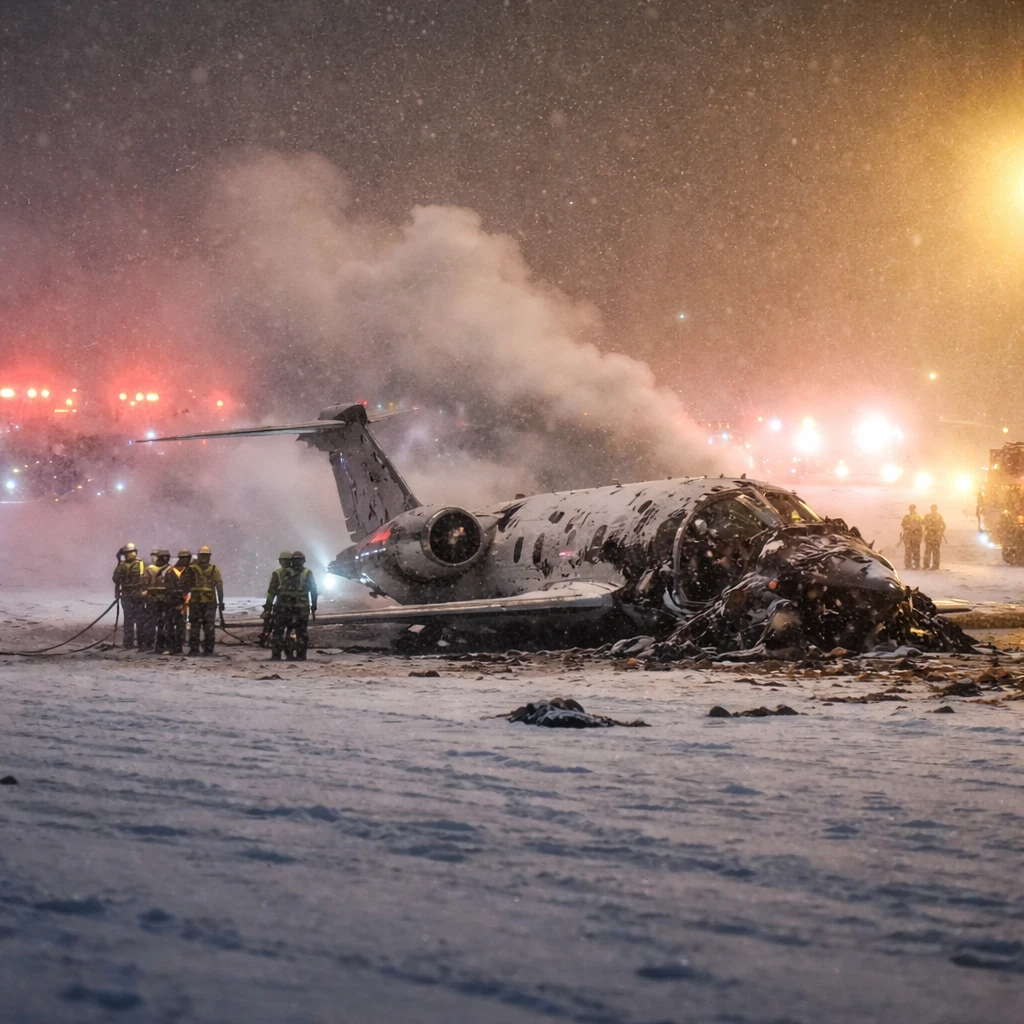

On Sunday evening, a private business jet experienced a fatal accident while attempting to take off from Bangor International Airport in Maine under challenging winter weather. The Bombardier Challenger 600, occupied by eight individuals including crew members, crashed around 7:45 p.m. local time during a snowstorm sweeping across New England and large portions of the United States.
The Federal Aviation Administration (FAA) confirmed that seven passengers lost their lives in the crash while a crew member survived but was seriously injured. At the time of the accident, snowfall was intensifying across the airport vicinity, although only a few inches had accumulated. Despite these conditions, other aircraft continued normal takeoffs and landings before the disaster occurred.
Baying International Airport, located approximately 200 miles north of Boston and providing direct air connections to cities such as Orlando, Washington, D.C., and Charlotte, suspended all operations immediately following the crash. The airport is expected to remain closed until at least noon on the following Wednesday.
The jet involved is registered to a corporate entity sharing a Houston, Texas address with Arnold and Itkin Trial Lawyers, a personal injury law firm. Documentation indicates that a founding partner of the firm serves as the registered agent for the company holding ownership of the aircraft.
Authorities including the FAA and the National Transportation Safety Board (NTSB) have initiated inquiries to determine the cause and circumstances surrounding the crash. Preliminary reports indicate the plane experienced a post-crash fire after failing to successfully depart. The NTSB has stated that no additional updates will be provided until their investigators arrive at the site.
Regarding victim information, the NTSB clarified that local authorities are responsible for public disclosures, while the airport's director, Jose Saavedra, withheld comment and requested further guidance and support from federal entities during a press conference held on Monday.
Audio recordings from air traffic control reveal that approximately 45 seconds after clearance for takeoff, controllers reported the aircraft was overturned. Emergency personnel responded rapidly, arriving on scene in under a minute, demonstrating prompt action despite the adverse weather.
Bangor International is noted for its preparedness to manage snow and inclement weather, leveraging its joint use agreement with the Maine Air National Guard to maintain operational runways regardless of conditions. This preparedness, however, did not prevent the crash amid what was described by the National Weather Service in Caribou, Maine, as an ongoing snowfall event that eventually totaled nearly 10 inches.
The event occurred during a time when a large winter storm affected the eastern U.S., bringing diverse precipitation such as sleet, freezing rain, and snow, severely disrupting transportation networks including air travel. The storm caused widespread flight delays and cancellations, affecting over 30,000 flights combined nationwide on that day, as tracked by flight data services. Regions including Philadelphia, Washington, Baltimore, New York, and New Jersey experienced substantial operational interruptions.
The Bombardier Challenger 600 model, introduced in 1980, is recognized for its wide-body design and walk-around cabin, accommodating between nine and eleven passengers. It remains a favored option on the charter market globally.
This tragic incident underscores the ongoing risks posed by adverse weather in aviation despite established protocols and technological advancements. The ongoing investigations will be critical in identifying factors that contributed to the accident and informing future safety measures.
Transportation reporter Josh Funk contributed additional information to this coverage from Omaha, Nebraska.