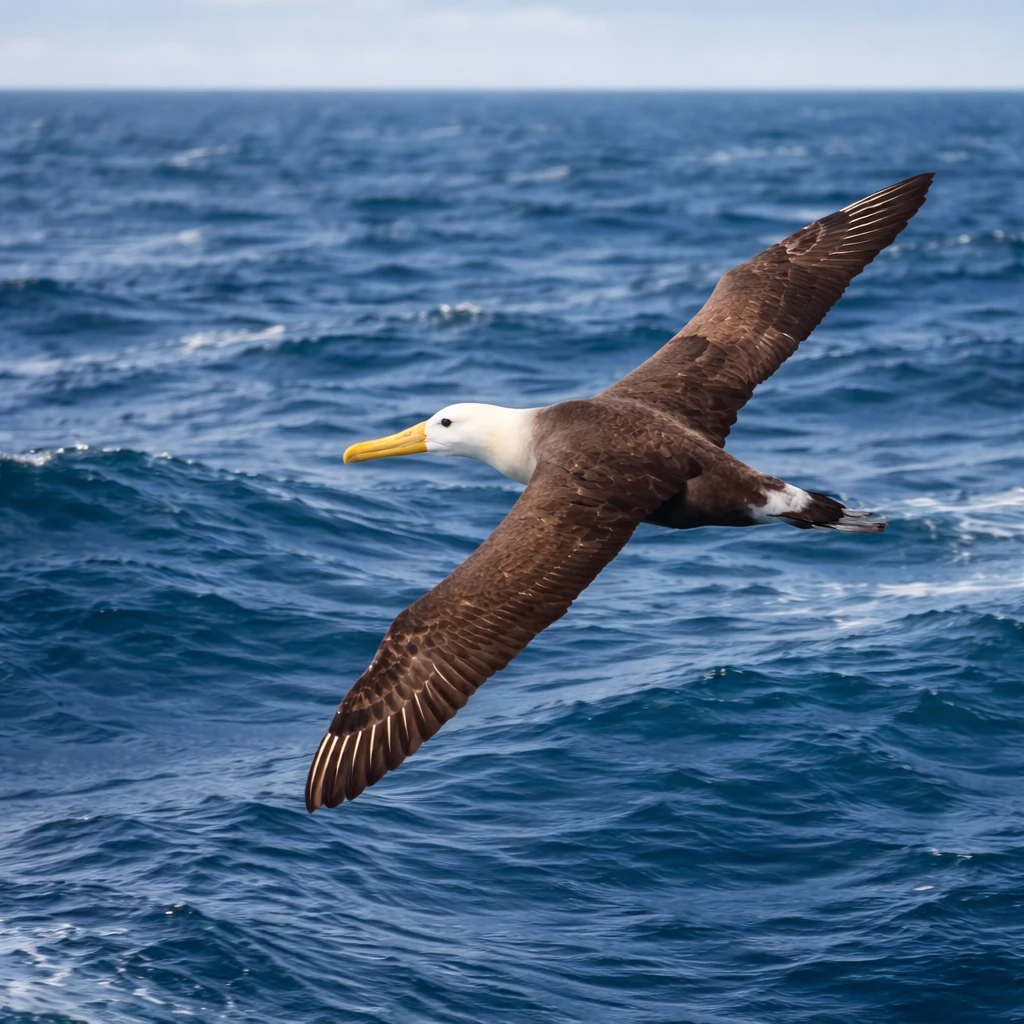

Along the central coast of California, marine researchers on a vessel encountered a waved albatross, a seabird native primarily to the Galapagos Islands approximately 3,000 miles (4,800 kilometers) to the south. This sighting marks only the second time this particular species has been documented north of Central America.
The waved albatross is distinguished by its yellow bill and black, button-like eyes. It can have an impressive wingspan reaching up to 8 feet (2.4 meters) and spends the majority of its life airborne over marine environments.
The individual bird was observed about 23 miles (37 kilometers) offshore from Point Piedras Blancas, roughly positioned midway between San Francisco and Los Angeles. This is a significant deviation from its known breeding grounds.
Marine ornithologist Tammy Russell, who was present aboard the research vessel, commented that the bird did not appear to be in a rush to return to its usual habitat. She noted that the same albatross had also been sighted off Northern California in October of the previous year.
Russell shared her astonishment on social media, expressing disbelief at witnessing such an occurrence. She is affiliated with the Farallon Institute as a contract scientist and is a postdoctoral scholar at the University of California, San Diego’s Scripps Institution of Oceanography.
Understanding the motivations behind the albatross’s northward journey remains challenging. Possible explanations include displacement by storm events or an inherent tendency in some birds to travel beyond typical ranges.
Russell explained that it is likely this adult bird did not participate in breeding during the last season, which normally occurs with the laying of a single egg in the spring and fledging of chicks by January. It is conceivable that this bird is on a non-breeding excursion, possibly returning to the Galapagos to reunite with its mate in the future.
However, it remains unknown how long the albatross will stay in northern waters or whether it will return to its traditional breeding grounds.
Marshall Iliff, who leads the eBird project at Cornell University’s Lab of Ornithology, observed that seabirds such as albatrosses are capable of extensive travel in search of food. Occasional individuals may appear far outside their conventional habitat, even crossing hemispheres or oceans.
Iliff indicated that this particular sighting could result from several factors, including scarcity of food resources prompting wider foraging ranges. Yet, at this point, there is no indication that this is a trend rather than an isolated anomaly.
The International Union for Conservation of Nature categorizes the waved albatross—the largest bird species in the Galapagos—as critically endangered. Their habitat is mostly located in tropical regions, where they nest on lava fields incorporating scattered boulders and sparse vegetation.
Waved albatrosses can live up to 45 years, sustaining themselves mainly on fish, squid, and crustaceans.
Russell highlighted that an increase in sightings in California could indicate northward shifts possibly driven by environmental changes. She referenced that five booby species have become prevalent in California waters recently due to rising temperatures and marine heatwaves.
Regarding the lone waved albatross currently observed, Russell emphasized that its appearance may serve as baseline data should this species expand its range into northern regions.