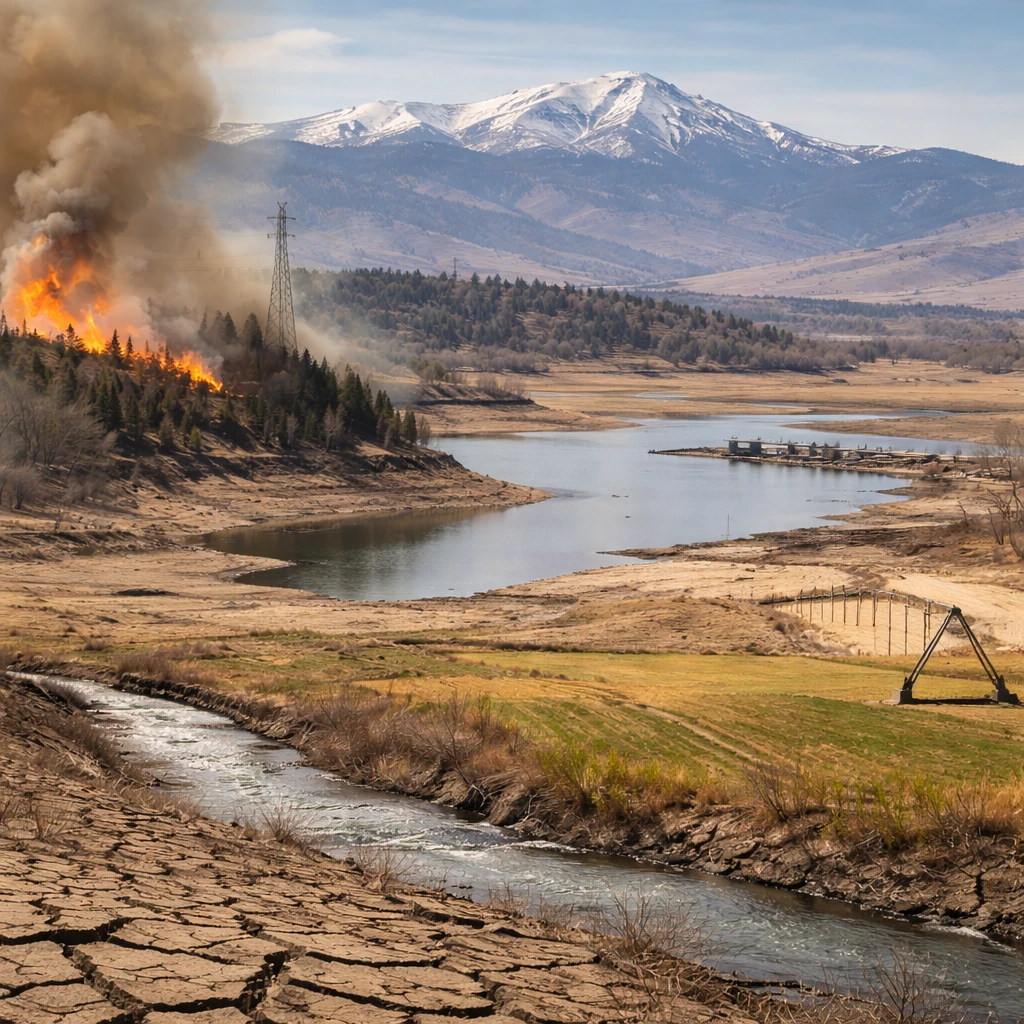

The Western United States is currently experiencing an unprecedented snow drought accompanied by exceptional heat, leading to diminished future water availability, heightened wildfire risks, and adverse effects on winter recreation and tourism.
Scientifically measured snow cover and snow depth have reached their lowest levels in decades. Data reveals that at least 67 weather stations across the Western U.S. have recorded their warmest December through early February period to date. Whereas normal snow cover during this time should approximate 460,000 square miles—comparable to the combined area of California, Utah, Idaho, and Montana—this year, it has receded to about 155,000 square miles, roughly the size of California alone, according to the National Snow and Ice Data Center (NSIDC).
Mark Serreze, the NSIDC director with nearly 40 years of experience in Colorado, remarked on the unprecedented nature of this winter, emphasizing the persistent weather pattern responsible for these conditions.
Oregon’s snowpack, a critical indicator that measures water content within snow, is not only at record lows but also approximately 30% below the previous minimum record, underscoring the severity of this drought, as noted by Jason Gerlich, NOAA’s regional drought early warning system coordinator.
While the eastern U.S. battles significant snow and unseasonably cold temperatures, residents in areas such as West Jordan, Utah, near Salt Lake City, observe the lack of snow firsthand. Locals express concern over diminished opportunities for winter sports and related economic activities.
Ski resorts throughout the region are grappling with an exceptionally challenging season due to insufficient snowfall. States including Oregon, Colorado, and Utah report their lowest statewide snowpack in records dating back to the early 1980s. Dry conditions throughout January led to precipitation levels at or below half the average in many states. Combined with frequent sunny days and warmer than average temperatures, this has resulted in minimal snow accumulation during a period typically marked by substantial snowy buildup in the Pacific Northwest and Northern Rockies. California’s position is somewhat improved attributed to higher rainfall in December, as highlighted by experts.
The Salt Lake City International Airport has not received an inch of snowfall for 327 consecutive days, marking the longest such stretch since records began in 1890-91.
Geographically, the Upper Colorado River Basin has emerged as a central zone affected by the snow drought. The traditional snowpack serves as a natural reservoir, releasing water gradually through late winter and spring to sustain river flows critical for agriculture, urban use, and hydropower generation. The current lack of snow, or accelerated melting, reduces this essential replenishment, posing a substantial concern for water resource management in the Colorado basin, according to University of California's Water Resources Institute analyst Daniel Swain.
Experts further warn that the early disappearance of snow accelerates the onset of wildfire season by leaving soils and vegetation exposed to warmer spring and summer conditions, enhancing dryness and fire susceptibility, as per researcher Daniel McEvoy from the Western Regional Climate Center.
The dominant factor in this snow drought is not merely a deficit in precipitation but the extraordinarily warm temperatures experienced throughout the West, a development linked to climate change driven by fossil fuel consumption. Since December 1, NOAA has registered over 8,500 instances of daily high-temperature records being tied or broken in the region. Warmer conditions mean that precipitation often falls as rain rather than snow, causing faster runoff and less water retention in mountain snowpacks, exacerbating drought impacts.
Colorado State University climatologist Russ Schumacher highlights that such a lack of snowfall due to heat exceeds typical variability, with December particularly warm resulting in snow only at the highest elevations, followed by a prolonged dry and warm spell through January.
Looking ahead, meteorologists anticipate a period of cooler and wetter weather across the Western U.S. with some snow, which may somewhat alleviate the snow drought. However, forecasters caution that temperatures will remain above average in many locations, and a return to normal snow levels is unlikely, although incremental improvements are possible.