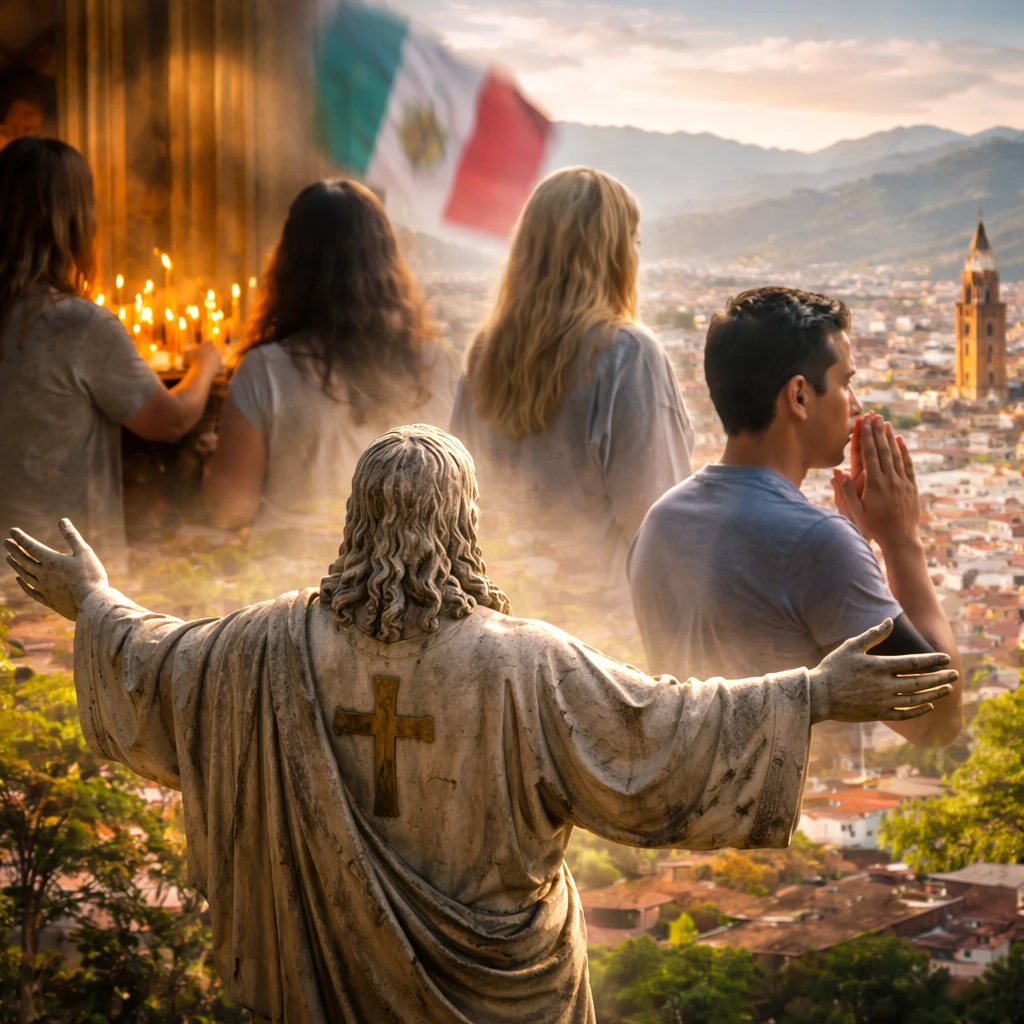

Over the past decade, Latin America has witnessed a notable decrease in the proportion of adults identifying as Catholic, alongside a growing demographic that describes themselves as religiously unaffiliated—encompassing atheists, agnostics, and those without a particular religious identity. This trend emerges from a report published this week by the Pew Research Center, which analyzed data collected in early 2024 from six of the region's most populous countries: Argentina, Brazil, Chile, Colombia, Mexico, and Peru.
Pew Research associate Kirsten Lesage, who led the study, pointed out that the combined population of these countries accounts for roughly 75% of Latin America's inhabitants. The analysis reveals a significant decline in the Catholic population share since 2013-14, concurrent with an increase in the share of adults who are unaffiliated with any religion.
While Christianity continues to dominate religious affiliation in Latin America, Catholicism’s prevalence has diminished in an area historically viewed as a Catholic stronghold. Notably, the region's deep ties to the papacy endure, with connections to recent popes who served extended tenures in Peru and Argentina.
The survey data indicates that Catholic affiliation ranges between 46% and 67% among adults in these nations. Concurrently, those identifying as religiously unaffiliated comprise between 12% and 33% of the adult populations. Importantly, each country has experienced at least a nine percentage point reduction in Catholic adherence over the past decade, whereas the portion of unaffiliated adults has grown by seven or more percentage points.
Lesage noted a particularly striking development: in Argentina, Chile, Colombia, and Mexico, the number of religiously unaffiliated adults has surpassed that of Protestants. Ten years ago, a majority of adults in these countries—approximately 60% or more—considered themselves Catholic. Today, about half of the populations in Brazil and Chile identify as Catholic, while around two-thirds in Mexico and Peru do so. Argentina and Colombia each report roughly 60% Catholic adherence, with all these figures representing declines compared to a decade ago.
The diminishing influence of the Catholic Church in the region correlates with public responses to clerical sex abuse scandals and opposition to church positions on issues such as abortion and LGBTQ+ rights. Many individuals now seek spiritual frameworks outside traditional religious institutions, engaging in practices such as yoga, tarot reading, astrology, and other belief systems not affiliated with formal religion. In Argentina and Colombia, unaffiliated adults constitute close to one-quarter of the population.
Previously, Pew had identified a significant shift toward Protestantism among former Catholics or individuals leaving organized religion a decade ago. However, this newer survey indicates that Protestantism’s share of the population has stabilized across the region. Brazil, for example, currently reports that 29% of adults identify as Protestant, up modestly from 26% in 2013-14.
The most prominent alteration lies in the growing number of individuals without any religious affiliation. In Mexico, approximately 20% of adults identify as atheist, agnostic, or without a specific religion, nearly doubling the roughly 10% representing Protestant branches.
Despite these evolving identities, Latin Americans generally maintain a strong religious sensibility. The Pew analysis found that belief in God remains widespread, and religion continues to play an important role in many individuals’ lives. Survey results show that over 90% of adults across all six countries report belief in God. Additionally, at least half of adults in Brazil, Colombia, Mexico, and Peru regard religion as "very important" in daily life. Daily prayer is common among majorities in Brazil, Colombia, and Peru.
Lesage emphasized that, according to these measures, Latin Americans demonstrate greater religiosity than populations in numerous other parts of the world surveyed by Pew, particularly when compared to Europe, where Christianity has significantly declined since childhood for many individuals.
Furthermore, belief in God remains steady relative to a decade ago, even among those without formal religious affiliation, as most unaffiliated adults across the region report belief in a divine presence.
The Pew poll included responses from 6,234 adults across the specified Latin American nations, collected between January 22 and April 27, 2024. The margin of error for the survey varies among countries from plus or minus 4.0 to 4.5 percentage points.
These findings provide insight into changing patterns of religious belief and identity in Latin America, highlighting significant demographic shifts that carry implications for cultural, social, and political dynamics within the region.