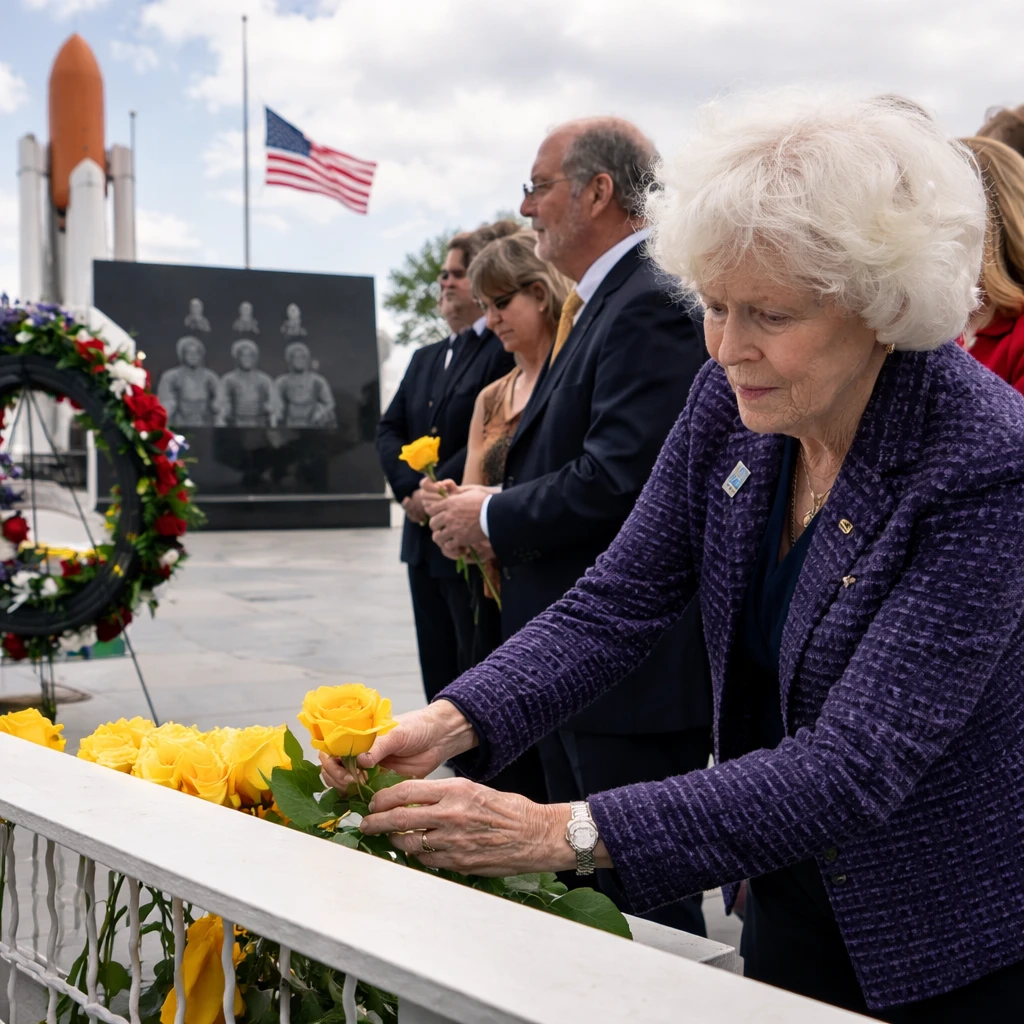

At the Kennedy Space Center in Cape Canaveral, Florida, a solemn memorial gathering took place on Thursday as families of the astronauts lost during the 1986 Challenger shuttle disaster reconvened to mark the somber 40-year milestone since that catastrophic event. The shuttle broke apart shortly after liftoff on January 28, 1986, resulting in the deaths of all seven crew members on board.
Among those commemorating the event was Alison Smith Balch, daughter of Challenger pilot Michael Smith, who, with tearful reflection, recounted how that chilling morning irrevocably altered her life along with countless others. Addressing the assembled crowd of mourners, she emphasized that the tragedy united many in a shared narrative of loss. Equally affected was Jane Smith-Holcott, Michael Smith's widow, who conveyed the ongoing depth of her grief, stating, "Every day I miss Mike - every single day is the same."
Investigations into the accident revealed that the exceptionally cold weather on the morning of the launch compromised the integrity of the O-ring seals in the shuttle's right solid rocket booster. This failure led to the shuttle's destruction just 73 seconds after takeoff. The disaster was not solely technical; a culture of dysfunction within NASA was also identified as a contributing element, a flaw that later played a role in the Columbia shuttle accident 17 years afterward.
NASA officials taking part in the ceremony reiterated the importance of the hard lessons the tragedy imparted. Kelvin Manning, the Kennedy Space Center’s deputy director, highlighted the necessity of continuous vigilance, especially in an era characterized by nearly daily rocket launches and with the agency's next manned lunar expedition imminent.
The Challenger crew notably included Christa McAuliffe, a schoolteacher selected from over a hundred candidates nationwide for the teacher-in-space program. Among those attending the memorial were two retired teachers who had also been contenders for that program. Bob Veilleux, a former astronomy teacher from New Hampshire, McAuliffe’s home state, remarked on the closeness they shared. Similarly, Bob Foerster, a retired sixth-grade math and science teacher from Indiana and once among ten finalists, expressed gratitude for the growth in space education following the tragedy, emphasizing the importance of viewing the shuttle crew not just as martyrs but as pioneers whose aspirations continued to inspire.
At the Space Mirror Memorial, located within Kennedy’s visitor complex, Foerster noted the poignant reality engraved in the black granite monument, which bears 25 names: the seven Challenger astronauts, the seven lost in the Columbia disaster of 2003, the three victims of the Apollo 1 fire in 1967, and individuals who perished in aviation and other work-related incidents affiliated with NASA.
NASA’s annual Day of Remembrance drew relatives of those who perished in the Columbia and Apollo accidents, with ceremonies held concurrently at Arlington National Cemetery in Virginia and the Johnson Space Center in Houston. Lowell Grissom, the brother of Apollo 1 commander Gus Grissom, reflected on the unrealized potential of the fallen astronauts, sharing how the talent that was lost continues to evoke reflection and remembrance.
This annual act of memorializing not only preserves the legacy of these astronauts but also serves as a solemn reminder of the inherent risks of space exploration, underlining the crucial need for stringent safety practices in current and future missions.