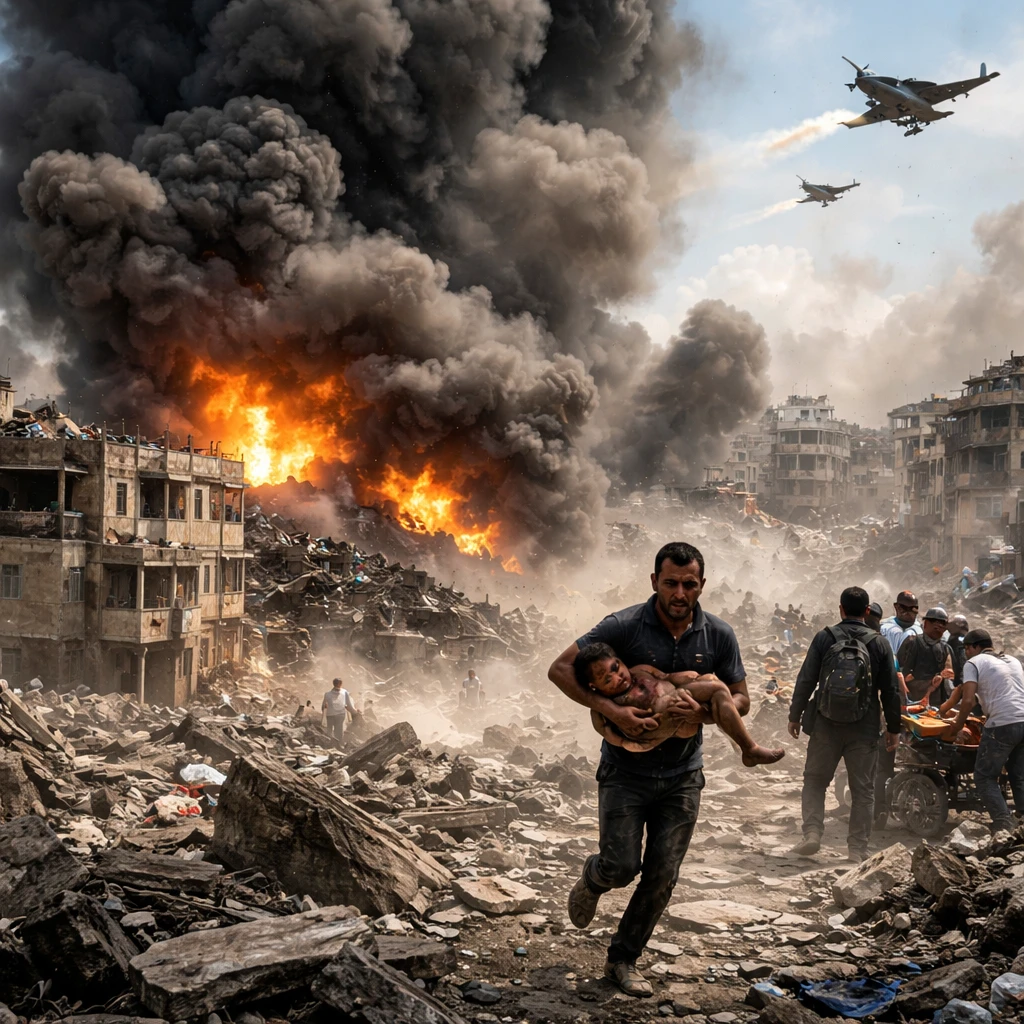

On Wednesday, the Gaza Strip experienced a surge in lethal Israeli military strikes that resulted in the deaths of at least 21 Palestinians, among them two infants, five children in total, seven women, and an active paramedic, hospital officials reported. These events occurred in the context of a precarious ceasefire agreement that was established on October 10 but has since been repeatedly disrupted by violence. The Israeli government justified the recent offensive as a necessary response to gunfire from militants that severely wounded an Israeli reservist soldier earlier that day, according to an Israeli military official who spoke anonymously in line with policy.
Notwithstanding the ceasefire, Gaza health authorities have documented that Israeli actions since the truce's inception have led to 556 Palestinian fatalities and approximately 1,500 injuries. On the Israeli side, four soldiers have been killed. Eight Arab and Muslim states, including Egypt and Qatar who are mediators of the agreement, have condemned Israel’s alleged persistent violations of the ceasefire terms.
Of special note is an early-morning airstrike on a residential building in the Tuffah neighborhood in northern Gaza, which claimed the lives of at least 11 individuals primarily from a single family, including a ten-day-old infant named Wateen Khabbaz, her five-month-old cousin Mira Khabbaz, their parents, and grandmother. Family members expressed their anguish and confusion over the targeting of children and civilians during prayers held at the Shifa Hospital courtyard in Gaza City, where the victims’ bodies were received.
The violence persisted into the afternoon with further strikes in Khan Younis, a southern Gaza city. A family tent was hit by Israeli strikes, resulting in three deaths, including a 12-year-old boy. Another attack on a tent in the Muwasi area caused at least two additional deaths and injured five others. Among the deceased was Hussein Hassan Hussein al-Semieri, a paramedic actively performing his duties at the time of the strike, according to the Palestinian Red Crescent's field hospital reporting from the scene. The Gaza health ministry reported a total of 38 people wounded in Wednesday’s strikes.
The Rafah border crossing between Gaza and Egypt, which opened on Monday and was seen as a crucial development for easing humanitarian pressure, has witnessed only limited passage since then. On Tuesday, merely 40 Palestinians entered Gaza, arriving at Nasser Hospital in Khan Younis early Wednesday morning. Despite the crossing being technically open, further movement stalled by midday, compounded by procedural delays, questioning of travelers, and unclear criteria for crossing eligibility.
Three women who crossed through Rafah on Monday recounted to officials and observers their experiences of being blindfolded, handcuffed, interrogated, and threatened for prolonged hours before release. The European Union, which maintains a mission and Palestinian staff at the crossing, denied having evidence of luggage confiscations or mistreatment at the border from either Israeli forces or Palestinian authorities. Meanwhile, the Israeli military stated it was not aware of any misconduct such as mistreatment or property confiscation by its personnel.
Progress within the ceasefire framework remains uneven. While violence has not ceased entirely, significant steps include Hamas’ release of all hostages it was holding, leading to Israel's reciprocation by freeing thousands of Palestinian detainees and initiating the gradual reopening of the Rafah crossing. Humanitarian aid flow into Gaza has increased, and a technocratic committee has been installed to oversee the territory's civilian affairs.
However, other essential components of the ceasefire agreement—such as deploying an international security force, disarming Hamas, and reconstructing Gaza—remain stalled without defined timelines. Since the war's onset on October 7, 2023, attacks involving thousands of militants from Hamas resulted in over 1,200 Israeli casualties, predominantly civilians, with 251 individuals abducted. According to Gaza health authorities, over 71,800 Palestinians have died since the conflict began; these figures combine both civilian and combatant deaths and are regarded as credible by international agencies and independent analysts.
Dr. Mohamed Abu Selmiya, director of Shifa Hospital in Gaza City, vehemently criticized the ongoing violence on social media, calling the conflict a “genocidal war” against Palestinians and questioning the roles of ceasefire mediators amid continued military actions. Israel, for its part, firmly denies any accusations of genocide in Gaza.
The recurrent hostilities and humanitarian challenges underscore the precariousness of the ceasefire and the enduring volatility besetting the region. Both sides continue to accuse one another of breaches, with civilians bearing the brunt of intensified confrontations and unresolved political disputes.