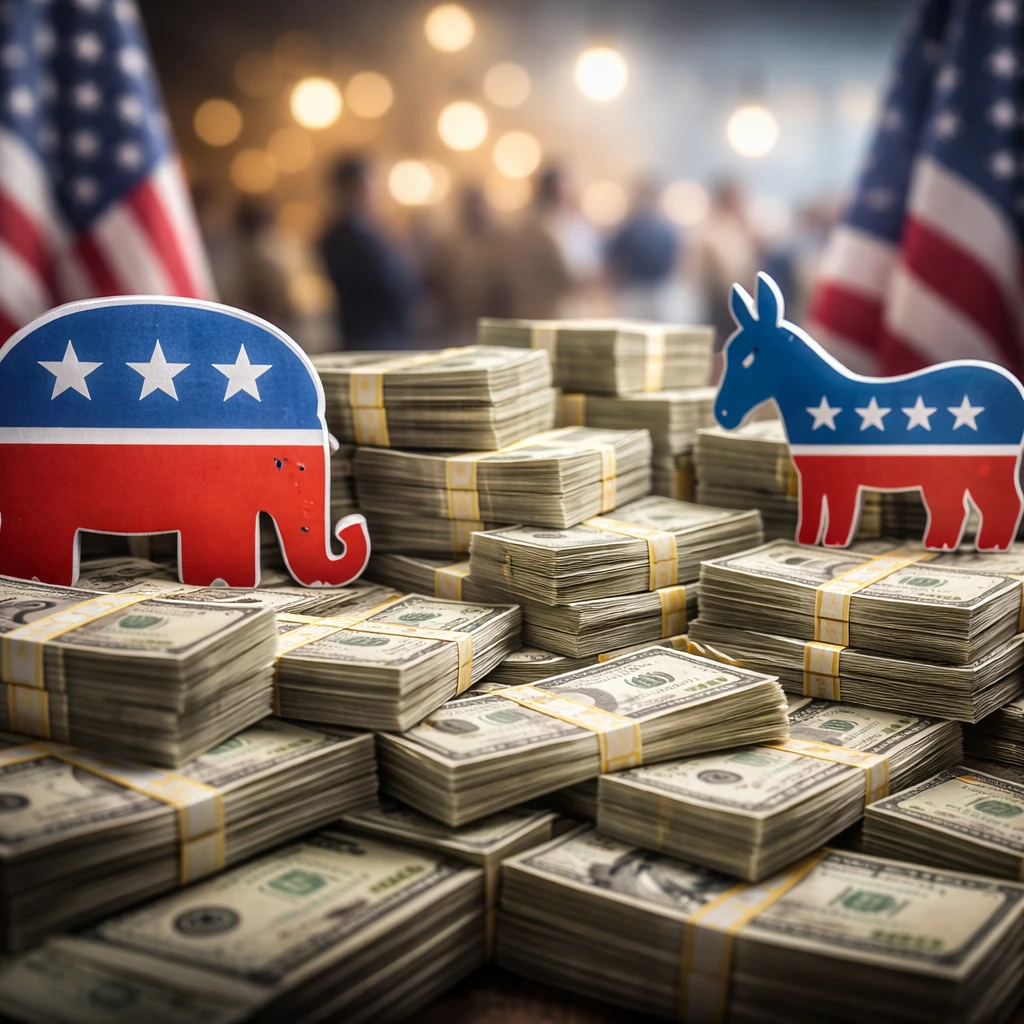

WASHINGTON – Fundraising figures submitted to the Federal Election Commission indicate that the Republican National Committee (RNC) significantly outpaced the Democratic National Committee (DNC) in contributions throughout 2025, establishing a sizable financial lead as the midterm elections draw near. The RNC raised $172 million over the year, finishing 2025 with $95 million in cash reserves. In stark contrast, the DNC reported $145 million raised but stood at a net negative with only $14 million in cash against $17 million in outstanding debt, placing the party in a precarious financial position entering 2026.
This fundraising disparity takes place amid a politically charged climate. The Republicans benefit from incumbency as they control the White House and both chambers of Congress; however, historically, the party holding power often faces electoral headwinds during midterms, which can advantage challengers. These dynamics suggest that the forthcoming election cycle will be fiercely contested.
When breaking down legislative campaign finances, the gap narrows but remains visible. The Republican Congressional Campaign Committee (RCCC), responsible for House races on the GOP side, enjoyed one of its strongest years in fundraising, accumulating over $117 million by the end of 2025. This total includes a substantial $13 million raised in December alone. Meanwhile, the House Democratic Campaign Committee (HDCC) ended the year slightly behind with $115 million.
Both the RCCC and HDCC commenced 2026 with approximately $50 million in liquid assets, based on reports expected to be filed shortly with the FEC. A similar pattern is observed in Senate fundraising efforts. The National Republican Senatorial Committee (NRSC) raised $88 million last year, maintaining over $19 million in cash at year-end. On the Democratic side, the Democratic Senatorial Campaign Committee (DSCC) amassed $79.8 million and closed 2025 with a slightly higher cash balance of $21.7 million.
Leading the House Republicans, Speaker Mike Johnson expressed optimism Sunday about the party's financial position and its implications for maintaining and possibly expanding the narrow GOP majority in the House. "We will have a war chest to compete," Johnson stated on Fox News Sunday, indicating confidence that fundraising momentum will translate into electoral advantages.
It is important to acknowledge that these fundraising totals reflect contributions recorded throughout the 2025 calendar year, preceding numerous significant political developments occurring early in 2026. Events such as the U.S. military action in Venezuela and the tragic deaths of two American protesters during immigration raids in Minneapolis have injected uncertainty into voter sentiment and donor behavior, making it difficult to ascertain the enduring impact of these occurrences on election dynamics.
From the Democratic perspective, Viet Shelton, spokesperson for the Democratic Congressional Campaign Committee, emphasized the party’s belief that Republicans are apprehensive. Shelton cited superior candidate quality and messaging from Democrats, which the party expects to resonate well with voters as they strive to reclaim control of the House. He asserted, "Momentum is on our side. The Republicans are running scared."
These developments unfold against a backdrop of political volatility and evolving campaign narratives. The divergent fundraising positions, coupled with unpredictable voter reactions to recent political events, suggest that both parties face distinct challenges and opportunities as the midterm elections approach.