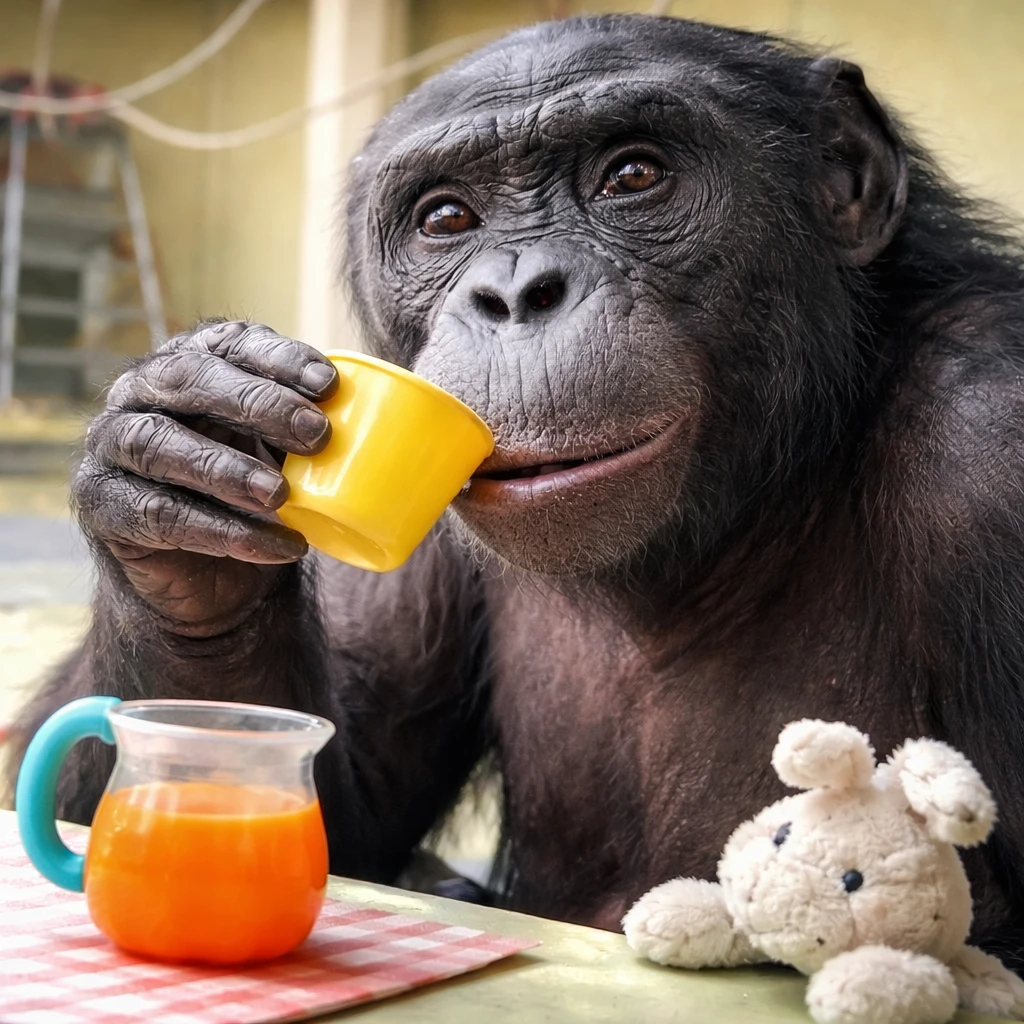

By the time children reach two years old, the ability to engage in pretend play is commonly observed. They transform their surroundings, such as turning a bedroom into a castle or hosting imaginary tea parties, reflecting a human hallmark of creativity. The capacity to generate scenarios from imagination underpins the arts, music, and other creative endeavors. Until recently, this trait was largely considered unique to humans.
A recent experimental study, for the first time, provides evidence that a captive ape exhibits signs of imagination. Researcher Christopher Krupenye from Johns Hopkins University, a co-author of the study, emphasized the significance of these findings by noting that the foundation for imaginative ability may not be exclusive to human beings.
The subject of the study was Kanzi, a bonobo who was raised in a laboratory setting. Kanzi became proficient in communicating with humans through the use of graphical symbols, skillfully combining them to convey novel meanings, and he acquired knowledge in crafting basic stone tools. Researchers sought to determine whether Kanzi possessed the capacity for pretend play, defined as behaving as though something is real while simultaneously understanding that it is not.
This inquiry was motivated by anecdotal reports of wild female chimpanzees mimicking maternal behavior by holding sticks as if they were infants, and captive chimpanzees seemingly dragging imaginary objects along the ground following play with tangible ones. However, since imagination involves abstract cognitive processes, discerning the internal experiences of apes presents unique challenges. Observed behaviors could alternatively represent imitation of human researchers or confusion between real and imaginary entities.
To investigate further, scientists adapted experimental approaches originally designed for studying pretend play in young children. In the study, they staged a scenario with Kanzi involving a juice party. Researchers pretended to pour juice from a pitcher into two cups, then feigned removing juice from one cup while maintaining the illusion. Kanzi was then asked to choose which cup he wanted. The bonobo selected the cup containing the imaginary juice 68% of the time during this task.
To clarify whether Kanzi could differentiate between real and pretend liquids, a control test was conducted using actual juice. Kanzi chose the real juice over the pretend one in approximately 80% of trials. Amalia Bastos, a co-author from the University of St. Andrews, noted that these results suggest Kanzi was able to distinguish real juice from imaginary juice.
A subsequent experiment involved placing fake grapes into two jars, yielding similarly favorable results consistent with the notion that Kanzi comprehended the distinctions between genuine and pretended items.
Despite these findings, some scientists remain skeptical about whether Kanzi’s actions qualify as true pretend play akin to human imagination. Duke University comparative psychologist Michael Tomasello, who did not participate in the research, pointed out that enacting the scenario presented and initiating pretend actions oneself may represent different cognitive demands. Tomasello expressed that more conclusive evidence, such as observing Kanzi actively pouring water himself in a pretend context, would be required to confirm equivalence with human imaginative play. The study’s results were published in the journal Science.
Kanzi was socialized extensively with humans, complicating the generalization of these findings to apes in natural environments. Kanzi passed away last year at 44 years of age. With numerous great ape species critically endangered in the wild, further study is needed to better understand their cognitive potentials.
Study authors suggest Kanzi’s demonstrated abilities open avenues for expanded research into the origins and presence of imagination within non-human species.