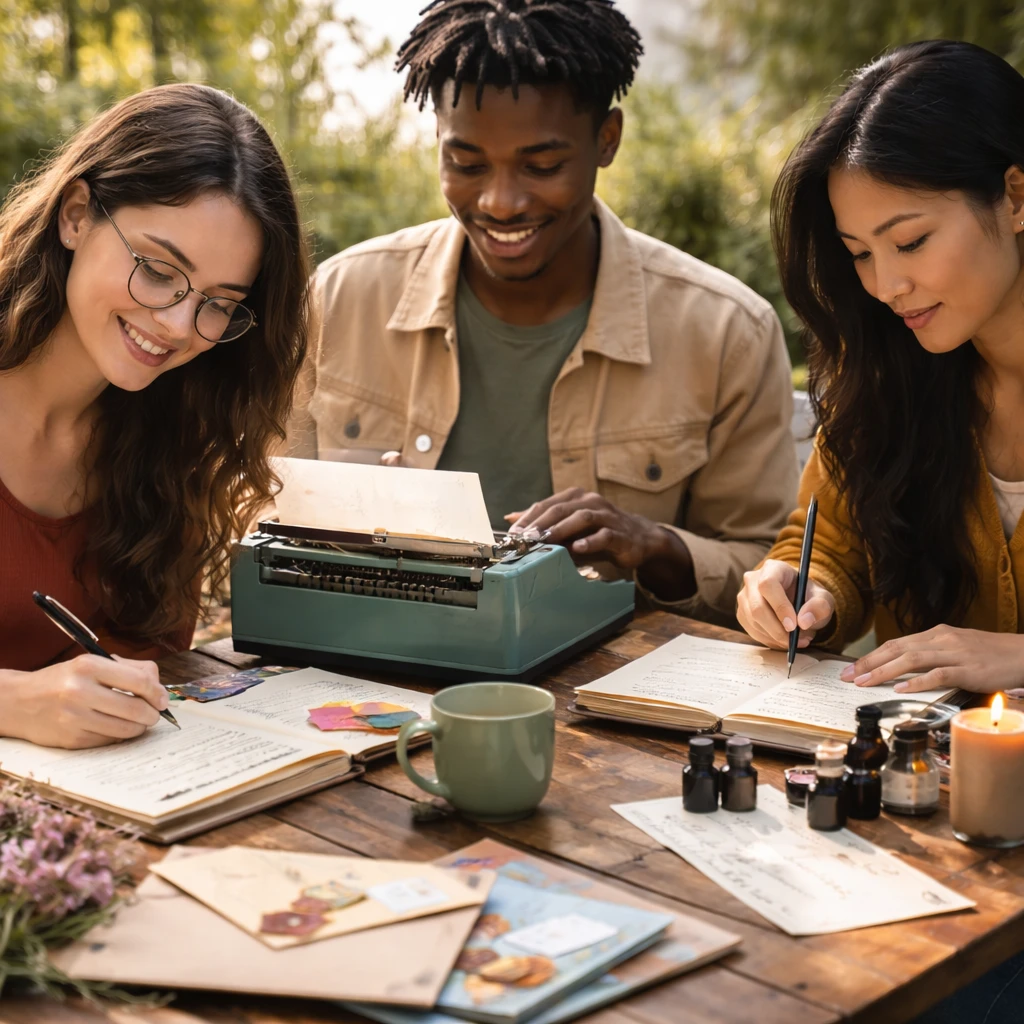

As contemporary life increasingly demands productivity optimization with blurred boundaries between professional and personal digital spaces, some individuals are intentionally decelerating by revisiting communication practices from earlier times. Activities centered on tactile engagement—such as letter writing, participation in typewriter circles, and sharing artistic penmanship via social media platforms—have sparked renewed interest in old-fashioned writing instruments and techniques.
Far from being mere relics, these pursuits serve a functional role for participants by facilitating reduced digital exposure, encouraging thoughtful use of time, and nurturing deeper interpersonal bonds. Melissa Bobbitt, a 42-year-old resident of Claremont, California, exemplifies this trend with her ongoing correspondence with approximately a dozen pen pals, sometimes extending to as many as 40 simultaneously. She regards these relationships as equivalent to friendships maintained through conventional in-person or telephonic conversations. Bobbitt emphasizes the therapeutic nature inherent in focused exchange of heartfelt thoughts through handwritten letters.
Writing by hand and the associated paraphernalia such as ink and paper continue to enable connections across global communities. These analog methods provide participants with unique opportunities to reflect, concentrate, and engage deliberately amid a societal climate marked by incessant accessibility and rapid information flow.
Embracing Analog for Mindful Engagement
In an environment where individuals are rarely without their devices, dedicating attention to writing letters or artistic projects such as scrapbooking requires deliberate effort and patience. The physical act of crafting messages, sealing envelopes with wax, and organizing pages can be aesthetically rewarding while serving as a meditative practice.
Stephania Kontopanos, a 21-year-old student based in Chicago, notes the challenge of disengaging from her phone and computer given her educational obligations and social circles largely centered on digital platforms. She observes a common scenario where even in social settings, peers remain absorbed by their devices. Efforts to momentarily set aside technology include composing postcards and creating scrapbooks or 'junk journals'—assemblies of everyday items like receipts and tickets used to chronicle memories and thoughts.
Kontopanos recounts how trips to the post office with her mother in Kansas have evolved into meaningful shared experiences, including interactions with postal workers that would otherwise be unlikely encounters. This routine exemplifies how returning to physical forms of communication can foster unexpected social interactions.
Nostalgia and Community Through Paper Correspondence
For KiKi Klassen, 28, residing in Ontario, Canada, letter writing serves as a conduit for nostalgia and connection, especially with the memory of her late mother who was affiliated with the Canadian Union of Postal Workers. In October 2024, Klassen initiated the Lucky Duck Mail Club, a subscription-based service delivering monthly mailings featuring her artwork and inspirational messages. This club has amassed a membership exceeding 1,000 individuals spanning up to 36 countries.
Klassen highlights the introspective aspect of crafting handwritten messages, noting the intentional selection of words and the openness it promotes. The exchange of letters has elicited emotional responses, illustrating the unique sense of security and expression paper communication provides, allowing writers to share candid feelings without immediate follow-up concerns.
Bobbitt recounts the thrill of receiving personal mail, particularly when not linked to bills or advertisements, suggesting that regular exchange of letters could enhance kindness and alleviate the dread associated with checking mailboxes. Her engagement with pen pal clubs since childhood and participation in global postcard networks like Postcrossing have facilitated sustained friendships evolving through shared correspondence.
Similarly, DJ Robert Owoyele from Dallas has fostered community through CAYA, a monthly event featuring activities such as letter writing, coloring, and vinyl listening. Since its launch less than a year ago, it has aimed to counter digital superficiality by emphasizing tangible, in-person experiences that nurture authentic connections.
Initiating Analog Practices in a Digital World
Although analog hobbies may appear accessible, integrating them into busy schedules often requires reevaluating priorities to create dedicated time for slowed, deliberate engagement. Kontopanos reflects on the realization of excessive phone use and the importance of discovering fulfilling activities worth prioritizing.
Entry points into these traditional pursuits include local clubs, fairs, and online communities focused on typesetting, wax sealing, and calligraphy. Examples include Type Pals for typewriter enthusiasts, the International Printing Museum’s Printers Fair in Los Angeles, the Wax Seal Guild on Instagram, and The Calligraphy Hub on Facebook.
Observing growing social media interest, Klassen suggests a potential cultural shift with younger generations gravitating toward analog experiences in the near future, summarizing the trend as “going analog in 2026.”