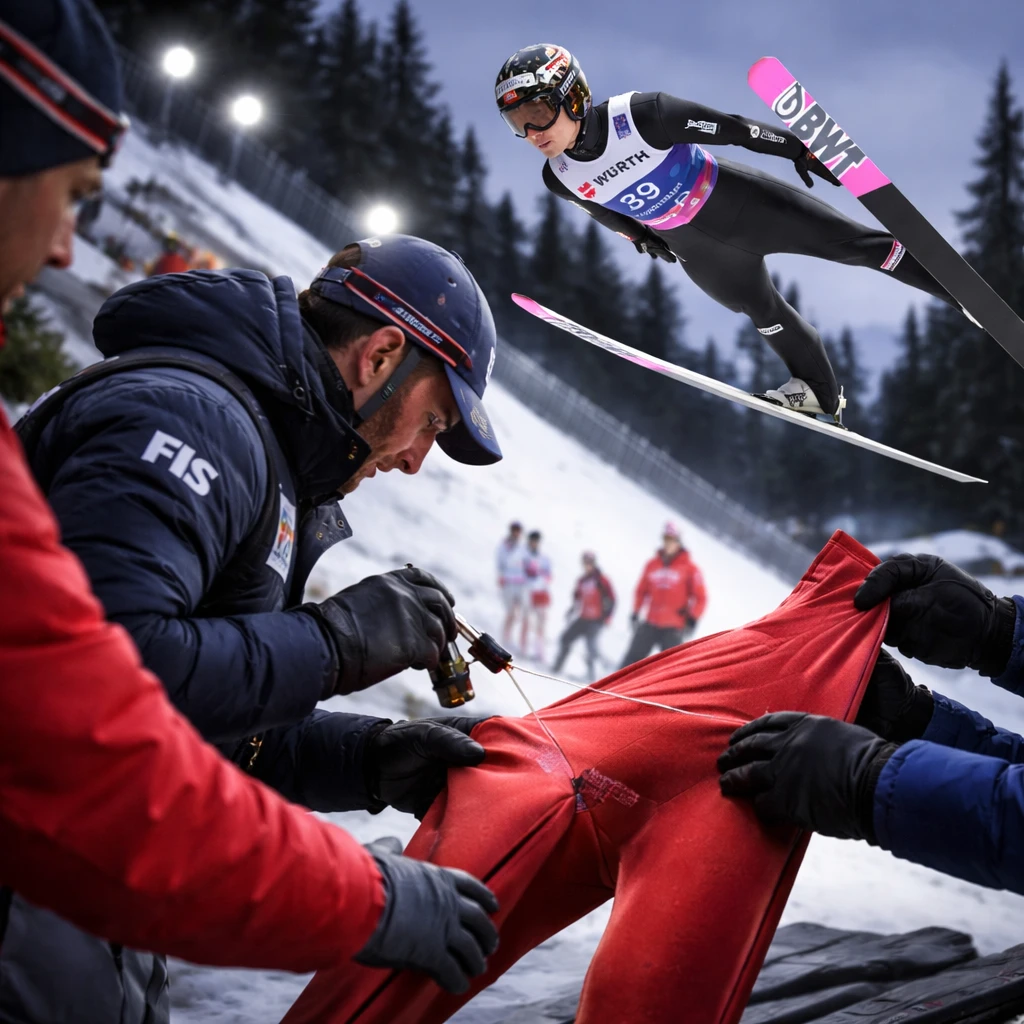

Securing an Olympic medal in ski jumping or facing disqualification can hinge on minute uniform details, specifically the fabric's size and fit. An enlarged suit can extend a jumper’s flight by meters, offering a substantial competitive edge, but such modifications risk violating the sport’s evolving regulations. These rules were reinforced after last year’s world championships when the Norwegian ski jumping team was found guilty of augmenting the crotch area of their top two male jumpers’ suits to increase surface area, thereby enhancing performance.
Following this incident, the International Ski Federation (FIS), which governs the sport, implemented new, stricter rules ahead of the current season and the Winter Games in Milan Cortina. Bruno Sassi, the FIS spokesman, emphasized that while disqualifications for suit violations have occurred historically, the severity and deliberate nature of the recent Norwegian incident were unparalleled. He highlighted that the team’s conduct went beyond merely pushing suit dimensions with an intent that was distinctly calculated to cheat the system.
Ski jumping combines both scientific precision and athletic artistry. Extensive preparation includes testing skis and apparel in wind tunnels to optimize aerodynamic efficiency well before athletes execute their jumps. Research published in the academic journal Frontiers in Sports and Active Living illustrated the impact of suit sizing, revealing that a mere 1 cm expansion in suit circumference could potentially add 2.8 meters (9.2 feet) to a jump — a margin capable of deciding podium positions.
Sören Müller, the lead researcher from the Institute for Applied Training Science in Leipzig, Germany, explained that the cuffs expanded by the V-position of the legs in the crotch region provide the most pronounced aerodynamic advantage due to their visibility and effect.
The controversy unfolded when video evidence from a whistleblower exposed Norwegian team officials actively modifying suits before the men’s large hill event. The head coach Magnus Brevik, his assistant Thomas Lobben, and staff member Adrian Livelten received 18-month bans for stitching additional material into the suit crotch areas to increase rigidity and surface size. These alterations escaped detection during competition but were discovered upon slot seam examination afterward.
Brevik publicly expressed deep regret about the misconduct. The scandal stripped defending Olympic large hill ski jumping gold medalist Marius Lindvik of his world championship silver medal, casting a shadow over Norway’s legacy in a sport it pioneered. Lindvik and teammate Johann André Forfang, both Olympic medalists, accepted three-month suspensions, allowing them to compete in the ongoing season, although they were not deemed complicit in the tampering. However, FIS noted they bore responsibility for failing to scrutinize the adjustments made during nighttime preparations.
The ski jumping community, known for its tight-knit nature, reacted vehemently to the cheating. Former German Olympic champion Jens Weissflog equated the suit alterations to doping, albeit through equipment manipulation. The fallout led Norway to overhaul its men’s team leadership to recover integrity.
In response, FIS has reformed its regulatory framework. The federation appointed a coordinator to oversee gear inspections and hired former Austrian jumper Mathias Hafele as an equipment expert. Hafele, who had previously tested the limits of the regulations as a competitor, is now tasked with fortifying compliance and enforcing new guidelines.
Under the revised system, all ski jumping suits undergo rigorous pre-event scrutiny conducted by two FIS controllers and a medical professional. Utilizing advanced 3-D measurement technology, they assess athlete uniforms for unauthorized modifications, emphasizing restrictions on arm and leg cuffs and preventing lowering of the crotch to artificially enhance surface area. Once authorized, tamper-proof microchips are embedded in the suits to detect any alterations before and after jumps via specialized scanners.
FIS has also introduced a penalty system mirroring soccer’s card system. Athletes disqualified for equipment violations receive a yellow card; a second offense results in a red card, disqualification from the subsequent event, and the loss of a team’s athlete quota for future competitions.
Rune Velta, a former Norwegian ski jumper who assumed head coaching duties in June, faces the challenge of rebuilding Norway’s tainted reputation. He describes the process as the most demanding of his career, aimed at fundamentally restructuring the team to center on athlete performance under strict compliance. Velta, previously a Swiss coach critical of the cheating, acknowledges that the team is subjected to heightened scrutiny this season. During the summer season, when ski jumping occurs on ceramic tracks and plastic landing mats, the Norwegian squad focused on adapting to altered suit dimensions and learning the nuances of the new regulatory environment.
Velta commented on the team’s approach, highlighting the low tolerance for even minor infractions and the summer’s role in mastering the standards and compliance enforcement to avoid further violations.