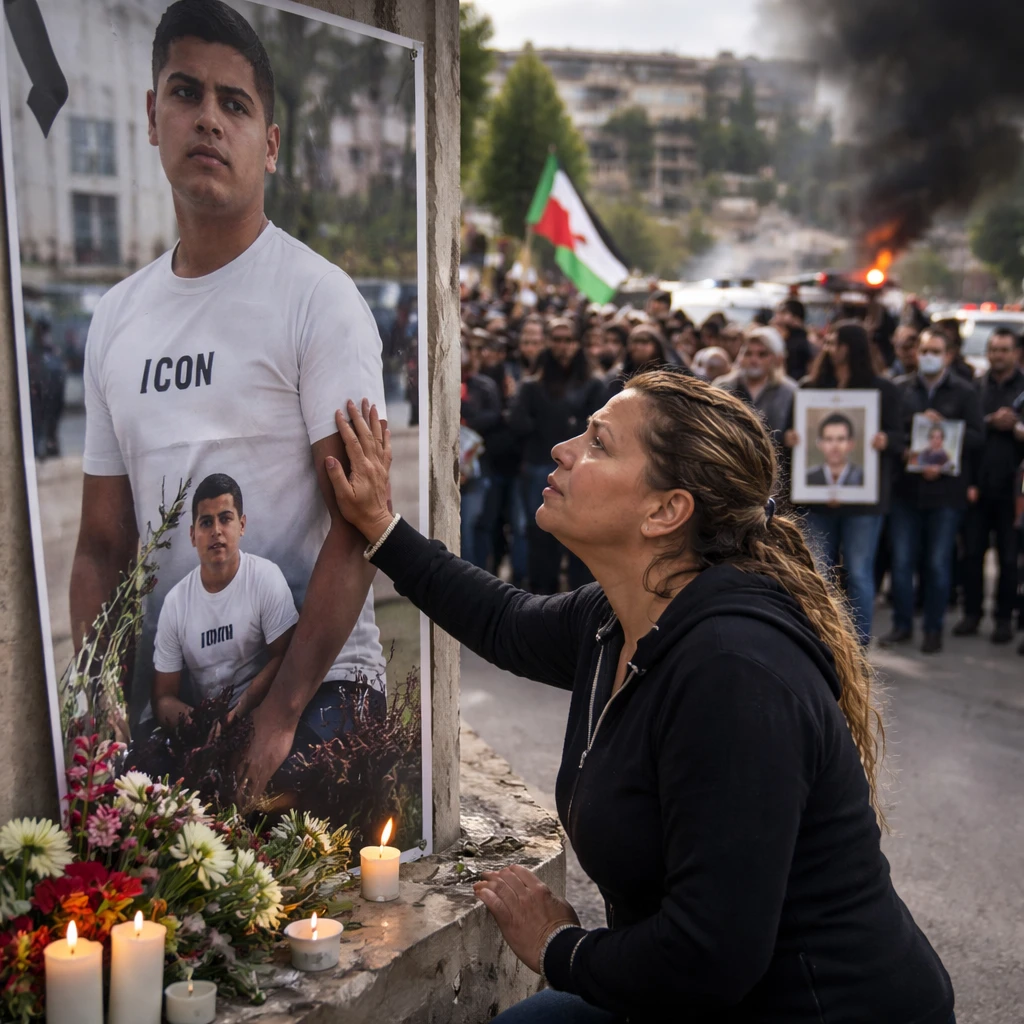
In the northern Israeli town of Kafr Yasif, the fatal shooting of 15-year-old Nabil Safiya has sent shockwaves through a community grappling with escalating gang violence. The incident occurred while Nabil was taking a break from studying for a biology exam, sitting inside a Renault when a man on a motorcycle fired shots and killed him. Police later stated the shooting resulted from mistaken identity. This tragic event underscores the pervasive threat of violence that has unsettled Palestinian towns within Israel for some time.
As articulated by Ashraf Safiya, Nabil’s father, the menace has become omnipresent, devoid of any recognizable pattern or safety net. He stated, "There is no set schedule for the shootings anymore. They can kill you at school, in the street, even at a football stadium." This statement highlights the extent to which community members live under constant threat.
The rise in violence affects the Palestinian minority, who comprise roughly 20% of Israel’s population. Crime statistics reveal a homicide rate related to criminal activity more than 22 times higher than that among Jewish Israelis, yet arrest and indictment rates for these crimes remain considerably lower. Critics draw attention to these disparities as evidence of systemic discrimination and insufficient law enforcement engagement toward Arab communities.
The social upheaval stemming from this violence has sparked widespread protests across Israel. Thousands gathered in Tel Aviv and other major cities to demand decisive governmental action. In Palestinian communities, strikes have led to closures of businesses and schools as residents express frustration and demand increased protection.
Following Nabil Safiya’s death, local residents organized marches, and students boycotted classes to honor his memory and protest ongoing violence. His family transformed their home into a memorial space adorned with images and posters celebrating his life. Ghassan Munayyer, a political activist from the mixed city of Lod, emphasized the differential treatment between Jewish and Palestinian communities by stating, "There is one law for Jewish society and a different one for the Palestinian society." This sentiment captures the mistrust many Palestinians feel toward the justice system.
Some Palestinians have achieved prominence in business and political arenas within Israel; however, many feel neglected by authorities. Chronic underinvestment and high unemployment rates have created conditions conducive to frustration and diminished trust in state institutions. In 2023, a record 252 Palestinian citizens in Israel were killed, according to data from Abraham Initiatives, a non-governmental organization dedicated to promoting coexistence and safer communities. The violence continues to escalate with at least 26 additional crime-related killings reported in the first month of 2024.
Walid Haddad, a criminologist affiliated with the Ono Academic College and a former official at Israel’s Ministry of National Security, explains that organized crime thrives due to the illegal weapons trade and loan-sharking in underserved areas where access to credit is limited. Criminal gangs reportedly extort residents and business owners for "protection" money, funding acts such as arson, shootings, and targeted assassinations of rival leaders. Haddad notes that perpetrators can receive substantial financial rewards, ranging from thousands to hundreds of thousands of dollars depending on the severity of their actions, facilitating a lifestyle of relative comfort for gang members.
The pervasive violence severely disrupts daily life in affected Palestinian communities. In Kafr Yasif, a town of approximately 10,000 residents, nightly curfews have become de facto as streets empty by evening, and residents often endure the sound of gunfire in their neighborhoods, undermining community safety and sense of stability.
Investigative and prosecutorial responses have been scrutinized for inefficiency. In the previous year, only 8% of homicide cases involving Palestinian citizens resulted in indictments, a stark contrast to a 55% charge rate in Jewish communities, according to Abraham Initiatives. Lama Yassin, director of shared cities and regions at the organization, remarks that strained relations with the police historically discouraged these communities from requesting increased law enforcement presence. However, ongoing insecurity has shifted public opinion, with citizens increasingly demanding stronger police deployment to restore order.
The persistent wave of violence has become a focal point for Palestinian-led political parties within Israel, who criticize successive governments for unfulfilled promises to curb bloodshed. Both politicians and activists highlight the uneven application of the law and alleged police apathy as root causes. Aida Touma-Suleiman, a member of the Israeli parliament, describes the police response as a form of collective punishment, pointing to aggressive operations targeting Palestinian communities in response to violence against Jewish Israelis, which often involve roadblocks and mass arrests, while criminal gangs operate with relative impunity.
Touma-Suleiman further contends that the state is effectively granting criminal organizations license to act freely by failing to intervene decisively. Under the current Minister of National Security, Itamar Ben-Gvir, police have intensified visible campaigns targeting other types of crime, such as protests and incidents in East Jerusalem and the occupied West Bank, but have not achieved effective suppression of gang-related violence within Palestinian communities.
Official statements from the Israeli police reject allegations of biased prioritization, asserting that homicide cases in Palestinian locales remain a top priority. They emphasize challenges such as witness reluctance to cooperate hinder investigations, affirming that decisions are evidence-based and comply with due process.
Back in Kafr Yasif, Ashraf Safiya vows that his son’s death will not be forgotten or go unanswered. Having been away at work when the shooting occurred, he rushed to the scene upon learning the news, finding his son critically wounded and rushed to the hospital, where doctors declared him dead. Motivated by a desire to prevent further tragedies, he has actively participated in organizing protests and mobilizing community response. "The idea is that the blood of this child will not be wasted," he said.
Authorities recently announced preparations to charge a 23-year-old suspect arrested in a neighboring town in connection with the shooting. They indicated that the original target was a relative accompanying Nabil, referring to the cousin present in the vehicle at the time. Police characterized Nabil as an unintended victim caught in familial disputes prevalent within Arab society.
Demonstrations in late January in Kafr Yasif featured participants carrying portraits of Nabil and Nidal Mosaedah, another local youth killed in recent violence. Police dispersed the protest, citing violations of permit terms, and detained several leaders, including the town’s former council head. Residents expressed concerns that such law enforcement actions, while curbing immediate protests, do little to address or reduce the underlying violence afflicting their communities.