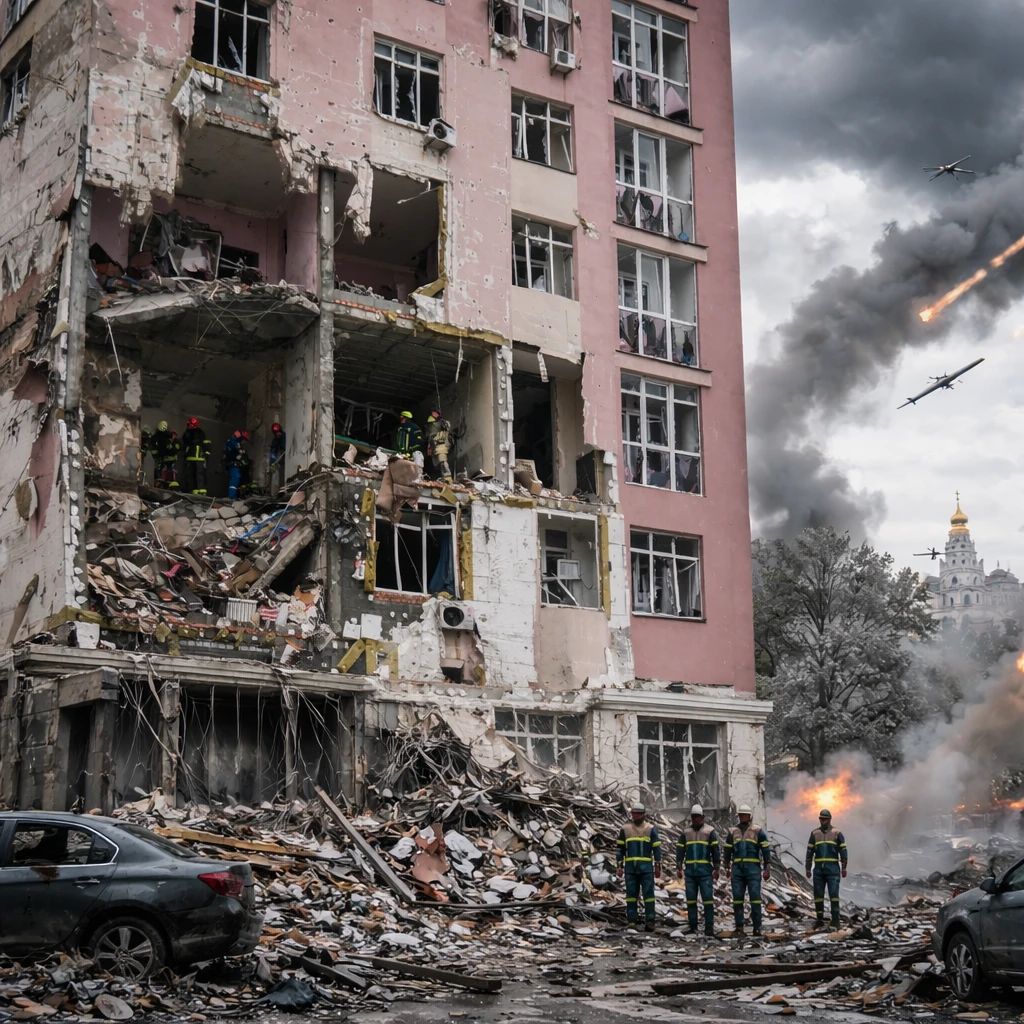

In the early hours of Saturday, Kyiv was subjected to a significant missile and drone assault by Russian military forces. Ukrainian authorities reported that the attacks resulted in at least one fatality and left 27 others injured. Explosions echoed throughout the city as the offensive spanned several hours.
The strikes occurred a day before Ukrainian President Volodymyr Zelenskyy was scheduled to meet with US President Donald Trump in Florida to advance talks aimed at ending the war. President Zelenskyy indicated that their agenda would include discussions on security guarantees and territorial concerns in the Donetsk and Zaporizhzhia regions.
Following a stopover in Canada, where he met with Prime Minister Mark Carney in Halifax, Nova Scotia, Zelenskyy condemned the assault as Russia's rejection of peace efforts. "This attack is Russia's response to our diplomatic endeavors," he stated, emphasizing the Kremlin's unwillingness to pursue peace. Concurrently, Carney announced a $1.8 billion economic support package for Ukraine, designed to facilitate additional financing from the International Monetary Fund and World Bank, aimed at reconstruction and development.
The Russian Ministry of Defense characterized the night operation as a "massive attack" employing long-range precision weapons from the land, air, and sea, including Aeroballistic Kinzhal hypersonic missiles as well as drones. Their targets were described as Ukrainian energy facilities and industrial military complex enterprises. However, the offensive also struck several residential buildings, causing civilian harm.
The Ministry justified the attack as a retaliatory measure against Ukrainian strikes on civilian sites within Russian territory. Earlier on Saturday, Russian defense sources reported that their anti-aircraft batteries neutralized seven Ukrainian drones over Krasnodar and Adygea regions overnight, and later, 147 additional drones were shot down across various Russian regions. Moscow's Mayor Sergei Sobyanin confirmed the interception of over 20 drones approaching the city, with no casualties or damages reported, though it was unclear if these counts overlapped with the official ministry tallies.
In the run-up to the Zelenskyy-Trump talks, the Kremlin released footage of President Vladimir Putin in military attire receiving operational updates from senior military officials at an undisclosed command post. General Valery Gerasimov, Chief of the Russian General Staff, reported full control over Myrnohrad in Donetsk Oblast, Guliaipole in Zaporizhzhia Oblast, and several other settlements—using the Soviet-era names for some locations.
Putin declared that if Kyiv's leadership remained unwilling to peacefully resolve the conflict, Russia would achieve its military objectives by force. The Ukrainian General Staff responded by characterizing the situation in Guliaipole as "difficult," with defensive efforts ongoing, and described conditions in Myrnohrad as "complicated." They also dismissed Russian claims of substantial battlefield success as false propaganda.
Amid the heightened military activity, Poland responded by deploying combat aircraft and temporarily closing airports in Lublin and Rzeszow, near the Ukrainian border. The closure lasted several hours during the attacks, though Polish forces reported no incursions into their airspace. The national aviation authority Pansa later resumed airport operations. The rationale behind Poland's alert status remained unclear, considering the Russian strikes focused on Kyiv, which lies distant from the border region.
According to Ukraine's Air Force, Russia launched a total of 519 drones and 40 missiles targeting Ukrainian infrastructure. Kyiv's energy and civilian infrastructure suffered the brunt, causing power and heating outages in some districts, as stated by President Zelenskyy.
Damages to residential areas were considerable, with Interior Minister Ihor Klymenko reporting damage to more than ten apartment buildings. One citizen, Olena Karpenko, recounted the traumatic experience of hearing a man trapped in flames during an attack, an ordeal that left emotional scars. She described a sequence of explosions near a thermal power plant followed by a devastating hit on her building.
Among those wounded were two children, with the strikes impacting seven districts within Kyiv, noted Tymur Tkachenko, head of the city's Military Administration. A body was recovered from the rubble, though it remained uncertain if it belonged to the man who perished in flames.
Emergency responders tackled fires in an 18-story residential building in Dnipro district and a 24-story building in Darnytsia district, with additional blazes recorded in Obolon and Holosiiv districts. Broader Kyiv region saw damage to industrial and residential structures. In Vyshhorod, rescue teams extracted an individual from collapsed housing debris.
DTEK, Ukraine's largest private energy company, reported extensive power outages in Kyiv due to the strikes, affecting hundreds of thousands of customers.
Looking ahead to diplomatic efforts, President Zelenskyy emphasized a commitment to resolving outstanding issues between Ukraine and the United States in the upcoming talks, with a focus on security guarantees. He highlighted that the US draft peace plan includes security assurances akin to NATO's Article 5—meaning an attack against Ukraine would trigger collective military response. However, concrete details require negotiation between the two nations.
Discussions on territorial concessions, a highly sensitive topic, are expected to focus on Donetsk and the Zaporizhzhia nuclear plant area. Zelenskyy reiterated Ukraine's firm stance against recognizing any Russian territorial claims under any conditions.
Contributions to reporting were made by correspondents based in Tallinn, Estonia, and Toronto, Canada.