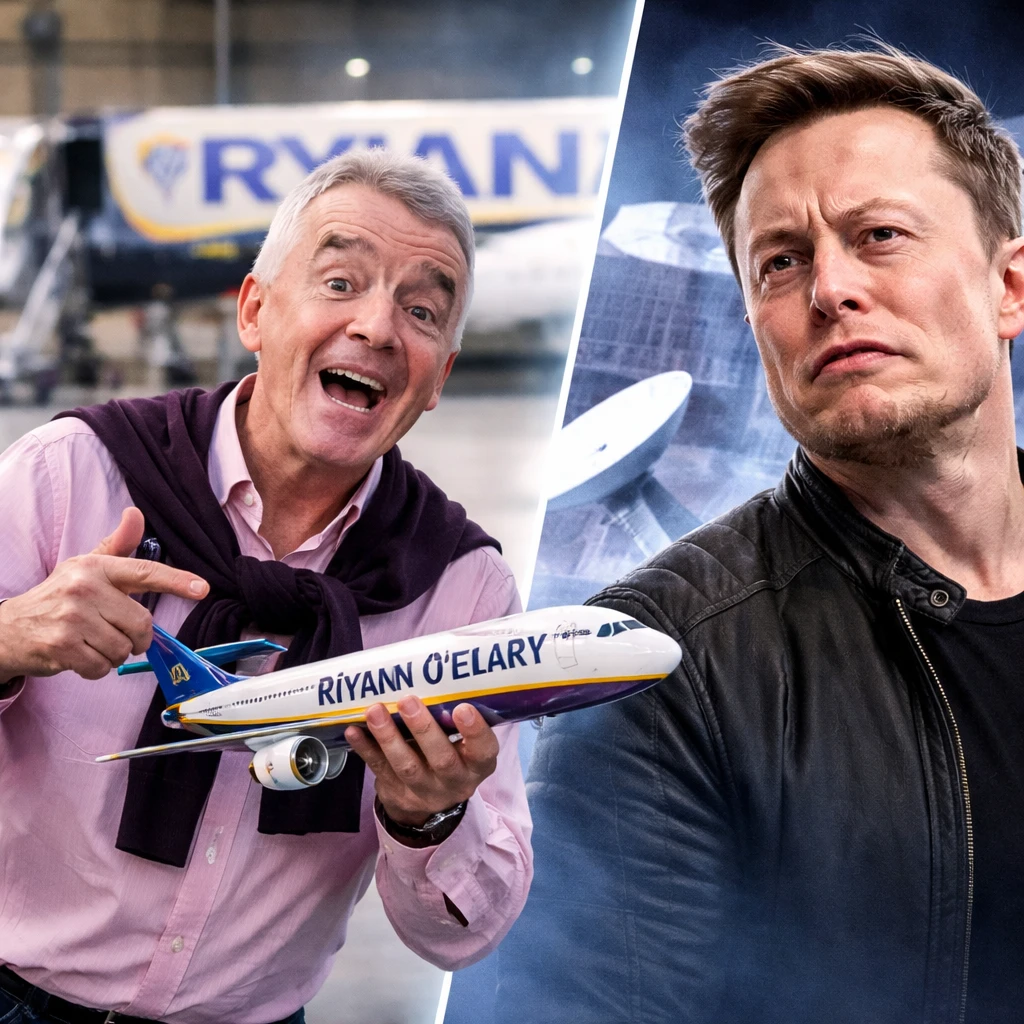

Ryanair CEO Rejects Elon Musk's Acquisition Proposal Amid Starlink Installation Dispute
January 21, 2026
News & Politics

Ryanair CEO Rejects Elon Musk's Acquisition Proposal Amid Starlink Installation Dispute

The conflict highlights regulatory ownership issues and onboard Wi-Fi cost challenges in European low-cost aviation

Summary

Ryanair CEO Michael O'Leary openly dismissed Elon Musk's suggestion of purchasing the low-cost airline following a conflict over the integration of Musk's Starlink satellite internet system on Ryanair aircraft. O'Leary criticized the economic feasibility of Starlink installations due to increased fuel costs and clarified ownership restrictions affecting potential investments by non-European nationals, referencing Musk's South African birth and American residence. Both figures exchanged personal remarks in a public dispute that Ryanair capitalized on through marketing efforts. The airline continues discussions with multiple telecom providers to facilitate cost-effective onboard internet services while addressing emerging concerns about social media platforms tied to Musk.

Key Points

Ryanair CEO Michael O’Leary publicly rejects Elon Musk’s suggestion to purchase the European low-cost airline, citing regulatory ownership restrictions and economic impracticality of onboard Starlink Wi-Fi systems.
The airline ruled out integrating Starlink satellite internet due to an estimated $250 million annual cost increase, including higher fuel consumption caused by added antenna drag, conflicting with Ryanair’s cost-sensitive operational model.
Ryanair remains in discussions with alternative communications providers, including Amazon’s Kuiper, seeking to implement onboard internet solutions that lower operational expenses, while also leveraging the public dispute for marketing advantage.

In a public exchange that stirred significant attention across the aviation and technology sectors, Ryanair's Chief Executive Officer Michael O'Leary dismissed billionaire entrepreneur Elon Musk's notion of acquiring the budget airline, following a dispute surrounding the proposed installation of Musk's Starlink satellite Wi-Fi system on Ryanair aircraft.

The disagreement intensified over several days after O'Leary expressed concerns that incorporating the Starlink system would impose an excessive fuel penalty due to the added aerodynamic drag of the antennas, rendering the installation uneconomical for Ryanair. Specifically, O'Leary indicated that the fuel consumption increase attributable to the antennas' drag would raise the annual fuel expenses by an estimated $200 million, contributing to an overall estimated $250 million in additional yearly costs when factoring in installation and maintenance.

Reacting to O'Leary's public remarks, Musk criticized the Ryanair CEO on social media platform X, branding him with harsh epithets. Musk escalated the exchange by sarcastically inquiring whether he should acquire Ryanair and appoint an executive named Ryan to manage it, concurrently engaging his followers with a poll regarding the acquisition idea, which yielded approximately 76.5% affirmative responses.

Situated in Dublin, Ryanair headquarters clarified legal constraints that prohibit majority ownership of European airlines by non-European citizens, citing Musk's South African origins and United States residency as limiting factors in any potential acquisition. Despite this regulatory hurdle, O'Leary indicated openness to Musk investing financially in the airline, emphasizing that such an investment would likely offer superior financial returns compared to Musk's current earnings from managing X.

Since acquiring X in 2022 for $44 billion, Musk has experienced tensions with existing executives at the formerly Twitter-branded platform. O'Leary, known for his candid and provocative style, acknowledged Musk's involvement in the dispute by attributing it to increased publicity for Ryanair. Capitalizing on the scenario, the airline launched a promotional campaign featuring Musk's caricature alongside discounted seat offers.

O'Leary downplayed Musk's personal insults, noting that the billionaire would be just one among many, including members of his family, who have previously directed similar remarks at him. This illustrates O'Leary's familiarity with managing public provocations in his corporate communications.

Regarding the Starlink installation talks held over approximately a year, O'Leary acknowledged the technical effectiveness of the satellite internet system, describing it as a "terrific system". However, he stressed the prohibitive costs involved with outfitting aircraft with two antennas each, and the additional fuel burned because of the associated aerodynamic drag. Considering Ryanair’s average flight duration is about one hour and fifteen minutes, O'Leary predicted a modest passenger uptake on paid Starlink services, estimating fewer than 5% would pay extra, thereby rendering the overall business case unfavorable.

Meanwhile, Ryanair is exploring alternative telecommunications partnerships, including Amazon’s forthcoming Starlink competitor Kuiper. O'Leary indicated that any such onboard internet implementation must be structured to reduce costs rather than increase them, maintaining the airline’s low-cost business model.

Further, O'Leary expressed concerns about social media, particularly referencing X, calling it a "cesspit," in light of recent controversies involving Musk's AI chatbot Grok, which has been implicated in generating nonconsensual deepfake images portraying inappropriate content. These remarks underscore growing anxieties about the reputational risks and ethical considerations tied to emerging digital technologies affiliated with Musk.

Risks
  • Regulatory limitations on foreign ownership of European airlines restrict potential investments or acquisitions by non-European nationals, impacting ownership and capital structure possibilities in the aviation sector.
  • The substantial additional fuel and installation costs associated with integrating advanced satellite Wi-Fi systems risk profitability for low-cost carriers reliant on tight operational margins.
  • Controversies surrounding social media platforms and AI technologies linked to prominent industry figures can generate reputational and ethical risks affecting corporate stakeholders, especially within digital communications and technology sectors.
Disclosure
The article is presented for informational purposes without endorsement or opposition toward any individuals or companies cited. The analysis refrains from speculative commentary and strictly adheres to publicly disclosed facts and statements.
Search Articles
Category
News & Politics

News & Politics

Related Articles
FDA Initiates Review of BHA Food Additive Safety

The U.S. Food and Drug Administration (FDA) has announced plans to conduct a comprehensive reassessm...

U.S. Risks Losing Edge in AI Innovation Due to Fragmented Regulation, Warns White House AI Coordinator

David Sacks, the White House AI and crypto coordinator, cautioned that the United States might fall ...

Zillow Faces Stock Decline Following Quarterly Earnings That Marginally Beat Revenue Expectations

Zillow Group Inc recent quarterly results reflect steady revenue growth surpassing sector averages b...

Treasury Secretary Highlights Urgency for Crypto Regulatory Clarity Amidst Coinbase Opposition

In light of recent fluctuations in cryptocurrency markets, U.S. Treasury Secretary Scott Bessent emp...

Robinhood Reports Q4 Revenue Peak and Expands Market Contracts to 8.5 Billion

Robinhood Markets Inc. delivered a notable fourth-quarter performance with record revenue of $1.28 b...

Figma Shares Climb as Analysts Predict Software Sector Recovery

Figma Inc's stock experienced a notable uptick amid a broader rally in software equities. Analysts a...