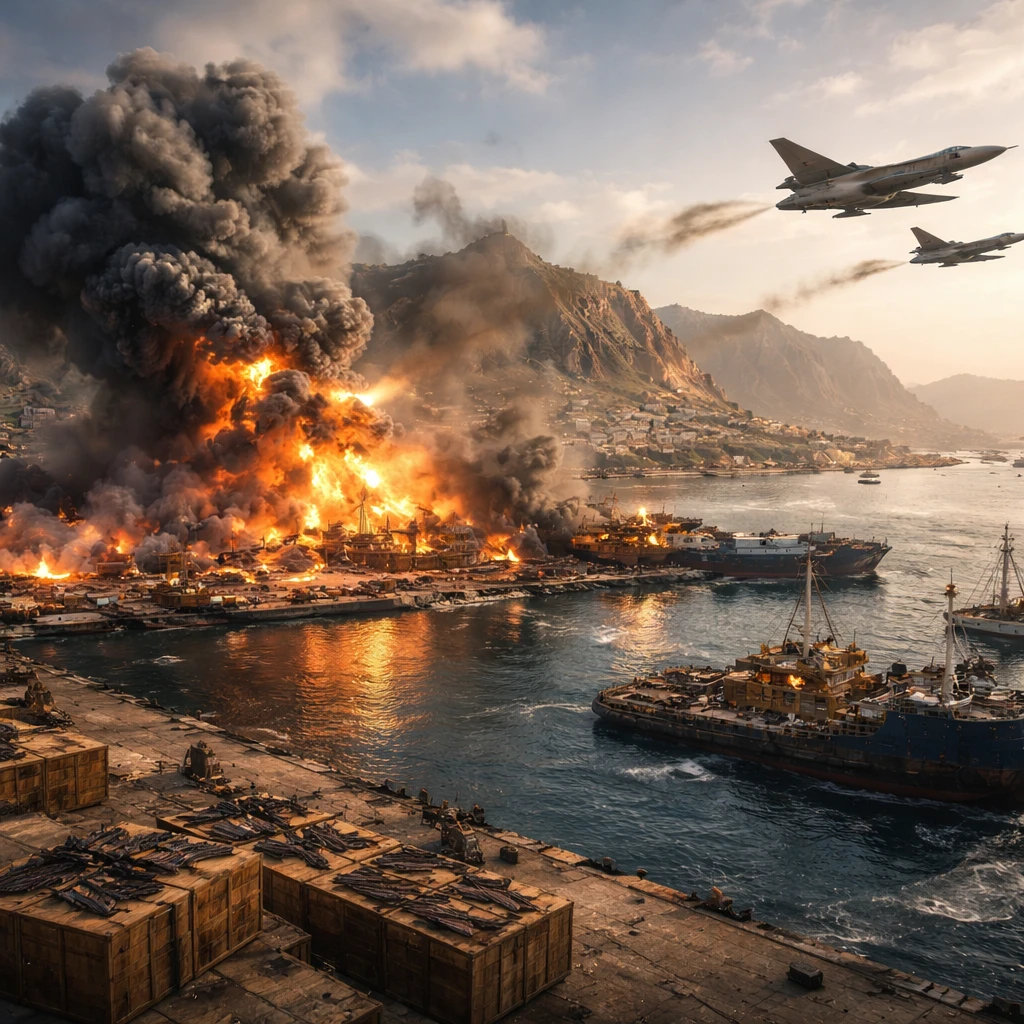

On Tuesday, Saudi forces carried out airstrikes on Mukalla, a port city in Yemen’s Hadramout governorate, targeting what the Saudi coalition described as weapon shipments destined for the Southern Transitional Council (STC), a separatist group backed by the United Arab Emirates. These strikes followed the arrival of vessels from Fujairah, a port on the UAE’s eastern coast, which reportedly delivered arms and military vehicles to the council’s forces.
According to a military statement disseminated by the Saudi Press Agency, the vessels arrived with their tracking systems disabled, a detail considered indicative of covert operations. The Saudi coalition justified the airstrikes as a necessary response to actions deemed an immediate threat to regional peace and security. The operation was described as a limited strike intended to target only the offloaded weaponry and armored vehicles.
The Saudi military also emphasized that the strikes were conducted overnight to minimize collateral damage. Details regarding casualties or involvement of forces other than Saudi Arabia remain unclear. The UAE has yet to issue an official response to the accusations and the attacks. Meanwhile, the Southern Transitional Council’s affiliated media acknowledged the airstrikes without providing further information.
One vessel believed to have been targeted is the Greenland, a roll-on/roll-off ship flagged in St. Kitts. Data analyzed on the ship's movement showed it had sailed from Fujairah on December 22 and reached Mukalla on Sunday. The identity of a second vessel involved is currently unknown. Social media content circulated by Yemen experts indicate newly arrived armored vehicles were being deployed within Mukalla shortly after the shipment.
Following the airstrikes, Yemen’s anti-Houthi coalition declared a state of emergency and severed cooperation with UAE forces. The coalition ordered all Emirati personnel to withdraw within 24 hours and imposed stringent controls on border crossings, airports, and seaports under their jurisdiction, permitting entry only with Saudi authorization.
The escalating attacks underscore growing tensions not only between Saudi Arabia and the UAE-backed Southern Transitional Council but reflect broader frictions between Riyadh and Abu Dhabi. Both countries, while aligned on several Middle East matters, have increasingly diverged over regional influence, economic competition, and their respective alliances within Yemen's multifaceted conflict. These developments come amid recent violent confrontations in Sudan where the two Gulf powers support opposing factions.
Geopolitically, Mukalla holds strategic importance. Situated approximately 480 kilometers northeast of Aden—the main anti-Houthi stronghold after the rebels seized Sana’a in 2014—the city recently came under STC control after displacing Saudi-backed National Shield Forces. The Southern Transitional Council has simultaneously promoted South Yemeni separatism, a cause that has gained public demonstrations in the region, reviving secessionist sentiments that had been dormant since South Yemen’s independence ended in 1990.
Observers anticipate continued calibrated responses from both sides. Analysts suggest the council may consolidate its authority in response to the strikes, whereas Saudi Arabia might heighten its efforts to disrupt weapon supplies, especially given its control over Yemeni airspace.
Adding regional complexity, Saudi Arabia's Foreign Ministry publicly attributed the Southern Transitional Council’s recent advances to UAE actions, labeling these steps as "extremely dangerous". Simultaneously, Israel recognized Somaliland, Somalia’s breakaway region, eliciting threats from the Houthis against any Israeli presence there, indicative of the region’s expanding geopolitical dimensions.
As the conflict persists, the implications for regional stability and security dynamics remain significant, particularly affecting sectors such as energy supply routes through the Red Sea, military logistics, and international diplomatic engagements in the Middle East and Northeast Africa.