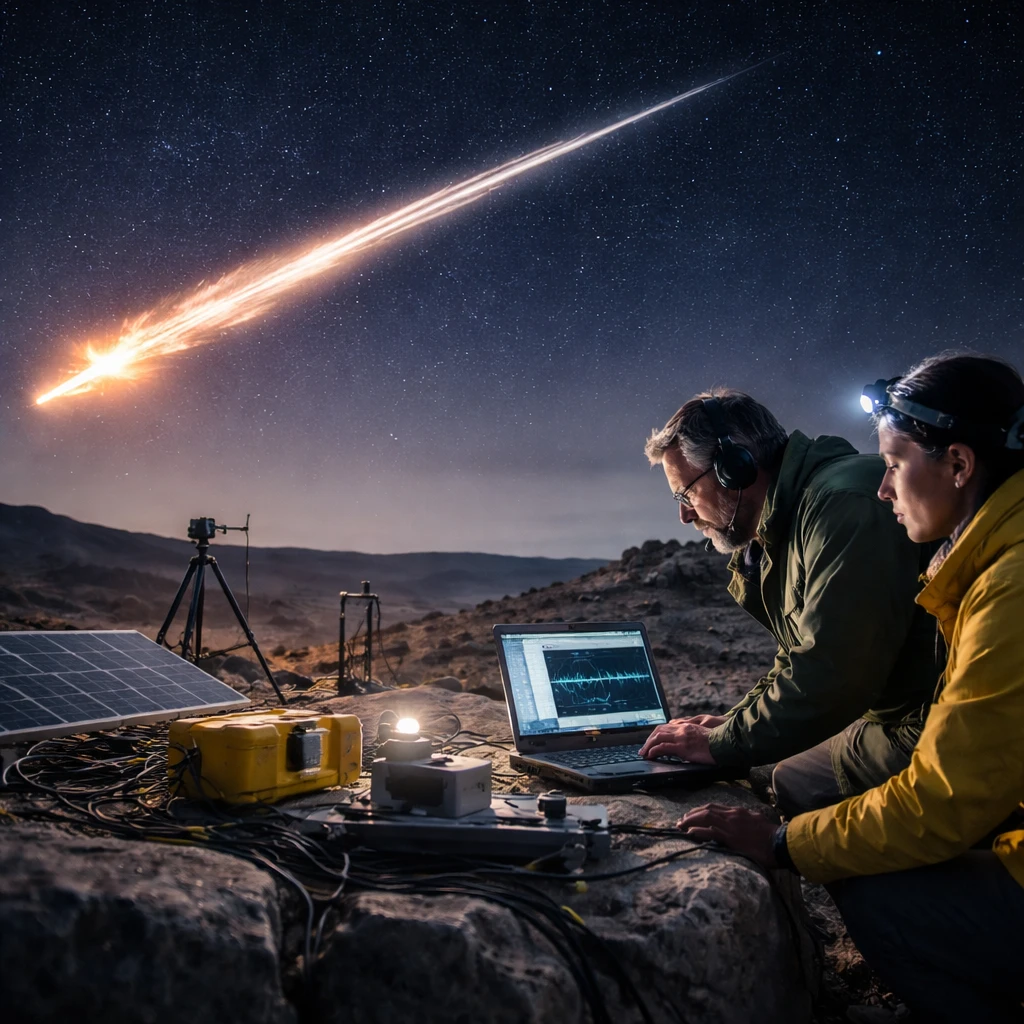

In a notable development in space debris tracking, experts demonstrated how seismometers—typically used for earthquake detection—can provide more accurate localization of objects reentering the atmosphere at supersonic speeds. This was highlighted by seismic data collected during the 2024 atmospheric reentry of a discarded Chinese module above Southern California, which allowed the researchers to revise the object's descent path nearly 20 miles (30 kilometers) southward compared to radar-based predictions.
Johns Hopkins University’s Benjamin Fernando, leading the study, emphasized the current challenge faced by monitoring efforts: while orbital tracking remains precise, once space junk begins to break up upon atmospheric entry, its trajectory is harder to ascertain. Utilizing seismic arrays to detect the sonic booms produced by such breakups could enable swifter deployment of recovery teams and enhanced safety measures.
The findings, published in the journal Science, focus on this singular debris event yet build upon data from seismic networks tracking dozens of other reentries—including wreckage from failed SpaceX Starship test flights in Texas—through public datasets.
Concerns about the risks posed by falling debris to aircraft have grown alongside the substantial increase in orbiting satellites over the past decade. Fernando pointed out that the proliferation of constellations such as SpaceX’s Starlink raises uncertainties, particularly regarding whether fragmented material consistently burns up upon reentry as companies claim.
Fernando, whose prior research has concentrated on lunar and Martian seismic activity, collaborated with Constantinos Charalambous of Imperial College London immediately following the 2024 event. By analyzing sonic boom recordings from over 120 seismometers, they reconstructed the falling module’s probable descent trajectory.
The uncontrolled Chinese module, abandoned in a deteriorating orbit since its detachment from the Shenzhou-15 spacecraft in 2023, weighed approximately 1.5 tons (1.36 metric tonnes) and exceeded 3 feet (1 meter) in size. Its breakup produced multiple sonic booms as it penetrated the atmosphere, providing cascade data that enriched the team's understanding of the fragmentation process.
While no ground impact was reported to verify the exact touchdown location, the research aims to quickly establish the speed, direction, and fragmentation of falling objects. In remote zones such as the South Pacific, existing nuclear blast detection stations might serve to capture sonic boom signatures, improving fall path predictions—an important consideration given NASA’s plan to retire the International Space Station with a controlled deorbit around 2029, and SpaceX’s development of autonomous deorbit vehicles.
Fernando intends to compile a comprehensive catalog of seismically tracked reentries and refine future trajectory models by incorporating atmospheric wind influences. Commenting independently, Chris Carr of Los Alamos National Laboratory noted the necessity to minimize the lag between reentry and path determination but acknowledged that this method represents a significant tool to rapidly identify debris fallout areas. This development is especially timely as Earth's orbital environment grows increasingly congested with satellites, heightening the volume of debris returning to the surface.