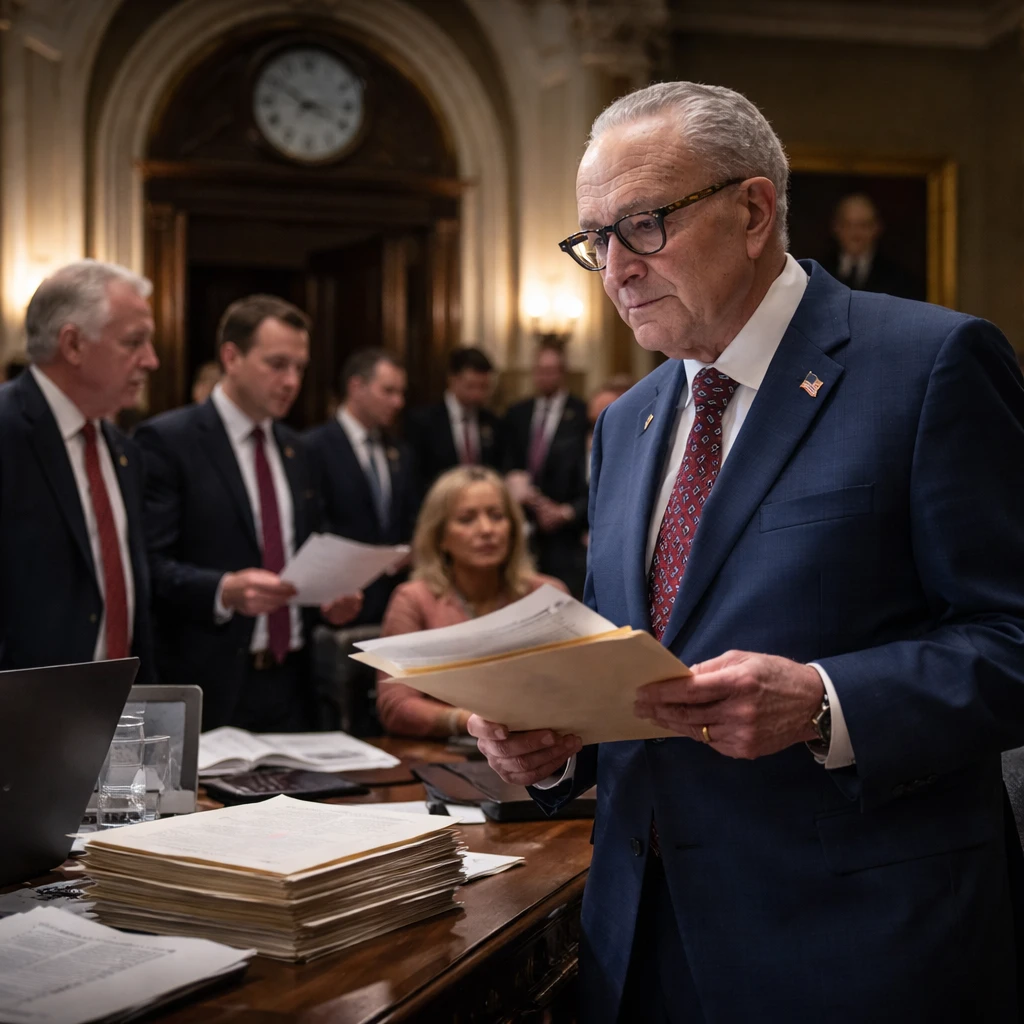

Efforts to circumvent a partial government shutdown intensified late Thursday as Senate leaders negotiated a potential bipartisan compromise on federal spending. Central to the debate was a rare decision to separate funding for the Department of Homeland Security from a bigger federal budget measure, temporarily funding it for two weeks to allow more time for discussions on how to limit the operations of the U.S. Immigration and Customs Enforcement (ICE) agency.
This maneuver came as Democrats, deeply unsettled by the recent deaths of two protesters at the hands of federal agents in Minneapolis, had threatened to reject the entire spending bill altogether, which would have prompted a shutdown as of midnight Friday.
President Donald Trump highlighted the bipartisan nature of the agreement on social media Thursday evening, noting that it would keep the majority of government functions financed through September while temporarily extending funding for Homeland Security. He urged lawmakers from both parties to give the measure a "much needed Bipartisan ‘YES’ vote." Earlier that day, Trump emphasized a desire to avoid a shutdown, though the final passage of the agreement remained uncertain.
Negotiations stretched late into the evening, with Senate Majority Leader John Thune leaving the Capitol ahead of the midnight deadline acknowledging unresolved objections from both Republicans and Democrats that needed resolution. Thune expressed hope that colleagues would collaborate the following day to finalize the legislation ahead of the Friday deadline when the Senate was set to reconvene.
South Carolina Senator Lindsey Graham revealed his opposition to the current proposal, citing concerns that ICE agents were being unfairly portrayed and opposing efforts within the bill to remove a recent law allowing senators to sue the government for unauthorized access to their data. Such disagreements underscored the challenge of forging a consensus even as the urgency to avoid a shutdown mounted.
The rare bipartisan talks emerged against a tense backdrop following the deadly shooting of 37-year-old Alex Pretti in Minnesota during a protest. The incident galvanized bipartisan calls for an inquiry into federal agent conduct.
Senate Democratic leader Chuck Schumer characterized this moment as critical, expressing strong condemnation of ICE’s actions outside legal bounds, phrasing it as "state-sanctioned thuggery" necessitating congressional action. Both parties acknowledge the gravity of the situation and the need for accountability.
The current stalemate echoes previous shutdown threats mere months after Democrats successfully opposed a spending bill over federal healthcare subsidies, resulting in a 43-day government closure. Unlike that episode, Democrats this time maintain a united front, motivated by the recent shootings linked to federal agents.
Republican willingness to negotiate appears stronger as some senators express openness to reforms following the fatalities, though agreement remains elusive. The environment is underscored by heightened partisan sensitivities and public scrutiny.
Democrats have presented specific demands focused on revising immigration enforcement protocols. Among their requests are an end to “roving patrols” within cities, enhanced coordination with local law enforcement during immigration arrests, and stricter warrant requirements. They also call for the implementation of enforceable codes of conduct to ensure accountability for agents violating protocols.
Schumer advocated for ICE agents to operate transparently, recommending the removal of masks during enforcement actions, mandatory body cameras, and visible display of proper identification, aligning with practices common across other law enforcement agencies.
Responding to the crisis, Tom Homan, President Trump's border enforcement official, announced that federal immigration authorities are working on plans to reduce the ICE agent presence in Minnesota, contingent upon cooperation from state and local governments.
Despite these negotiations, significant policy disagreements endure. Democrats aim to halt the Trump administration’s stringent immigration crackdown, with leaders like Senator Richard Blumenthal signaling readiness to shut down the agency if reforms are resisted. Conversely, Republican opposition remains, with North Carolina Senator Thom Tillis opposing mandates requiring agents to expose their identities, citing safety concerns for families of enforcement personnel.
Graham shared a nuanced position, endorsing some proposed reforms like improved training and body cameras while warning that any Democratic attempts to modify the funding bill would prompt him to advocate for restrictions against sanctuary city policies.
Meanwhile, in the House, Speaker Mike Johnson articulated a reluctant stance on dividing funding packages but acknowledged the necessity of rapid action if the Senate’s bifurcated bill passes to prevent a government shutdown. Johnson hinted at challenging decisions regarding scheduling the House's return to Washington to approve the separated bills.
House Republicans remain firm against adjusting the bill they recently approved. The conservative House Freedom Caucus explicitly tied their support for the spending measure to inclusion of Department of Homeland Security funding, reinforcing their loyalty to the president and ICE.