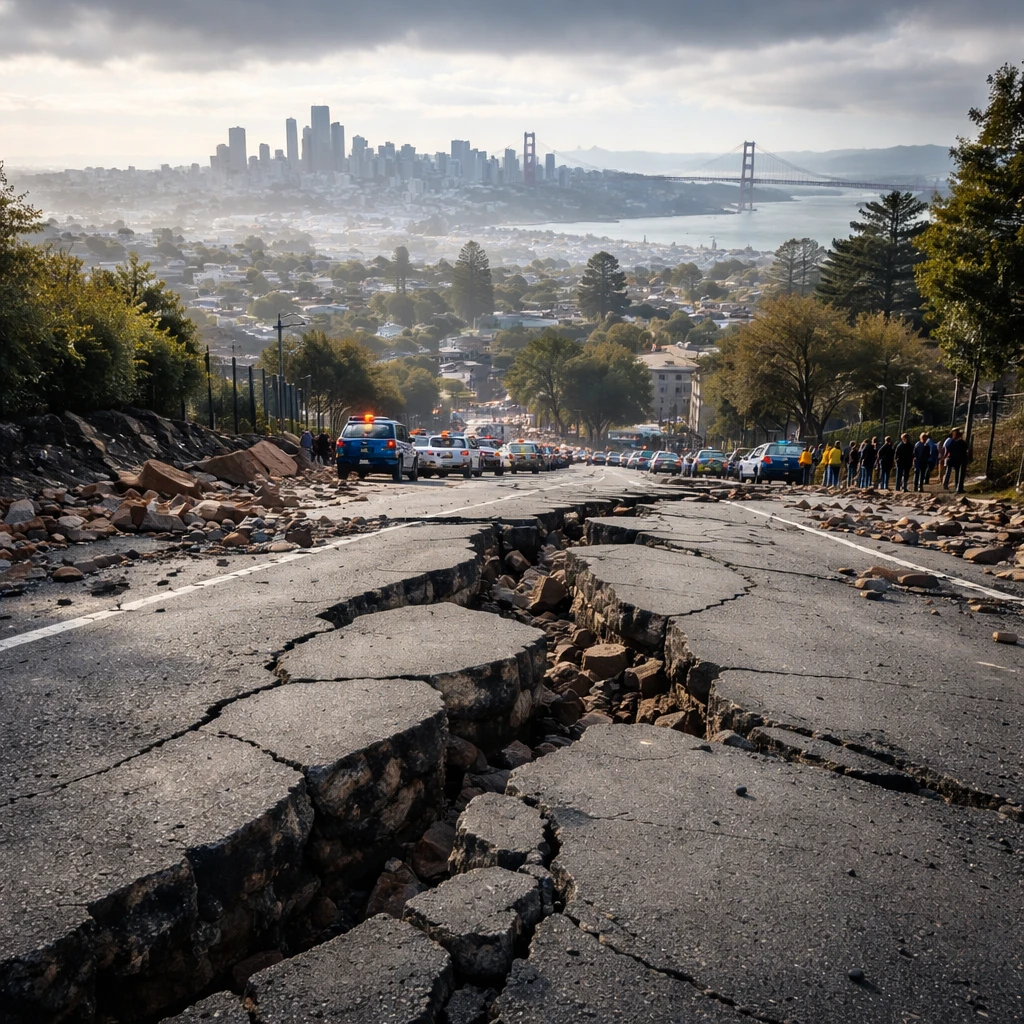

Residents in the San Francisco Bay Area experienced a series of small earthquakes on Monday morning, centered just south of San Ramon, an area that has seen significant seismic activity in recent times. According to the U.S. Geological Survey, the most substantial earthquake registered a magnitude of 4.2 shortly after 7 a.m., accompanied by at least twelve smaller tremors starting around 6:30 a.m. and continuing for over an hour.
Seismologists have observed that the eastern region of San Francisco is prone to earthquake swarms, which are sequences of multiple minor earthquakes occurring over brief periods. Such phenomena have been documented in this area for decades, highlighting a persistent geological dynamic.
Lucy Jones, a seasoned seismologist based in Southern California, noted that the recent quake swarm represents the tenth such sequence documented since monitoring began in 1970. She explained that the Bay Area’s major earthquakes usually originate along prominent fault lines including the Hayward Fault and the San Andreas Fault, the latter extending along Northern California’s coast before intruding inland.
Regarding the implications of the earthquake swarms, Jones pointed out the possibility that these could signify the gradual formation of a new fault line. However, such a process would unfold over an extensive timeframe, potentially spanning 100,000 years, making immediate conclusions impossible.
Despite the tremors, there have been no immediate reports indicating substantial structural damage. The Bay Area Rapid Transit system indicated that train operations might experience delays due to the implementation of temporary speed reductions as part of standard track safety inspections in response to the seismic events.
Shaking from the earthquake was perceptible over 30 miles (48 kilometers) away, including in San Francisco and several East Bay cities such as Oakland and Richmond.
Recent months have seen multiple earthquake swarms affecting the area, with Contra Costa County alone recording 87 quakes of magnitude 2 or higher during November and December. These data were analyzed by the San Francisco Chronicle last month based on USGS information. Jones explained that various Californian regions periodically encounter swarms that strike repeatedly in confined zones and do not follow the typical pattern of a mainshock followed by aftershocks.
Other factors besides new fault formations may contribute to earthquake swarms, including the presence of fluids or magma underground as observed near volcanic regions like Mammoth Mountain. Jones emphasized that experiencing a swarm is not a reliable predictor of an imminent larger earthquake. She highlighted that in the San Ramon area, swarms have occurred around ten times over the past 50 to 55 years without leading to significant major quakes.