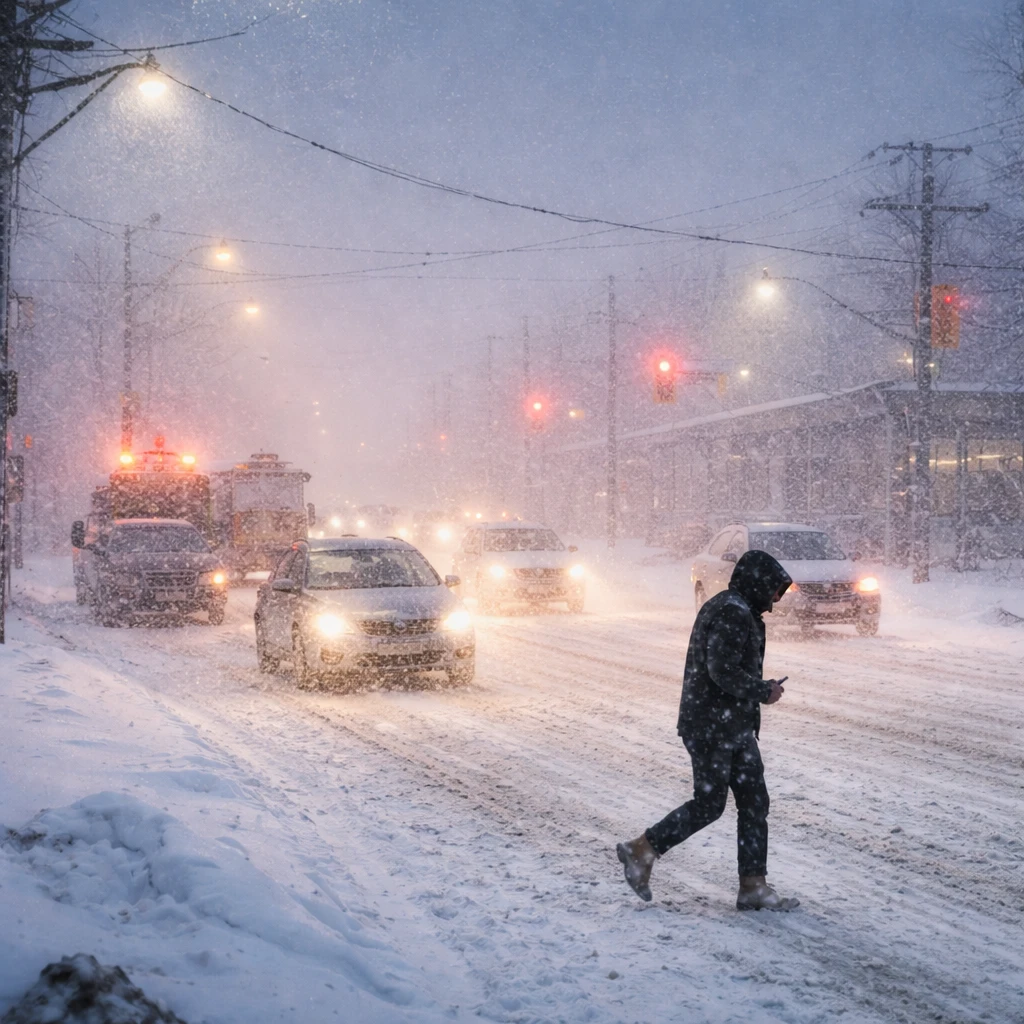

As the work week began in the United States, a massive winter storm continued to impose heavy snowfall across the Northeast, following earlier ice accumulation in southern regions. This powerful weather system has disrupted travel and daily life in a broad corridor extending roughly 1,300 miles from Arkansas through New England.
Throughout Monday, the storm deposited over a foot of snow across much of the Northeast, causing significant interruptions including halted traffic, numerous flight cancellations, and widespread school closures. Some of the hardest-hit locations faced forecasts calling for up to two feet of snow.
In Falmouth, Massachusetts, located about an hour south of Boston, snow fell persistently and heavily, forcing the town to effectively shut down. Local resident and minister Nell Fields described the necessity of continuous shoveling just to allow her dog outside, noting that seven inches had already accumulated with additional snowfall expected. She reflected on the unusual pause the storm imposed, suggesting it forced the community into a moment of stillness amid life’s usual pace.
Meanwhile, in New York City’s Upper East Side, resident January Cotrel found delight in the fresh snow blanketing her street, a location that is regularly closed off during storms to permit sledding and other winter activities. Expressing hope for substantial snowfall during such events, she welcomed the temporary shutdown of urban life as an opportunity to enjoy the quiet beauty of the city under snow.
Following the storm's snowfall, temperatures plunged sharply, with forecasts indicating that the night’s nationwide average low temperature would reach 9.8 degrees Fahrenheit minus 12.3 degrees Celsius, marking the coldest such average since January 2014. This chilling spell extended across all of the contiguous United States, a remarkable meteorological note.
From Montana down to Florida’s Panhandle, cold weather advisories and extreme cold warnings were issued as temperature readings dropped to zero degrees Fahrenheit (minus 18 Celsius) or lower in many regions. Strong winds intensified the cold conditions, and concerns mounted over the potential for refreezing icy roadways, which could further endanger travelers after challenging weekend weather.
In the South, despite precipitation largely ending in places such as Mississippi, officials cautioned that hazards remained substantial. Governor Tate Reeves emphasized that the risk from freezing rain conditions, which had already caused slick roads and damage to power infrastructure, was far from over. In Corinth, Mississippi, Caterpillar, a major manufacturer, instructed its employees at a remanufacturing facility to remain home for Monday and Tuesday as a safety precaution.
The Southern states experienced their most severe ice storm since 1994, with the largest-ever deployment of ice-melting chemicals — approximately 200,000 gallons — along with salt and sand to treat roads. Governor Reeves urged residents to avoid nonessential travel and maintain connections with friends and family for support during the ongoing hazardous conditions.
At the height of the storm on Sunday morning, around 213 million people were under some form of winter weather warnings. Power outages affected hundreds of thousands, especially in Tennessee and Mississippi, where the ice storm's impact was most acute.
Air travel was disrupted on a massive scale, with about 12,000 flights canceled and nearly 20,000 delayed across multiple impacted airports including those in Philadelphia, Washington, Baltimore, North Carolina, New York, and New Jersey. These effects were expected to persist into Monday as airports continued to manage the aftermath.
Tragically, the storm's severity coincided with several fatalities. In New York City, Mayor Zohran Mamdani reported that at least five people were found deceased outdoors amid plunging temperatures on Saturday, with investigations ongoing regarding the causes. Similarly, two deaths due to hypothermia linked to the storm were reported in Caddo Parish, Louisiana.
Back in Massachusetts, minister Nell Fields maintained church services despite the harsh weather. She shared a perspective that the storm, while disruptive, also created an unusual opportunity for reflection and community focus, highlighting the importance of caring for one another in difficult times.