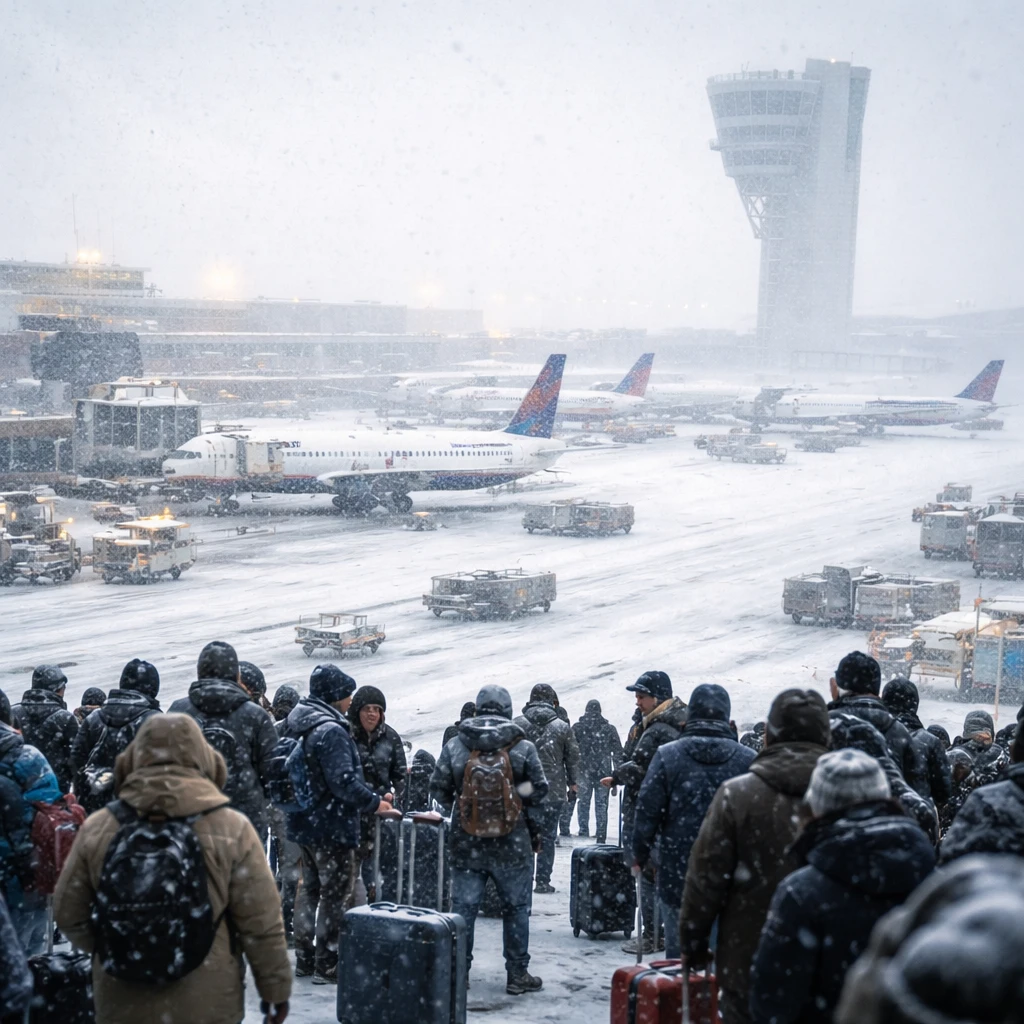

NASHVILLE, Tennessee — A significant winter storm has created severe travel challenges across the United States on Sunday, leading to widespread flight cancellations and delays at several major airports. The snow, freezing rain, and sleet affected an expansive region covering nearly 180 million residents — over half the U.S. population — stretching from the southern Rocky Mountains to the New England area, according to reports from the National Weather Service on Saturday evening.
After impacting parts of the South, the storm progressed northeastward on Sunday, bringing expected snowfall accumulations ranging from 30 to 60 centimeters (roughly one to two feet) spanning from Washington, D.C., through New York City to Boston. This intense winter weather severely hampered air travel infrastructure and operations across the corridor.
Flight monitoring service FlightAware documented that more than 10,700 flights were canceled on Sunday alone, marking this as the highest volume of cancellations observed since the onset of the pandemic, per aviation analytics firm Cirium's data through Sunday morning.
By midday Sunday, the most severe cancellations were concentrated at heavily trafficked airports in the Northeast and other sectors. Philadelphia International Airport faced a cancellation rate of 94%, with 326 flights grounded. New York City’s LaGuardia Airport experienced a 91% cancellation rate with 433 canceled departures, while JFK International Airport recorded approximately 75% of flights—458 in total—being canceled according to FlightAware records.
Washington’s Ronald Reagan National Airport announced on its website that all outbound flights were canceled for the day, totaling roughly 420 canceled departures across all airlines operating there.
Additional significant disruptions were anticipated at key hub airports including Dallas-Fort Worth International, Charlotte Douglas International, Philadelphia, and Atlanta’s Hartsfield-Jackson International Airport, the latter being the busiest airport in the country.
One affected traveler, Allan Lengel from Detroit, who planned to return Monday from Fort Lauderdale, Florida, where temperatures had been in the 80s Fahrenheit, will remain at his destination until Wednesday following Delta Air Lines’ advisory to modify his reservation in response to the weather-related flight interruptions.
Lengel, aged 71, expressed a pragmatic attitude toward the delay, stating, “I can’t say I’m disappointed. Frankly, I had anticipated returning later due to Michigan’s cold weather conditions.”
Major airlines reported substantial cancellations: American Airlines had canceled more than 1,400 flights, representing approximately 46% of its scheduled departures for Sunday. Delta Air Lines announced over 1,300 cancellations, Southwest Airlines reported more than 1,260, United Airlines recorded around 900 canceled flights, and JetBlue experienced over 570 cancellations, roughly 71% of its planned flights for the day.
Vikrant Vaze, a professor at Dartmouth specializing in commercial aviation logistics, indicated that the recovery process from these widespread cancellations and delays will likely extend over several days. He further warned that even travelers outside the immediate impact zone may face consequential delays due to the interlinked nature of airline networks and cascading scheduling effects.
“With numerous airlines involved, recovery largely depends on each carrier’s network structure, the scale of the disruptions they have endured, and their inherent capacity to manage such expansive operational disturbances,” Vaze elaborated.
Guidance for Travelers Amid Disruptions
Passengers who have had their flights canceled and are already at airports should seek assistance by queuing to speak directly with customer service representatives. Those still at home or in lodging accommodations are advised to contact airline reservation teams via phone or online platforms, while concurrently researching alternative flights to better manage wait times.
Most airlines offer rebooking on later flights at no additional fee, subject to seat availability on those flights.
Regarding the possibility of securing passage on a different airline, policies vary. While some major carriers may arrange connections on partner airlines, there is no firm obligation to do so, and success can be variable.
Travelers whose flights have been canceled and who opt not to travel or have pursued alternate transportation methods are entitled to full refunds, as mandated by federal regulations, even for tickets originally labeled non-refundable. This entitlement extends beyond the ticket price to encompass baggage fees, seat upgrades, and other ancillary services paid for but unused due to cancellations.
This comprehensive disruption highlights the vulnerability of air travel operations to severe weather events and underscores the importance for passengers to prepare for potential delays and cancellations during significant snow and ice storms.