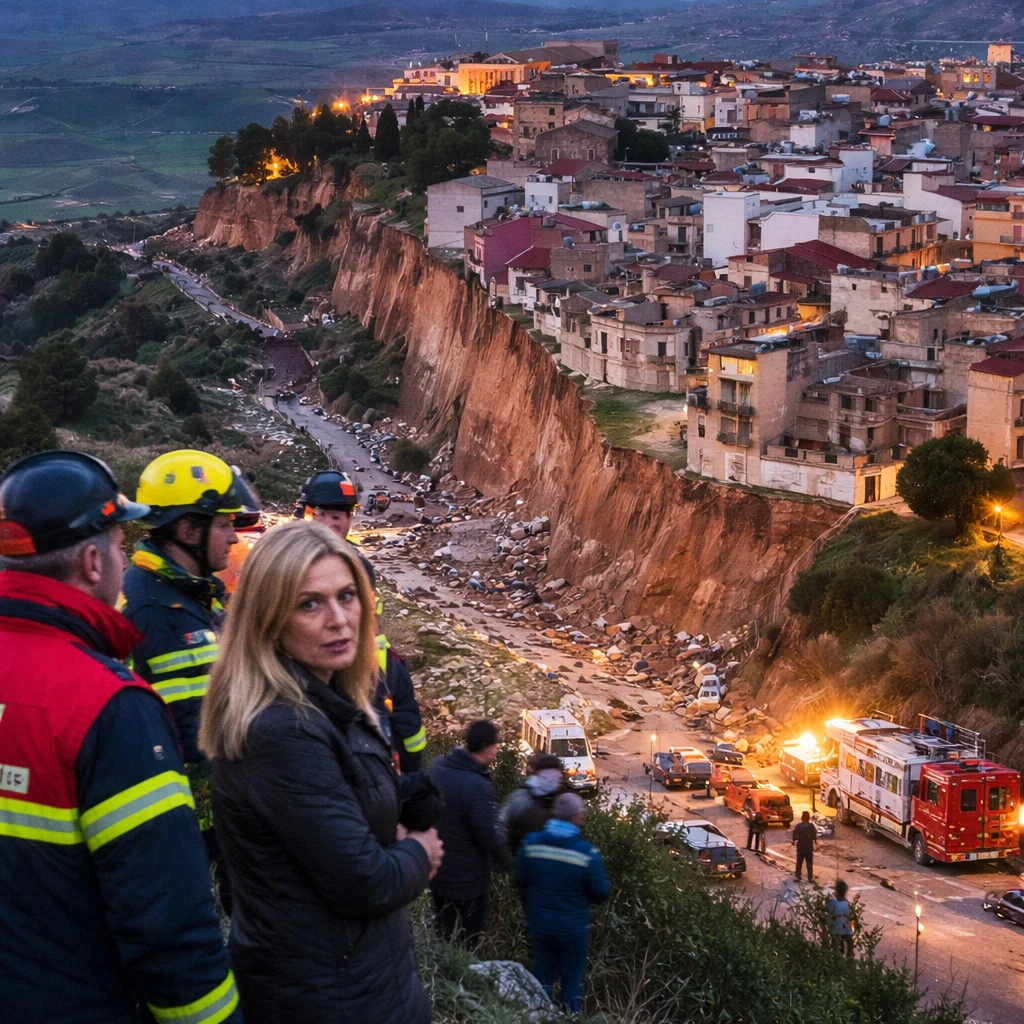

In the wake of persistent heavy rains induced by Cyclone Harry, the southern Sicilian town of Niscemi is grappling with the aftermath of an extensive landslide that has destabilized the edge of its settlement. The event has triggered the displacement of over 1,500 residents and inflicted significant structural damage. Italian Prime Minister Giorgia Meloni made an on-site visit Wednesday, underscoring the gravity of the situation and the government's response initiatives.
The landslide extends approximately 4 kilometers (2.5 miles) along the hill on which Niscemi is situated, with aerial images revealing vehicles and buildings that have toppled roughly 20 meters from a newly formed cliff edge. Many other homes continue to perch precariously close to the unstable terrain, raising concerns over potential further collapses.
Emergency teams specializing in civil protection have demarcated a 150-meter wide exclusion zone around the most vulnerable sector of the town, just inland from the coastal city of Gela, to prevent entry and mitigate additional risk to inhabitants and responders.
Fabio Ciciliano, head of the civil protection agency, described the situation, noting that the entire hillside is sliding downwards toward the Gela plain. He emphasized the uninhabitability of residences situated on the affected land, indicating the necessity for authorities to collaborate closely with local leadership to identify permanent resettlement solutions for displaced families.
Authorities have warned residents that the saturated, shifting ground remains unstable, implying that returning to previous homes is unfeasible in the foreseeable future. Consequently, inhabitants must seek long-term housing alternatives outside the compromised zone.
The Italian federal government declared a state of emergency covering three southern regions impacted by Cyclone Harry, including the Niscemi area, allocating an initial fund of 100 million euros (approximately $120 million) for immediate relief. Concurrently, officials in Sicily estimate the cyclone-related damages across the island to total around 2 billion euros.
During her visit, Prime Minister Meloni conducted a helicopter survey of the affected region and convened with local, regional, and civil protection officials at the town hall. She pledged that the preliminary financial support marks just the beginning of the government's commitment to attend to the urgent requirements of those displaced. She also affirmed efforts aimed at restoring essential infrastructure such as transportation routes, utilities, and schools, along with facilitating access to alternative accommodations for residents.
In an official statement, Meloni's office elaborated on the complex nature of the situation, indicating that the ongoing activity of the landslide prohibits the precise determination of areas needing intervention, complicating the establishment of appropriate remedial measures.
Geological experts highlight that Niscemi is constructed over layers of sand and clay, which become notably permeable during heavy rainfall, contributing to ground instability. Previous landslides have occurred in the region, notably a significant event in 1997 that necessitated the evacuation of 400 persons. Geology professor Giovanna Pappalardo of the University of Catania remarked that the current landslide has more extensive implications, with a front extending about 4 kilometers and directly threatening multiple residential properties located at the slope's edge.
The incident has reignited debates among policymakers concerning the authorization of construction on terrain with a known high risk for landslides, given the area's geological characteristics.
Renato Schifani, Sicily's center-right regional president, recognized the validity of such inquiries but noted that his tenure has been relatively recent. He stressed the importance of focusing on institutional responses to provide immediate support to those affected by the landslide rather than dwelling on retrospective accountability.
Additionally, Elly Schlein, leader of the center-left Democratic Party in opposition, called upon the government to reconsider the allocation of 1 billion euros approved for the contested project of a bridge connecting Sicily to the Italian mainland. She proposed redirecting these funds towards regions devastated by the storm, highlighting that the bridge initiative currently faces legal challenges.