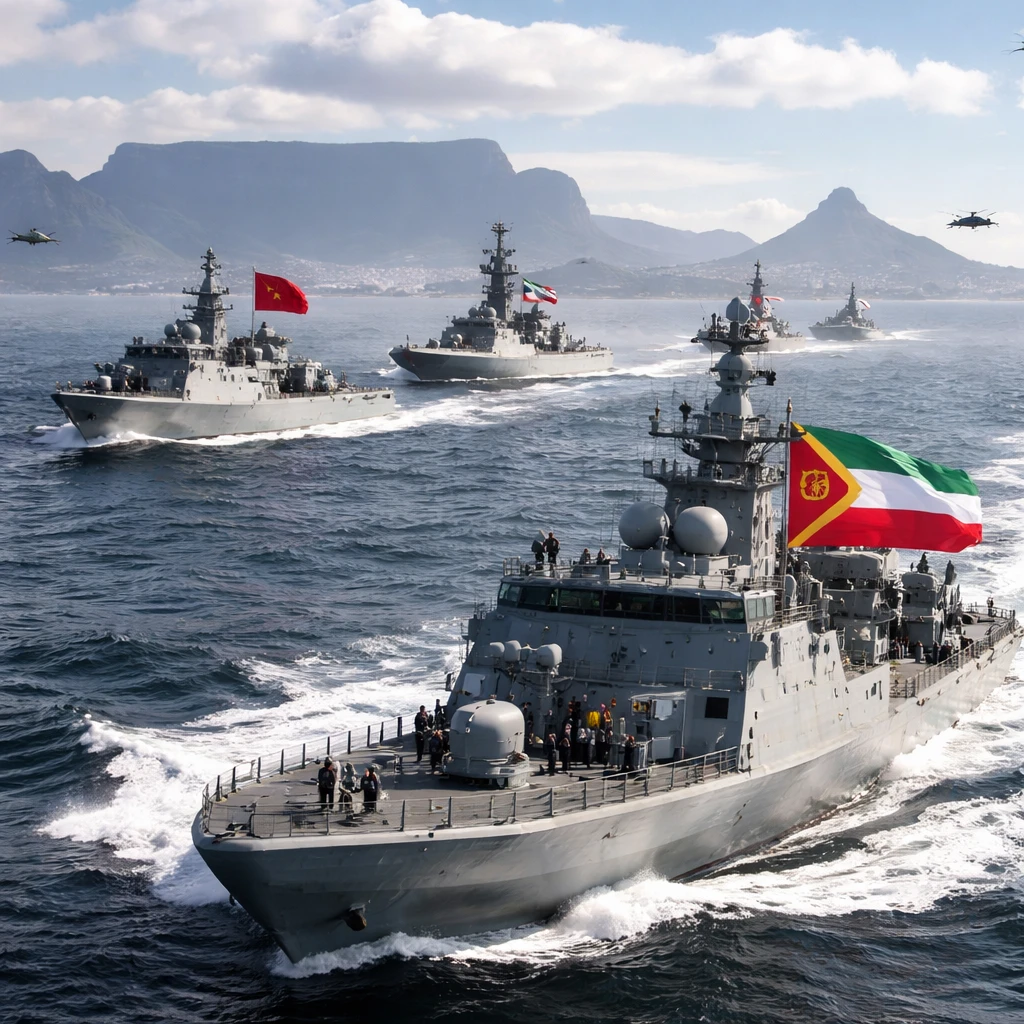

Off the southern coastline near Cape Town, South Africa, a combined naval exercise began Friday involving warships from China, Russia, Iran, and the host nation. This week-long series of maneuvers is designed to enhance collaboration among the countries, focusing on maritime safety and anti-piracy operations, anchored by a desire to deepen military cooperation within the BRICS consortium.
These naval drills were initiated as part of an agreement established last year under BRICS, an association of emerging economies that originally included Brazil, Russia, India, China, and South Africa. Iran joined this bloc in 2024, signaling an extension of BRICS’ geographic and strategic scope. While China, Russia, and South Africa are established members, it remains unconfirmed whether other BRICS nations such as Brazil, India, or the United Arab Emirates are participating in this exercise, according to a spokesperson from South Africa’s armed forces.
The drills have commenced against a backdrop of heightened global tensions. Recently, the United States intervened in Venezuela, seizing tankers transporting crude oil from the country, an act that has exacerbated geopolitical strains. Concurrently, Iran’s inclusion in the naval maneuvers occurs while domestic protests against its leadership swell within the country.
The metallic silhouettes of Chinese, Russian, and Iranian vessels have so far been observed entering and departing the Simon’s Town naval base, located just south of Cape Town where the Indian and Atlantic Oceans converge. China’s contribution includes the Tangshan, a large destroyer measuring 161 meters in length, emblematic of its naval reach. Russia’s Baltic Fleet has deployed a smaller warship, the Stoikiy, alongside a replenishment tanker to assist the squadron.
South Africa has a precedent for hosting such exercises, having conducted naval drills with China and Russia in 2023 as well. Initially, these current drills had been scheduled for late November but were postponed due to South Africa hosting a Group of Twenty summit, welcoming leaders from Western and other nations, presenting diplomatic considerations that influenced timing.
These military engagements are likely to increase diplomatic friction between South Africa and the United States. Despite South Africa's role as Africa’s most industrially advanced economy and a prominent advocate for continental interests, its perceived military alignment with Russia and Iran has attracted criticism at the highest levels of U.S. administration, especially under former President Donald Trump.
In February, Trump issued an executive order citing South Africa’s affiliations with “bad actors on the world stage,” directly pointing to its military relations with Iran as justifications for curtailing U.S. assistance. The BRICS forum itself has been used by China and Russia as a platform to voice criticism against the United States and Western policies.
South Africa maintains that its foreign policy remains nonaligned and neutral. Nevertheless, the docking of a Russian warship at Simon’s Town in 2023—accused by the U.S. of violating sanctions by loading weapons destined for the Ukraine conflict—strained relations further. South African officials denied these claims. Domestically, some political factions, such as the Democratic Alliance, oppose these drills, arguing the government’s engagement with sanctioned states like Russia and Iran compromises national and continental interests.
Overall, the ongoing naval exercises illustrate the growing complexity of maritime security cooperation among emerging economies, set against a backdrop of shifting geopolitical tensions and contesting global influences. South Africa’s role as host highlights its strategic position and the delicate balance it attempts to maintain amid competing international pressures.