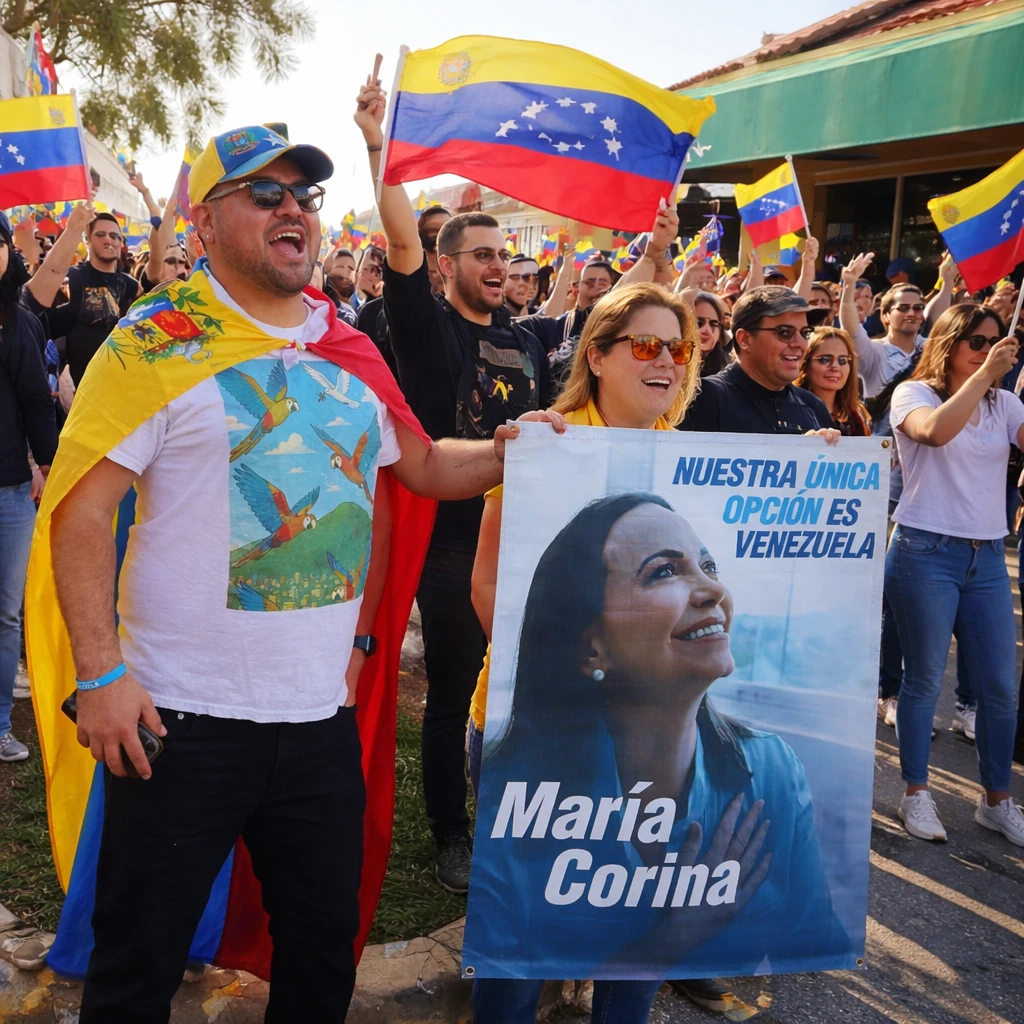

In the Miami suburb of Doral, Florida, known for its large Venezuelan community, residents gathered on Saturday to celebrate the U.S. military operation that resulted in the removal of Venezuelan President Nicolás Maduro. Chants of "liberty" filled the air as Venezuelan flags were worn with pride, symbolizing a long-awaited triumph against Maduro's authoritarian regime. This development, shaped by months of intensified American pressure, brought a mix of emotions to those who had endured years of separation and hardship.
News of Maduro's capture and his subsequent removal from Venezuela spread rapidly among the community, triggering impromptu rallies near cultural centers such as El Arepazo, a focal point of Venezuelan culture in Doral. People holding signs that read "Libertad" expressed combined emotions of hope and apprehension about what this political change would mean for their country.
Alejandra Arrieta, a Venezuelan immigrant since 1997, voiced the collective sentiment saying, "We’re like everybody — it’s a combination of feelings, of course. There’s fears. There’s excitement. There’s so many years that we’ve been waiting for this. Something had to happen in Venezuela. We all need the freedom."
David Nuñez, who fled Venezuela six years ago because of his political activism, shared his personal story amidst the celebrations. He revealed that he had not seen his daughters, ages 8 and 17, in all that time due to the political climate. "The most important thing is that we’re going to be able to be with our families soon," he stated emotionally. "At least for me, I haven’t seen my daughters in six years so I have a lot of mixed feelings. I’ve cried a lot. I’m really happy because I know that I’m going to be able to return to Venezuela very soon."
Saturday's operation, which President Donald Trump announced, culminated weeks of meticulous planning by U.S. officials, tracking Maduro’s routines and behavior. President Trump further stated that U.S. forces would temporarily govern Venezuela during the transition period. This marked the climax of an intensifying campaign by the Trump administration against Maduro’s government in the oil-rich nation.
Despite the formal announcement, community members continued their celebrations outside local venues, enthusiastically chanting and waving Venezuelan flags while percussionists provided rhythmic accompaniment. The mood reflected a decades-long yearning for change that had finally entered a tangible phase.
Since 2014, approximately eight million Venezuelans have fled their country due to a deteriorating political and economic situation. Originally relocating to neighboring Latin American countries, a growing number have sought refuge in the United States, often undertaking perilous journeys through jungle terrains in Colombia and Panama or arriving under humanitarian parole supported by American sponsors.
Doral’s Venezuelan diaspora, initially composed of upper-middle-class professionals and entrepreneurs seeking opportunity during the Chávez era, has grown increasingly diverse. The population now includes a wide range of socioeconomic backgrounds — from doctors and lawyers to beauticians and construction workers — with varying immigration statuses ranging from naturalized U.S. citizens to those residing without documentation.
Niurka Meléndez, who escaped Venezuela in 2015 and now resides in New York City, where she co-founded Venezuelans and Immigrants Aid, echoed cautious optimism about the impact of Maduro’s removal. She emphasized the humanitarian crises that plagued Venezuela, including forced displacement, repression, hunger, and pervasive fear, and underscored the crucial need for international assistance to aid recovery efforts.
“For us, it’s just the start of the justice we need to see,” Meléndez expressed. She further remarked that while removing the authoritarian regime does not guarantee recovery, it creates the essential opportunity for rebuilding Venezuela on principles of justice, rule of law, and democracy — free from criminal control over its institutions.
As celebrations continue among the expatriate community, questions about Venezuela's future governance and economic stabilization persist. The unfolding transition will require significant humanitarian and institutional rebuilding efforts, alongside the reestablishment of democratic safeguards to support sustainable progress.