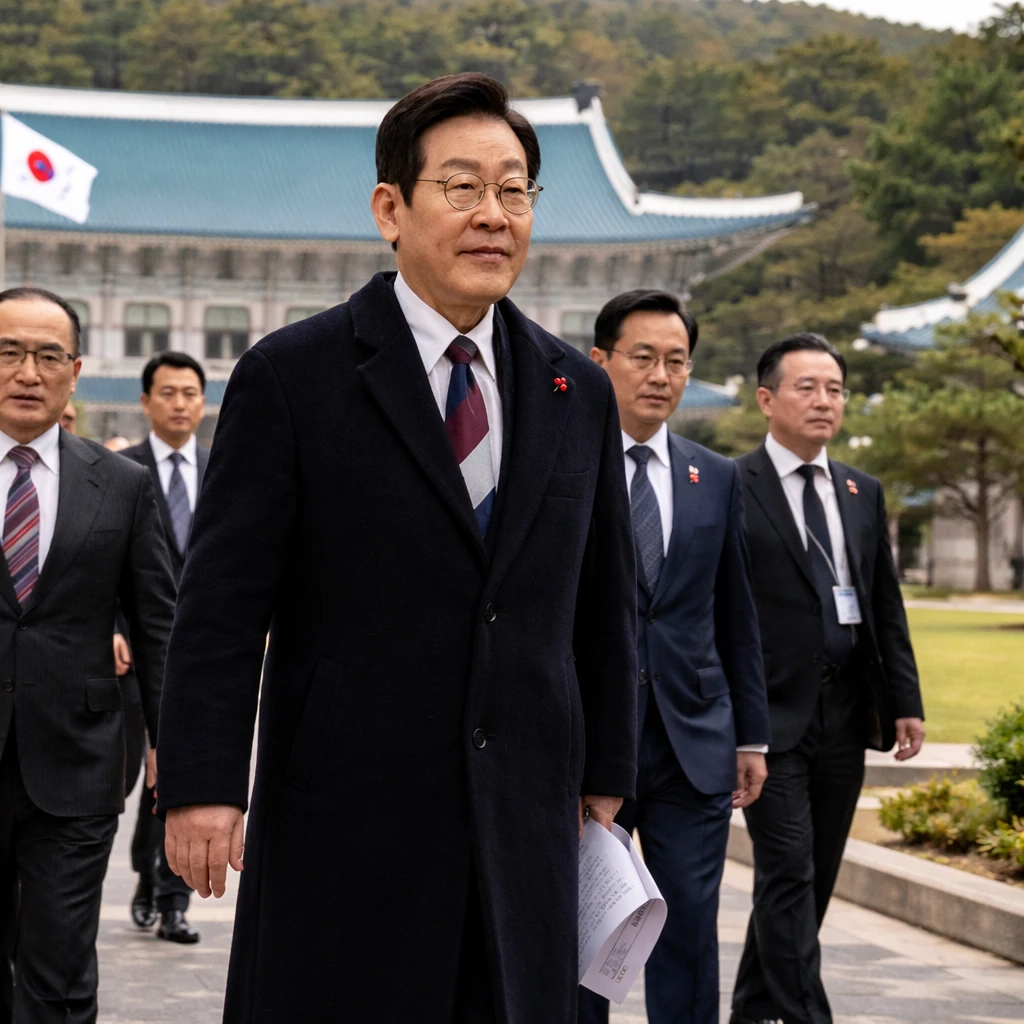

On Monday, South Korean President Lee Jae Myung made a significant move by commuting to Cheong Wa Dae, the nation's traditional presidential palace, marking its use as the official presidential office for the first time since he assumed office in June. This transition occurs more than three years after former President Yoon Suk Yeol shifted the presidential office away from Cheong Wa Dae to buildings within the Defense Ministry compound.
This marks the first presidential commute to Cheong Wa Dae since May 9, 2022, the concluding day of ex-President Moon Jae-in's tenure. Yoon, upon starting his presidency, had operated from a repurposed Defense Ministry building and had subsequently opened sections of Cheong Wa Dae to the public, transforming it into a tourist attraction that attracted millions of visitors.
President Lee, who emerged victorious in a snap election in June following Yoon's removal due to a brief imposition of martial law in December 2024, has been in the process of relocating the presidential office back to Cheong Wa Dae, also known as the Blue House. This effort is perceived as part of an initiative to revoke the legacy of his now-jailed predecessor.
Situated on the lower slopes of a mountainous area in northern Seoul, Cheong Wa Dae encompasses approximately 250,000 square meters (62 acres) adjacent to the historic Gyeongbokgung Palace. Over the decades, the site has undergone several renovations and has served primarily as the presidential office since the government's establishment after South Korea's independence following World War II.
Prior to President Lee's commute, officials ceremonially raised the presidential flag bearing two phoenixes at midnight at Cheong Wa Dae, signifying its reinstatement as the official seat of the presidency. Upon Lee’s motorcade passing through the compound gates, guards rendered a salute, and numerous supporters assembled nearby waved South Korean flags while chanting his name.
A video released from Lee's office showcased the president conducting a tea meeting with senior aides within one of the rooms inside Cheong Wa Dae. Subsequently, he toured the National Crisis Management Center located underground beneath the palace. This center, dedicated to security and disaster response coordination, had been refurbished in preparation for Lee's return. The president also carried out his first official approval at the palace by formally accepting the credentials of Benin’s ambassador-designate to South Korea, according to presidential spokesperson Kang Yu-jung.
President Lee issued a statement expressing his condolences to the families of the 179 victims of a Jeju Air crash that occurred a year prior in the coastal town of Muan. He urged those officials responsible for the investigation to thoroughly determine the cause of the accident.
Though the presidential office has been designated to return to Cheong Wa Dae, Lee's office noted that he will continue commuting from his current residence in another Seoul district until the relocation is finalized at an unspecified time.
Yoon’s move to the Defense Ministry compound had been justified on the grounds that Cheong Wa Dae’s location on a hillside made it too detached from the public. The relocation reportedly cost around $40 million, with Yoon dismissing concerns over security and expenditures, asserting that the change would make his presidency more democratic. As a conservative figure, Yoon precipitated a major democratic crisis in December 2024 by declaring martial law amidst tensions with Lee's liberal Democratic Party, which dominated the legislature and opposed much of his policy agenda.
The martial law was short-lived, lasting only hours after a group of lawmakers circumvented a military blockade and voted to repeal the directive. Subsequently, Yoon was impeached in December 2024, removed from office in April of the following year by a Constitutional Court ruling, and re-arrested in July. He currently faces serious criminal charges, including rebellion, which could result in life imprisonment or the death penalty.