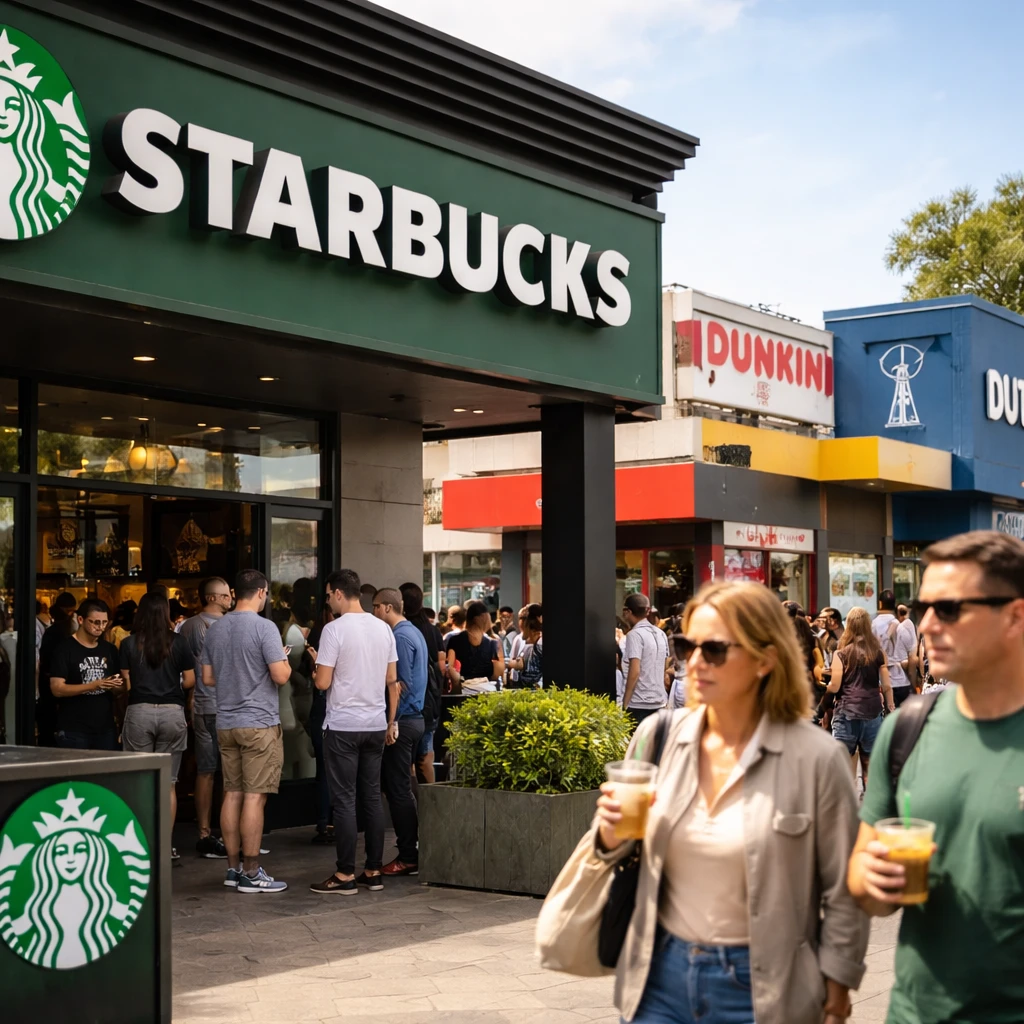

Americans are consuming coffee in increasing volumes, reaching levels not seen in decades. Despite this growth, Starbucks - the largest coffee retailer in the United States with nearly 17,000 stores and expansion plans - has witnessed a notable dip in its market share. Increasing competition from numerous emerging coffee chains is complicating efforts to reclaim lost customers.
According to data from Technomic, a food industry consultancy, Starbucks's share of consumer spending at US coffee shops decreased to 48% in 2024 and 2025, down from 52% in 2023. Dunkin', a long-established competitor that recently opened its 10,000th US location, gained ground in those years.
Starbucks faces additional challenges from rapidly growing drive-thru chains such as 7 Brew, Scooter's Coffee, and Dutch Bros. Moreover, Chinese chains like Luckin Coffee and Mixue have entered the US market with new store openings. Specialty coffee brand Blue Bottle, which operates 78 US stores, has also expanded since the start of the year. Even fast-food giants McDonald's and Taco Bell are enhancing their beverage selections.
"People haven’t fallen out of love with Starbucks, but they’re now polyamorous in their coffee choices," noted Chris Kayes, chair of the management department at George Washington University School of Business. "Consumers are actively exploring alternative coffee options and discovering different brands."
Caffeine Consumption Rises Amidst Expanding Coffee Retail Landscape
The National Coffee Association, an industry group, reports that approximately 66% of Americans consumed coffee daily in both 2024 and 2025, marking an increase of 7% since 2020. This heightened demand has fueled a 19% rise in chain coffee store counts nationwide, now exceeding 34,500 locations, as reported by Technomic.
While Starbucks transformed from a small regional chain in 1987 into a national powerhouse, newer and smaller regional chains are experiencing rapid growth. For example, Nebraska-based Scooter's Coffee grew from 200 locations in 2019 to over 850 today. Similarly, Arkansas-based 7 Brew expanded from 14 stores in 2019 to more than 600.
Industry analyst Neil Saunders from GlobalData Retail indicates an overabundance of supply relative to demand. "Starbucks' large size may hamper its ability to increase sales by opening new stores," he explained, adding that Starbucks is nearing market saturation and operates a mature business.
Starbucks Innovates Amid Competitive Pressure
Despite market challenges, Starbucks remains confident. At a recent investor conference, the company emphasized ongoing initiatives to enhance customer service and create more inviting store atmospheres, which are reportedly increasing US store traffic. Plans include adding 25,000 seats in cafes nationwide by fall.
Starbucks plans to open over 575 new US locations in the next three years, including a new smaller-format store concept. These smaller stores feature indoor seating, drive-thru lanes, and mobile pickup options but are less costly to construct. This strategy is intended to allow store placement in locations previously inaccessible.
Additionally, Starbucks is introducing new menu items such as updated pastries and health-oriented snack foods rich in protein and fiber to attract customers back.
Menu Innovation and Consumer Preferences
One challenge Starbucks faces is perceived stagnation in menu innovation, especially among younger consumers who favor novelty and willingness to try emerging brands. For instance, Dutch Bros from Arizona introduced protein coffee drinks in January 2024, two years before Starbucks implemented similar offerings. Energy drinks account for a quarter of Dutch Bros' revenue, a product category introduced nearly 14 years ago.
Starbucks tested iced energy drinks on a limited basis in 2024 and announced plans to soon include customizable energy drinks on its menu. Dutch Bros, led by former Starbucks executive Christine Barone, operates just over 1,000 US shops, primarily drive-thru outlets with walk-up windows, aiming to double its store count by 2029 by emphasizing speed and convenience.
Value propositions are also critical. Dutch Bros offers 24-ounce medium drinks compared to Starbucks' 16-ounce medium size, while Luckin Coffee's US locations use apps loaded with coupons and promotions to attract customers. For example, in New York City, Luckin's nine stores serve many mobile orders from customers drawn by price incentives.
Customer Xunyi Xie, visiting New York from Delaware, tried a Velvet Latte at Luckin's during a $1.99 promotion and expressed that although he normally brews espresso at home, he would frequent Luckin's if a store were convenient to his route. On the topic of Starbucks, Xie remarked, "I think it’s overpriced."
Financial Dynamics and Strategic Outlook
According to a Morningstar investment research analysis, in 2024, average spending per Starbucks customer was $9.34, contrasted with $8.44 at Dutch Bros and $4.68 at Dunkin'. Starbucks refrained from raising prices in its 2025 fiscal year and plans a cautious approach to any future price changes.
Morningstar equity analyst Ari Felhandler suggested Starbucks should avoid aggressive discounting since competitors are prepared to undercut prices. Instead, he advised maintaining current pricing while justifying value through store redesigns and new product launches to stimulate customer return.
Chief Operating Officer Mike Grams emphasized that Starbucks' future lies not in exclusively drive-thru or kiosk formats but in cafes that offer comfortable seating, characterized as the "soul of Starbucks." These venues also accommodate mobile ordering, drive-thru, and delivery. He highlighted the company's goal to cater to customers seeking both convenience and an inviting environment to linger.
Grams commented, "Competition will always exist; we monitor it closely but do not aim to mimic competitors. We provide a genuine space for customers to sit, enjoy, and engage in various activities." However, Kayes from George Washington University expressed skepticism whether this approach will suffice to sustain Starbucks’ market leadership. He noted that customers seeking cozy or premium experiences may have gravitated to independent cafes or upscale brands like Blue Bottle.
Kayes concluded, "In some respects, Starbucks suffers from its own success. The perception of Starbucks as unique and exciting has diminished."